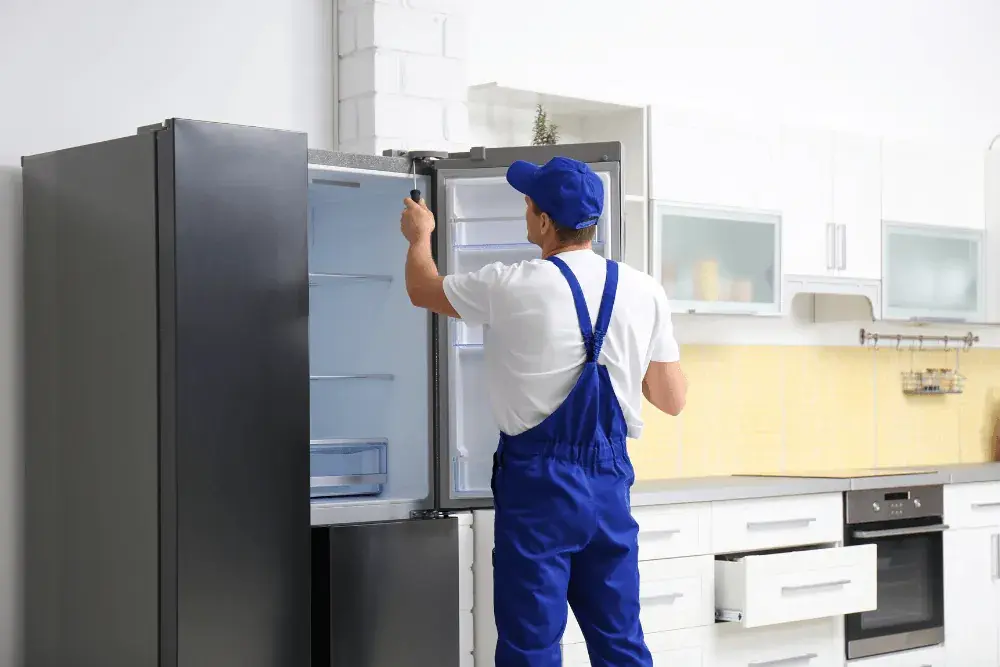
An ice maker that fills with water and does not freeze it has a cooling problem, not an ice maker problem. In a refrigerator, the ice maker has no refrigeration of its own. It sits in the freezer's cold air and waits. If that air is not cold enough, or not reaching the mould, the water stays liquid or turns to slush, and the ice maker never moves on to harvest.
So this guide is mostly about the freezer: how cold it needs to be, how to measure it properly, and the eight or nine reasons a freezer runs warm, from a door left ajar to a failed compressor. It also covers ice makers in the fridge door, which have their own cold-air supply, and free-standing ice machines, which do have their own refrigeration and fail differently. For a repair, see refrigerator repair or fridge ice maker repair.
CauseHow to tellWho fixes it
Freezer set too warmSetting changed, or on a holiday or eco modeYou
Door or drawer not sealingFrost round the opening, door springs back, seal tornYou, or a new seal
Air vents blocked by foodFreezer packed against the back wall or the vent to the ice makerYou
Too much warm food or frequent door openingStarted after a big shop or a partyYou: wait
Condenser coil dirty or fridge badly ventilatedFridge runs constantly, sides hotYou
Evaporator iced over (defrost fault)Frost on the back wall inside the freezer, fan noisy or silentTechnician
Evaporator fan failedNo air movement in the freezer with the door switch pressedTechnician
Condenser fan failedCompressor hot, no airflow at the back or underneathTechnician
Compressor or start componentsClicking every few minutes, no steady humTechnician
Refrigerant leak or restrictionCompressor runs all the time, freezer only coolTechnician
Control or sensor faultTemperature display wrong, erratic coolingTechnician
In-door ice room not getting cold airFreezer is cold, door ice maker is notTechnician
The top five can all be checked at home and cost nothing. Start by measuring the temperature, because guessing is where most wasted repairs begin.
Water freezes at zero degrees C, and a freezer at minus 5 will freeze a tray of water eventually. An automatic ice maker needs much more than that, for two reasons.
It has to freeze a full mould solid in an hour or two, not overnight. That needs a large temperature difference.
It is designed not to harvest until a sensor in the mould reads a set low temperature, typically somewhere around minus 9 to minus 12 degrees C at the mould. That stops it ejecting cubes with liquid centres. A freezer only a little below zero never reaches that trigger.
Freezer air temperatureWhat the ice maker does
Minus 18 degrees C or colderNormal production
Minus 15 to minus 18Works, more slowly
Minus 12 to minus 15Marginal. Long cycles, small or hollow cubes, may stop
Minus 5 to minus 12Food stays frozen. Ice maker stops cycling. Water in the mould freezes slowly and is never ejected
Zero to minus 5Ice cream soft, slush in the mould
Above zeroThawing. A serious cooling fault
These bands are typical, not exact. The point is that an ice maker stops well before food thaws, which makes it the earliest warning of a freezer that is losing performance.
The number on the fridge's display is the temperature the control is aiming for, or a reading from one sensor. It is not proof of what the ice maker is experiencing.
1
Use a fridge-freezer thermometerA simple dial or digital one.
2
Place it between frozen packs near the ice makerNot in the door, not against the back wall, and not in a pile of newly added food.
3
Close the door and leave it for at least six hoursOvernight is better. Do not open the door in between.
4
Read it as soon as you open the doorThe reading rises within seconds.
5
Repeat in another part of the freezerA big difference between top and bottom, or front and back, means poor air circulation.
ReadingDisplay saysConclusion
Minus 18 or colderMinus 18Freezer is fine. The fault is at the ice maker or its air supply
Minus 10Minus 18Freezer is underperforming. The display shows the target, not the result
Minus 18 at the bottom, minus 8 at the top near the ice makerMinus 18Airflow problem
Swings from minus 20 to minus 5 through the dayAnyDefrost fault, door seal, or heavy use
Warm in the afternoon, fine at nightAnyFridge in a hot spot or poorly ventilated
Write the readings down. Two or three numbers with times are worth more to a technician than any description.
In the mouldMeaning
Liquid water after three hoursFreezer near or above zero at the ice maker. A real cooling problem
Slush or a thin skin of iceFreezer a few degrees below zero
Solid on the outside, liquid in the middle when a cube is brokenFreezing slowly: marginal temperature or poor airflow
Solid cubes, never ejectedEither still not cold enough to trigger the harvest, or the ice maker's sensor, heater or motor has failed
Cubes ejected hollow or wetHarvesting before fully frozen: sensor fault or a fill that is too small
Nothing in the mouldA fill problem, not a freezing one. See not filling with water The fourth row is the ambiguous one. To separate a cold problem from a unit problem, confirm the freezer is at minus 18 near the ice maker and wait a full day. If solid cubes are still sitting in the mould, the ice maker has failed to harvest. See not making ice.
Cause 1: settings and modes
Check the freezer set temperature. It should be minus 18 degrees C, or the middle to cold end of a numbered dial. On some dials a higher number is colder and on others it is warmer: check the manual.
Check that a holiday, vacation, eco or energy-saver mode is not on. These raise temperatures or reduce defrosting.
Check that demo, showroom or display mode is not on. In that mode the lights and display work and the compressor never runs. It is usually cancelled by a button combination given in the manual.
Check the fridge was not recently switched on. A warm fridge needs up to 24 hours to reach temperature, and longer when loaded.
Use a quick-freeze, power-freeze or ice-plus function for a day if the fridge has one. It runs the compressor harder, and it is a good test: if the freezer still cannot get cold, something is wrong.
Check that the fridge section's setting has not been turned very warm. On single-evaporator fridges the two compartments share cold air.
If a setting was the cause, the freezer will be back at temperature within a day.
Cause 2: doors, drawers and seals
Warm, humid air leaking in is the commonest reason a sound freezer runs warm. It raises the temperature directly and it lays frost on the evaporator, which blocks airflow and makes things worse.
1
Close the door and look along the gapIt should be even all round.
2
Do the paper testShut a strip of paper in the door at several points round the seal. It should resist being pulled out. Where it slides freely, the seal is not gripping.
3
Look for what is stopping the doorA box, a bag, a drawer not pushed home, an ice bin not seated, or a shelf out of its slot.
4
Check the seal itselfTears, hardened sections, corners pulled out of their groove, mould or sticky residue.
5
Check the fridge is level, or tilted very slightly backSo the doors swing shut by themselves.
6
On freezer drawers, check the runnersA drawer off its runner sits a few millimetres open at one side.
Sign of an air leakWhere
Snowy frost round the door openingSeal not sealing at that point
Frost all over the food and wallsDoor left ajar, or a long-term leak
Ice chute in the door frostedDispenser flap not closing
Water drops or mist on the sealWarm air meeting cold
Door alarm soundingDoor not fully closed
Clean a dirty seal with warm soapy water and dry it. A seal that has gone hard or torn is replaced. A dropped door is adjusted at its hinges.
A frost-free freezer makes its cold at a finned coil hidden behind the back panel and uses a fan to push that cold air round the compartment through vents. The ice maker is cooled by that moving air. Anything that stops the air stops the ice.
Do not pack food hard against the back wall. Leave a few centimetres.
Find the vents. slots or grilles in the back wall and sometimes the ceiling. Keep them clear.
Keep the area round the ice maker clear. A bag of peas pushed up against the mould insulates it.
A freezer that is about three-quarters full works best. Completely empty, it swings in temperature. Completely full, air cannot circulate.
On bottom-freezer drawers, do not overfill above the rim.
On side by side models, keep the top shelf near the ice maker loosely loaded.
SymptomMeaning
Bottom of the freezer hard frozen, top near the ice maker softAir not circulating upward
Ice maker works after rearranging the freezerIt was blocked
No air felt at the vents with the door switch held inFan not running, or coil iced solid: a fault, below
To feel for airflow, open the freezer door, press the door switch in with a finger so the fan runs, and hold your other hand at a vent. You should feel a steady flow of very cold air.
A fridge moves heat from inside to outside. If it cannot get rid of that heat, it cannot get cold. In Dubai's summer this matters more than anywhere.
ProblemSignFix
Condenser coil coated in dustCoil at the back or underneath is grey and furry. Fridge runs non-stop. Sides or the strip between the doors very hotUnplug. Vacuum and brush the coil. Do it once or twice a year
No clearanceFridge pushed tight to the wall, boxed into a cabinet with no vents, or items stacked on top and besideLeave the gaps the installation instructions give
Hot locationFridge in a garage, on a balcony, in a store room with no air conditioning, or beside an ovenMove it, ventilate the space, or accept reduced performance in summer
Direct sunAfternoon sun on the side of the fridgeShade it
Built-in fridge with a blocked plinth grilleKitchen plinth fitted across the air inletClear the grille
Condenser fan not running, on models that have oneCompressor very hot, no air movement at the back near the floorTechnician
Most domestic fridges are rated for room temperatures up to a stated limit, shown as a climate class on the rating plate. A fridge in a space that reaches the high forties in August is outside what many were built for, and the ice maker is the first thing to stop.
A frost-free freezer melts the frost off its hidden coil several times a day with a heater. If that system fails, frost builds until the coil is a solid block and no air can pass through. The compressor runs, the coil is very cold, and the compartment is not.
SignDetail
Frost or ice visible on the back wall inside the freezerOften a bulging patch behind the panel
Freezer and fridge both warming over one to two weeksGradual, then quite sudden
Fan noise changesA rattle or buzz as the blades touch ice, then silence
Works well for a week or two after the whole fridge has been switched off and thawedThe classic sign. The frost melted and has begun to build again
Water under the crisper drawers or on the freezer floorDefrost drain blocked or frozen
If you suspect this, empty the fridge into cool boxes, switch it off, prop the doors open and leave it for a full 24 hours with towels down. Switch it back on. If it cools properly and the ice maker restarts, and then declines again over the following days or weeks, the defrost system has failed. The parts involved are the defrost heater, a thermostat or sensor on the coil, and the control or timer. That is a technician's repair, and the manual defrost has both confirmed the diagnosis and bought you some time.
FanWhereJobIf it fails
Evaporator fanInside the freezer, behind the back panelCirculates cold air through the freezer and, on most fridges, to the fresh food sectionCoil gets cold, compartments do not. Ice maker stops early. Fridge section warms too
Condenser fanAt the back near the compressor, on fridges with a coil underneathCools the condenser and compressorPoor cooling, compressor overheating and cutting out
Ice room fan, on some in-door ice makersIn the duct to the door or the ice compartmentDelivers freezer air to the ice makerFreezer cold, ice maker not
The evaporator fan stops when the door is opened on most fridges. Press the door switch to hear it.
A fan that squeals, rattles or chirps is failing or hitting frost.
Do not poke anything through the vents to free a fan.
A fan that is silent with the compressor running needs testing. It may have failed, or it may be iced in by a defrost fault.
Cause 7: compressor and sealed system
If the compressor is not running, or is running without pumping, nothing gets cold. These are the serious faults, and they are less common than the ones above.
SymptomLikely fault
A click, a hum for a few seconds, another click, repeated every few minutes. Compressor hotStart relay, capacitor or overload, or a seized compressor
Silence from the compressor, lights onControl board, thermostat, or the compressor circuit
Compressor runs constantly, freezer only cool, coil frosted on a small patch onlyLow refrigerant from a leak, or a restriction in the system
Compressor runs, no frost on the coil at allNo refrigerant, or a compressor that is not pumping
Fridge was laid on its side or moved recentlyOil in the wrong place, or a damaged pipe. Stand it upright for several hours before switching on
Oily residue at pipe jointsRefrigerant leak
Sealed system work means recovering the refrigerant, repairing the leak or replacing the part, evacuating and recharging by weight. Whether it is worth doing depends on the age and value of the fridge. A request to top up the gas misses the point: a system that is low has leaked, and the leak has to be found.
Many French door fridges put the ice maker in the left-hand fridge door or in a sealed box at the top of the fresh food section. It is surrounded by air at 3 or 4 degrees C, and it is kept cold by a duct of freezer air, sometimes with its own fan or its own small evaporator.
SymptomCause
Freezer at minus 18, door ice maker not freezingDuct blocked with frost, ice room fan failed, or the damper that controls the duct stuck
Ice room full of frostHumid fridge air leaking in through a worn gasket or a gap, then freezing in the duct
Works with the fridge door closed for hours, fails in a busy householdEach door opening warms the ice room
Ice melts and refreezes into a lumpIce room not holding temperature
Water dripping from the ice room onto the top shelfFrost melting during defrost
Make sure the fridge door closes fully and its seal grips, particularly at the top hinge side.
Make sure the ice bin is pushed fully home and its seal is clean.
Do not block the duct opening where the door meets the cabinet. On some models it is a rubber-edged port at the side.
Lowering the freezer setting a degree or two often helps a marginal in-door ice maker.
These designs are the most sensitive of all to air leaks. The repair is usually sealing and airflow, not a new ice maker. See our guides for Samsung and LG.
Free-standing ice machines not getting cold
Undercounter, countertop and commercial ice machines have their own refrigeration. When they do not get cold, the causes are different.
MachineSymptomLikely cause
CountertopPump runs, prongs or tray never get coldRefrigerant lost or compressor worn. Rarely worth repairing
CountertopMakes a little ice in a cool room, none in a warm oneRoom too hot, warm water in the tank, vents blocked
UndercounterWater runs over the plate, never freezesCondenser blocked or grille covered, fan failed, low refrigerant, hot gas valve stuck open
UndercounterThin ice, slowDirty condenser, hot room, scale
CommercialLong freeze, or never freezesDirty condenser, hot kitchen, leaking valves, low charge, compressor
AnyIce melts in the binNormal to a degree. The bin is insulated, not refrigerated
Start with air: clean the condenser and its filter, clear the vents and check the room temperature. Then use cold water. If the machine still will not freeze, it needs a refrigeration diagnosis. See commercial ice machine not making ice and portable and countertop ice makers.
1
Measure the freezer temperature near the ice makerProperly, over several hours.
2
Set the freezer to minus 18, or one step colderAnd switch off any holiday or eco mode.
3
Check the doors and sealsPaper test. Remove whatever is in the way.
4
Rearrange the freezerClear the vents and the space round the ice maker.
5
Clean the condenser coil and check the clearancesUnplug first.
6
Use the quick-freeze function for 24 hoursIf fitted.
7
Measure againIf it reaches minus 18 and ice production restarts, you have fixed it.
8
If it does not, and there is frost on the back wall, do the 24-hour manual defrostAs a test.
If the freezer still cannot reach minus 18 after all of that, it has a fault that needs instruments to find.
Do not replace the ice maker for a freezing problem. A new one will sit in the same warm air.
Do not chip frost off the back panel or the coil. The tubes behind are thin and carry refrigerant.
Do not use a heater, hair dryer on high or steam cleaner inside the freezer.
Do not keep turning the dial colder and colder. If it cannot reach minus 18, a colder setting changes nothing.
Do not block vents with foil or liners.
Do not run a fridge that clicks on and off every few minutes for days. Unplug it.
The freezer will not reach minus 18 degrees C after the home checks.
There is frost on the back wall, or it returns after a manual defrost.
No air moves at the vents with the door switch pressed.
The compressor clicks on and off, is silent, or runs constantly without cooling.
The freezer is cold and an in-door ice maker is not.
The fridge section is warming as well.
There is water inside the fridge or on the floor.
Our diagnostic visit is AED 100 plus VAT, with a fixed price before any work. Tell us your thermometer readings, whether there is frost on the back wall, and what the compressor sounds like. See refrigerator repair.
Why is my ice maker not freezing the water?
+
The freezer air at the ice maker is not cold enough. Check the setting, the door seal, the air vents and the condenser, then suspect a defrost, fan or cooling fault.
How cold should my freezer be for the ice maker to work?
+
About minus 18 degrees C. Most ice makers slow down above minus 15 and stop above about minus 12.
My food is frozen and there is no ice. How?
+
Food stays frozen several degrees warmer than the temperature an ice maker needs to complete its cycle.
There is water in the ice tray that never freezes. What is wrong?
+
The freezer is near or above zero at the ice maker. That is a cooling fault, not an ice maker fault.
Why is the ice maker getting cold but the cubes are hollow?
+
They are being harvested before they are frozen through, or the fill is too small.
Can a dirty condenser stop ice production?
+
Yes. It raises the freezer temperature by a few degrees, which is enough.
What is a defrost fault?
+
The heater that melts frost off the hidden cooling coil has stopped working, so the coil ices solid and air cannot pass.
Will switching the fridge off for a day fix it?
+
If the cause is an iced coil, it will work again for a week or two. It confirms a defrost fault and does not cure it.
My freezer is cold and the ice maker in the door is not. Why?
+
The duct or fan that carries cold air to the door ice maker is blocked or failed, or air is leaking into the ice compartment.
Does a hot kitchen affect the ice maker?
+
Yes. A fridge in a hot or unventilated space loses performance, and the ice maker stops first.
Should I replace the ice maker?
+
No, not for a freezing problem. Fix the temperature first.
Who repairs freezers and ice makers in Dubai?
+
One Click Dubai sends a technician the same day. Call or WhatsApp +971 55 209 9785.
Freezer will not reach minus 18?A technician can find the cause on site. The diagnostic is AED 100 plus VAT, and repairs carry a 1-month warranty.