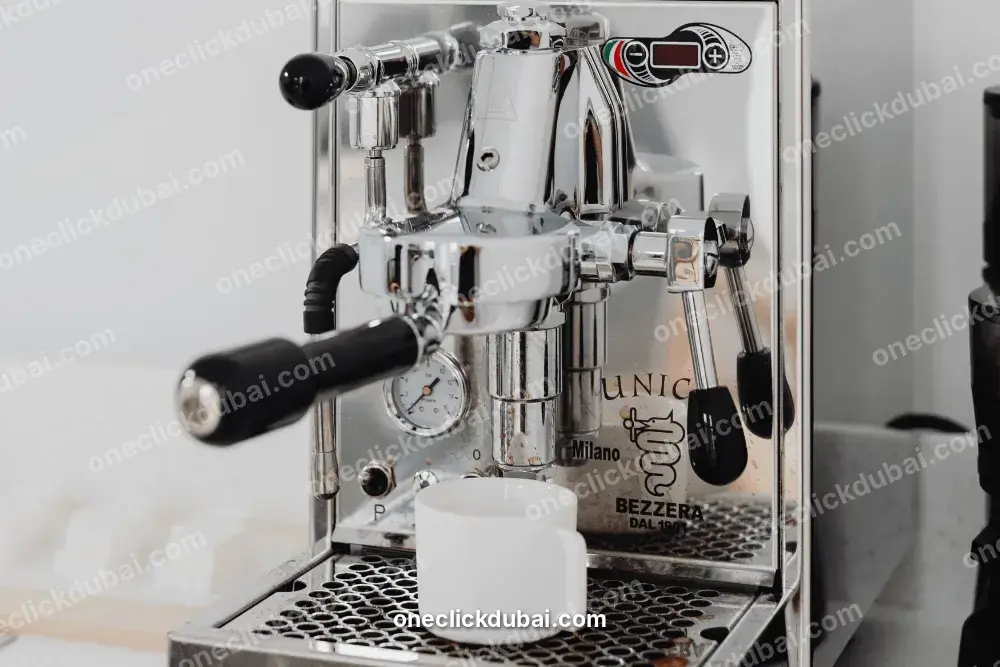
Overview
A commercial coffee machine earns its keep between seven and eleven in the morning. If it stops then, the cost is not the repair bill. It is the queue that walks out, the staff standing idle and the regulars who try the café next door. One Click Dubai sends a technician to cafés, restaurants, hotels, offices and canteens the same day, finds the fault on site and quotes one price before any part is fitted.
This page is written for the person who runs the machine, not only the person who fixes it. It explains what each kind of commercial machine does, which symptom points to which part, what Dubai's water does to the inside of a boiler, what a service plan should include, and how to keep trading on the day a machine fails.
We repair on site wherever the fault allows. A machine goes to the workshop only when the repair cannot be done on the bar, and only with your agreement.
Commercial coffee machine repair in Dubai: what we fix and what it costs
The visit costs AED 100 plus 5% VAT, and the technician uses it to find the fault. After that you receive one price for the repair. Commercial coffee repairs come between AED 80 and AED 400 depending on the fault, and the price covers genuine parts and labour.
Because the range is wide, the useful number is the one on your own quote. We give it after the diagnosis and before any part goes in.
Which commercial machine do you have?
Commercial coffee equipment falls into a few families, and each fails in its own way. The model name is on the front, and the rating plate on the back or underside carries the serial number and electrical rating. A photo of that plate when you book tells us which parts to bring.
The brand matters less than the family. A Rancilio, a Gaggia, a La Marzocco and an Astoria share the same working parts, so the same checks apply. Brand-specific notes are on our pages for Rancilio and Gaggia, and the main coffee machine repair page covers the rest.
Who should repair it: supplier, warranty and agreements
In Dubai, many café machines arrive through a coffee supplier. The supplier lends or leases the machine, the café buys beans from them, and the agreement says who services it. Read the agreement before you call anyone, because if the supplier is obliged to repair the machine, a third party opening it may breach the contract.
We are independent of the machine makers. If your machine should go back to the dealer or supplier, we say so before we touch it.
Fault guide: find the symptom, find the likely part
A good technician measures before replacing. These are the symptoms we meet most often, with what they usually mean. They are a guide for the operator, and the diagnosis on site confirms it.
Machine not heating
Check the boiler pressure gauge if your machine has one. Many commercial espresso machines hold their steam boiler at roughly one to one and a half bar, but the correct figure is in your machine's manual. A gauge that sits low while the machine is on points to the heater or the pressure control.
Weak, watery or fast espresso
Run a controlled test before you message us. Dose the same weight, grind a notch finer and time the shot. Many cafés aim for around 25 to 30 seconds, but your roaster's recipe comes first. If the shot will not settle whatever the grind, look at the grinder burrs and then the machine.
Weak or slow steam
Soak the tip in milk cleaner and clear each hole with a pin. If steam is still weak, stop using the wand and book a visit. Running a machine with low pressure for weeks hides a fault that is cheap today.
Water leaks
Water near mains wiring is dangerous. If you see water under a machine, switch it off at the isolator before you do anything else.
No water from the group
Check the tap on the water supply and the softener first. If a pump hums but delivers nothing, the line is probably air-locked or the pump is worn.
Machine will not fill, or overfills
An overfilling boiler can push water through the steam wand, so stop using the machine until it is checked.
Error messages and dead displays
Bean-to-cup and volumetric machines show messages when a sensor or a part fails. Write the message down, with the time and what the machine was doing. Messages pointing to scale, a brew unit or a milk system are common, and each has a cleaning procedure in the manual. A message that returns straight after cleaning needs a visit.
Commercial grinders: the part everyone forgets
Customers blame the espresso machine for what the grinder does. A worn grinder gives uneven particles, so some of the water flows fast through coarse grounds and some stalls in fine ones. The cup tastes sour and bitter at the same time.
Burrs on a busy café grinder are consumables. Many cafés replace them on the roaster's or maker's recommendation, and the figure depends on the burr type and the volume of coffee ground. We check burr wear at every service.
Dubai water, scale and what it does to a coffee machine
Scale is the single most expensive thing in a commercial coffee machine, and it builds invisibly. It coats heating elements so they take longer to heat and burn out sooner. It narrows pipes and solenoids until flow drops. It cakes level probes until the machine misreads its own boiler. In a hard-water area, an unfiltered machine shows the effects far sooner than most owners expect.
A softener protects only while someone looks after it. On site we regularly meet one that was fitted years ago and never serviced, passing hard water straight through. A water test at the machine tells you which situation you are in.
Descaling, done carefully
Boilers that have never been descaled need a longer, repeated treatment. We flush them on site, show you what came out and agree a schedule.
Commercial bean-to-cup machines: the faults that stop service
A bean-to-cup machine does the barista's work inside a cabinet: it grinds, doses, presses the coffee, brews it and, on many models, froths milk. Staff only touch a screen, so a fault looks like a message and a dead button. Behind the message there are four systems, and each fails differently.
Do not keep pressing the button after a brew-unit message. A unit forced through a jam can crack a part that costs far more than the clean that would have fixed it. Write the message down, switch the machine off if it makes grinding or clunking noises, and send it to us with a photo of the screen.
Daily care for a bean-to-cup comes down to three jobs: empty and rinse the grounds container and drip tray, run the milk-system cleaning cycle with the cleaner the maker specifies, and wipe the dispensing area. Weekly, take out the brew unit if the model allows it, rinse it under warm water without soap and let it dry before refitting. Follow the maker's manual for the exact steps on your model.
Batch filter brewers and airpots
The simplest machines still fail, and they fail in a pattern: slow, weak or lukewarm coffee, and a puddle.
Filter brewers sit on the counter all day and take less cleaning attention than an espresso machine, so scale builds up quietly. In a hard-water area, a monthly descale is a reasonable starting point, and the maker's manual overrides it. Rinse thoroughly, and brew a full cycle of plain water before the next service.
Pod and capsule machines in offices
Office machines are used by many people who are not responsible for them, which is where the faults come from. Staff leave the tank empty, pull the capsule container out mid-cycle or push the wrong cup under the spout.
Name one person on each floor as the machine's keeper. A weekly two-minute check by one person prevents most of the breakdowns we see.
Milk systems and steam wands: hygiene and safety
Milk is the dirtiest thing a coffee machine handles. Residue left in a steam wand or milk tube grows bacteria and blocks the outlet, and a blocked outlet is a safety risk because the wand can spit hot milk.
A wand that spits irregularly, leaks at the base or has a knob that will not seal needs a visit. Do not keep forcing a valve that will not close.
Where the machine sits: heat, power and plumbing
Many commercial coffee faults start with how the machine was installed, not how it was built. A short checklist for new sites and for machines that keep failing.
If a machine trips the breaker repeatedly, do not keep resetting it. Switch it off and send us the plate details. Repeated trips mean a fault in the heater, a wet connection or an overloaded circuit, and each needs a different fix.
Keep a simple machine log
A notebook or a shared phone note beside the machine saves money. After a few months it shows patterns that nobody remembers.
When you message us, the log lets the technician arrive with the right parts. A fault that comes back every two weeks is a different job from one that has never happened before.
Questions to ask any repair company before they open your machine
Whoever you call, these questions separate a technician who diagnoses from one who guesses.
A good answer names pump pressure, boiler pressure or temperature, and the water side. A bad answer is that they will replace the likely part.
A failed gasket, screen or valve should be shown to you, with the reason it failed.
One figure for the part and the labour, given before work begins, not an open-ended hourly charge.
Ask for genuine or maker-approved parts and ask what cover comes with them.
Cover on the part and the labour should be stated in writing.
A technician who has read the agreement, or asks to see it, protects you from a clause you did not know about.
We answer all six before the visit, on WhatsApp.
Spares worth keeping on site
A spares kit costs little and covers the stoppages that happen most often. For parts that belong to your specific model, send us the plate and we will tell you which to hold.
Cleaning routine for staff
Most breakdowns we are called to trace back to a routine that slipped. This schedule keeps a machine serving.
The gasket is the cheapest protection on the list. Changing it early costs a few dirhams, while letting it fail mid-service costs a call-out and a lost morning.
Service plans for cafés, hotels and offices
A service plan turns the checks above into booked visits, so nobody has to remember them. The plan is written down, so you know what each visit covers.
The right rhythm follows how hard the machine works. A hotel breakfast machine and a café that opens at six are different cases. Tell us your cups per day and opening hours and we will suggest a visit schedule and a price for your site.
When the machine fails in the middle of service
A breakdown at nine in the morning goes better with a plan. These steps save the most time.
A bang, a burning smell, water on the floor, a tripped breaker and a loss of flow each point to a different part.
Keep the machine off, and resist resetting the breaker again and again.
Mains water tap open, softener bypass closed, drain clear, power switch on, machine filled to its level.
Send the model, the plate photo, a short video of the fault and when it began.
Serve from a second machine, a batch brewer or a grinder-and-filter setup, and tell us if the day needs to be recovered around your opening hours.
After the repair we note why it failed. Two gasket failures in a year mean the change interval is too long.
Keep a small spares kit on site: group gaskets, shower screens, a steam tip and a blind basket. They cost little and cover the three common stoppages.
Repair or replace a commercial coffee machine
These machines are designed to be serviced, so most decisions favour repair.
We apply one test everywhere: if the quote nears half the price of a comparable new machine, we advise buying new. A sound commercial machine seldom gets there.
Buying a used commercial machine
We can inspect a used machine before you commit, and give you a written list of what it needs.
What happens at a commercial coffee machine visit
Tell us the model, the symptom and how long it has been down, with a photo of the plate.
The technician runs water from the groups and wand, listens to the pump and checks the gauges and the water side.
Pump pressure, boiler pressure and temperature are read before anything is replaced.
You receive one price. A faulty part is shown to you.
If the part is in the van, it goes in at once. We test a shot and the steam before leaving.
You get an invoice and one month of cover on the new part.
Commercial coffee machine repair near me: areas we cover
We repair commercial coffee machines in Dubai Marina, JBR, Palm Jumeirah, JLT, Downtown, Business Bay, Jumeirah, Al Barsha, Dubai Hills and Deira. Elsewhere in the UAE, message us and we will say what is possible.
Frequently asked questions
Who repairs commercial coffee machines in Dubai?
We do, at your café, restaurant, hotel or office, usually the same day. Message us on WhatsApp at +971 55 209 9785. A new machine or one supplied under a coffee agreement should go to the dealer or supplier first.
How much does commercial coffee machine repair cost in Dubai?
The visit is AED 100 plus VAT. The repair is AED 80 to AED 400 depending on the fault, and the price is agreed before work begins.
Do you repair both espresso and bean-to-cup machines?
Yes, plus batch brewers, grinders and pod machines.
Can you repair my machine on site?
Usually yes. A machine goes to the workshop only when the repair cannot be done on the bar, and only with your agreement.
My espresso machine has no pressure. What should I check?
Check the grind and the beans, then the group gasket and shower screen. If those are fine, the pump or the pressure control needs a gauge test.
Why does my group head leak?
The gasket has hardened. Replacing it with a new screen is a lower-end repair.
How often should I service a commercial coffee machine?
Many busy cafés book a service every six months, with gaskets changed more often. Your cups per day set the real interval.
Do you offer service plans?
Yes. Tell us the machine, your daily volume and opening hours, and we will suggest a plan and a price.
Do I need a water softener?
In Dubai, a filter and a softener protect the heating parts of any machine that runs all day, and both need servicing.
Will repairing a machine void a supplier agreement?
It can. Read the agreement first, and ask the supplier if they will attend.
What descaler should I use?
One made for coffee equipment, used as the pack says, with a full fresh-water rinse afterwards. Never mix products.
Can I use a machine bought abroad in the UAE?
Only if the voltage and phase on its plate match the UAE supply. Check the plate before plugging in.
Book a commercial coffee machine repair
Message us on WhatsApp at +971 55 209 9785. Send the model, the fault and a photo of the plate. If the machine is down during service, say so and we will book you first.