Overview
Espresso machines are among the most repairable appliances in a home. They are built from a small number of parts: a pump, a heater, a few valves, a group head, a gasket and a steam wand. When one stops working, the fault is often in one of those parts, and a technician with a pressure gauge can find it in a single visit.
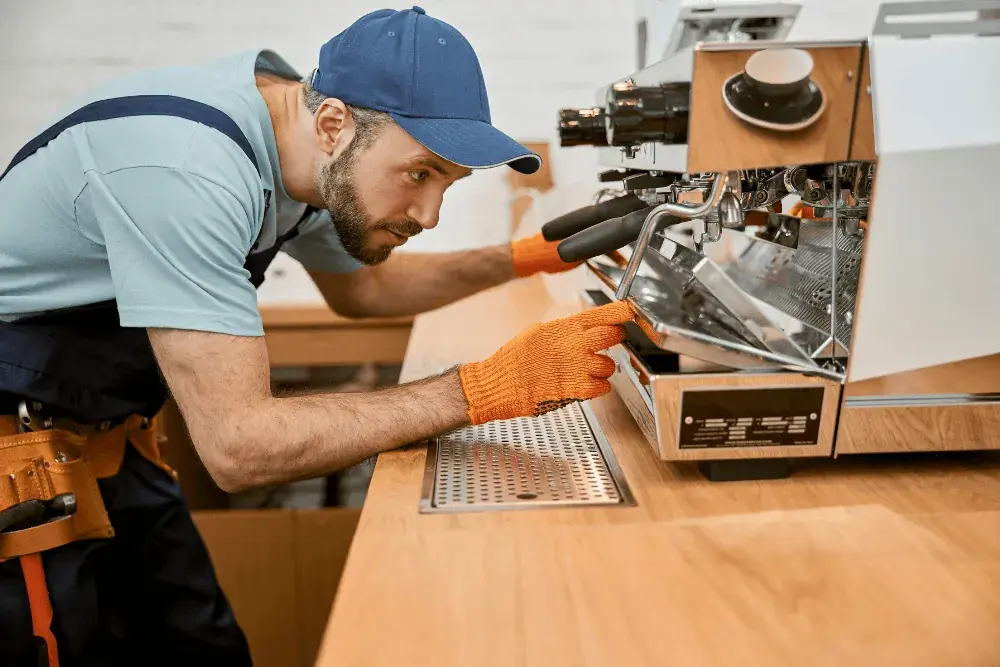
One Click Dubai repairs semi-automatic, lever, heat-exchanger, dual-boiler and thermoblock espresso machines at your home or office, usually the same day. This page is organised by how the machine is built, because the design decides what fails, what the symptom looks like and what is worth repairing. It also tells you what you can safely try before calling us.
We repair on site wherever we can. A machine goes to the workshop only when the fault cannot be fixed at your kitchen counter, and only with your agreement. The price is agreed before any part is fitted.
Espresso machine repair in Dubai: what we fix and what it costs
The AED 100 plus 5% VAT visit fee pays for the diagnosis. Afterwards you get a single price for the repair. Espresso machine repairs run from AED 80 to AED 400 depending on the fault, with genuine parts and labour included.
Your own quote is the number that counts. We give it after the diagnosis, before any part is fitted.
The short answer: what is wrong with your machine?
Most espresso complaints fall into a few patterns. This table points to the likely cause so you know what to look at first.
The sections below explain each pattern, starting with the design of the machine, because the same symptom can mean different things on different designs.
Four designs, four sets of habits
The way a machine heats water decides how it behaves and how it fails. If you do not know which design you own, the manual or the maker's website will say. As a rule, a machine with a single steam switch and one boiler is a single-boiler machine, and a machine with a pressure gauge for the steam boiler and a large group head is usually a heat-exchanger design.
Thermoblock machines are common in homes, and they are also the ones where repair gives the least value when the cost of the part approaches the cost of a new machine. Single-boiler, heat-exchanger and dual-boiler machines are built to be serviced, and a good one is usually worth keeping for years.
Brand-specific notes are on our pages for Gaggia, Breville and Rancilio. If you own a Rocket, ECM, Lelit, La Pavoni or another prosumer machine, message us with the model and we will tell you what parts to expect.
How an espresso machine moves water, and why that helps you diagnose
Follow the water. It leaves the tank, passes through the pump, reaches the heater, goes to the group head, flows through the coffee and ends up in the cup. A fault lies somewhere on that path, and a test at each point narrows it down.
A useful first test is to run the machine with no portafilter and watch what comes out of the group. Strong, even flow means the pump, the heater path and the solenoid are working. Weak or uneven flow points at the shower screen, the group or the pump. No flow points at the tank, the pump or a blockage.
Leaks: where the water comes from
A common leak on any machine is the group gasket. It is a rubber or silicone ring that hardens with heat and age, and when it stops sealing, water escapes around the portafilter. A sign you can check yourself: when you lock the portafilter in, does the handle travel further round than it used to? If it passes the six o'clock position, the gasket has probably flattened and needs replacing.
Check the basket before you buy a gasket. A dent in the rim stops the basket sealing against the ring, and a new gasket will not cure that. Then remove the shower screen and look behind it. Coffee oil and fine grounds build up and divert water around the edge.
When a leak means switch off
A leak from the boiler area or from beneath the machine is a safety matter. Water close to the heater and the wiring can cause a short or a shock. Switch off at the wall, unplug the machine, let it cool and keep it off until it has been checked.
Weak, fast or sour shots
A weak shot is usually the coffee, not the machine, so test the coffee first. It takes ten minutes and tells you which side the problem is on.
Beans roasted within the last few weeks give much better crema than beans months past roast.
Use the dose the basket is made for, level the bed and tamp evenly.
Many baristas start at about a 1 to 2 ratio of dose to liquid in 25 to 30 seconds. Your roaster's recipe is the better guide.
If the shot runs too fast, grind finer. If it chokes, grind coarser. Change only the grind between tests.
A pressurised basket makes foam by pressure and not by grind, so it hides a coarse grind. Try a single-wall basket to see what the machine is really doing.
A worn gasket or a clogged shower screen causes uneven flow and a thin shot.
If the grind, the beans and the group are right and the shot is still thin, the pump pressure is the next suspect. A technician reads it with a gauge fitted to a portafilter. A pump that cannot reach pressure is replaced. A pressure-limiting valve that opens too early is cleaned or reset. Please do not turn the valve screw by feel, because a guess leaves the machine at the wrong pressure.
Sour shots with a good grind often mean the water is not hot enough. That can be a design habit (steaming right before brewing on a single-boiler machine) or a fault (a thermostat or element that no longer reaches temperature). The temperature section below explains how to tell them apart.
Choked shots, slow flow and dripping
If the machine drips for a long time after a shot and the used puck is wet and sloppy, the solenoid is the first thing to check. A healthy puck is firm and dry because the solenoid vents the pressure at the end of the shot. A solenoid that does not vent leaves the group under pressure, and when you release the portafilter you can get a burst of hot water, so take care.
Steam problems
Clean the wand after every drink. Wipe it with a damp cloth, then open it for a second to blow the milk out of the tip. Dried milk narrows the holes and is a common reason for weak steam. Soak the tip weekly in milk cleaner and clear the holes with a fine pin, never a knife.
Thermoblock machines produce less steam than boiler machines, and you may not get café-style microfoam on a small machine whatever you do. That is the design, not a fault. A single-boiler machine needs time to climb from brew to steam temperature, so wait for the steam light or the pressure gauge before you open the wand.
Temperature: why shots taste sour or burnt
Espresso is sensitive to water temperature. A few degrees too cool gives sour, thin shots. A few degrees too hot gives bitter, burnt ones. The usual cause is the way the machine was used in the minutes before the shot.
If the habit is right and shots are still cool, the machine has a temperature fault. The usual suspects are a brew thermostat that opens too early, a heating element that has lost power, or scale insulating the heater. We test with a thermometer or probe before replacing anything. If the shots are too hot, the cause is usually a thermostat that does not open.
No water, pump noise and air
A vibration pump always buzzes, but loud knocking or a rising pitch is a warning. Do not keep running a pump dry, because a dry pump overheats. Fill the tank, bleed the air and listen again. If the noise stays, book a visit and we will replace the pump or refit the tube.
A dead machine
A machine that shows no light and no sign of power needs a methodical check.
Rule out the wall socket. Never use an extension lead or a damaged plug.
A cable that is hot, marked or cracked is a reason to stop using the machine.
Switches fail at the contacts. A switch that feels loose or crackles needs replacing.
A fuse blows when the machine runs dry or overheats. It does not reset itself.
Only a technician should open the case and test with a meter.
Do not open an espresso machine yourself. Mains electricity and a hot, wet boiler are an unsafe combination. If the machine is dead, unplug it and book a visit.
Lever machines and prosumer machines
Lever machines, such as the classic La Pavoni style, put the pressure in your arm. Their faults are mostly mechanical: worn piston seals, leaking gaskets, a tired spring, or scale in the boiler. Prosumer machines, with large group heads, pressure gauges and a pump to the mains or a tank, fail like small commercial machines.
A prosumer machine deserves proper maintenance. The cost of servicing it is small next to the cost of a new one, and the parts are standard. Tell us the exact model, and send a photo of the plate, so we can bring the right gaskets.
Descaling an espresso machine
Scale is the thing that quietly kills espresso machines. It coats heating parts, blocks thin lines, sticks valves and eventually stops the machine heating at all. Tap water leaves scale behind, so an espresso machine used daily needs a descale routine.
A machine that has never been descaled needs more than the routine dose. If water barely flows, or the machine takes ages to heat, the scale is heavy. We flush it on site and show you what came out.
Daily and weekly care for a home espresso machine
Not every machine can be backflushed. Machines without a three-way solenoid, such as many thermoblock machines, should not be backflushed with a blind basket, and the manual will say which kind you have. If it is unclear, ask us.
Reading the pressure gauge
Many prosumer and heat-exchanger machines have one or two gauges, and they tell you more than any amount of guessing. Which gauge you have decides what it means.
Read the pump gauge with a real shot running. A reading with no coffee in the basket can look high because there is no resistance. A reading that rises smoothly and settles during a normal shot is healthy. If the needle sags as the shot runs, the pump or the gasket is losing pressure.
Take a photo of the gauges at rest and during a shot, and send them with your message. The technician can then tell which part to bring.
Portafilters, baskets and the small parts that wear
Several cheap parts decide shot quality, and they wear out quietly. Replace them before you blame the machine.
Keep a spare gasket, shower screen and steam tip at home. They are small, and having them saves a wait.
Water for a home espresso machine
What you pour into the tank decides how long the machine lasts. Very soft or distilled water can confuse the sensors on machines that use a water-level probe, and very hard water coats the heater. The best answer depends on your machine, and your manual states the maker's advice.
If you notice white flakes in a cup or a coating on the shower screen, the water is leaving scale. That is the cue to descale and to improve the water you use.
Electrical safety in a Dubai home
Most espresso machines draw a lot of current while the boiler heats. That is why a socket shared with a kettle or a toaster can trip the breaker. A dedicated socket avoids the problem.
What to tell the technician when you book
Look on the front and on the plate under or behind the machine.
For example: leaks at the group, no steam, pump buzzes, trips the breaker.
Suddenly, or slowly getting worse over weeks.
A new gasket, a descale, a different grind. It saves repeating tests.
It tells us whether warranty applies and which parts it uses.
A ten-second clip of the fault, with the sound on, is worth a page of description.
With those six answers, most faults can be narrowed to two or three likely parts before the technician leaves.
Repair or replace an espresso machine
Our test is simple: if the repair costs close to half of a comparable new machine, buy new. We would rather say so than fit an expensive part to a machine that will fail again.
Buying or inheriting a second-hand espresso machine
We can do a full check of a second-hand machine in one visit and give you a written list of what it needs.
What happens at an espresso machine repair visit
Give us the make and model, describe the symptom, and attach a photo of the plate if you have one.
Water goes through the group and the wand while the technician listens to the pump and looks for leaks.
Pressure at the group and water temperature are read before anything is replaced.
You receive one price. We show you the faulty part.
A part we carry goes in at once. Anything else is ordered and fitted on the earliest return visit.
We pull a shot and test the steam before leaving. You receive an invoice and a month of cover on what was fitted.
A machine goes to the workshop only with your agreement.
Espresso machine repair near me: areas we cover
We repair espresso machines in Dubai Marina, JBR, Palm Jumeirah, JLT, Downtown, Business Bay, Jumeirah, Al Barsha, Dubai Hills and Deira. Elsewhere in the UAE, message us and we will say what is possible.
Frequently asked questions
Who repairs espresso machines in Dubai?
We do, at your home or office, usually the same day. Message us on WhatsApp at +971 55 209 9785. If your machine is new, the dealer's warranty comes first.
How much does espresso machine repair cost in Dubai?
The visit is AED 100 plus VAT. The repair is AED 80 to AED 400 depending on the fault, and the price is agreed before we start.
Why is my espresso machine leaking from the group head?
The group gasket has probably hardened. Check whether the portafilter now locks past the six o'clock position. A dented basket or a dirty shower screen can also cause it.
Why is my espresso weak?
Test the beans, the grind and the dose first. If those are right, the gasket, the shower screen or the pump pressure is the next place to look.
Why is there no steam from my espresso machine?
The tip is probably blocked with dried milk. Soak it and clear the holes. If steam is still weak, the valve or the boiler needs checking.
Why does my espresso taste sour?
The water may be too cool. On a single-boiler machine, wait after steaming and flush the group. If the habit is right, a thermostat or element may be failing.
Can I backflush my machine?
Only if it has a three-way solenoid. Check the manual. Many thermoblock machines should not be backflushed.
Should I use vinegar to descale an espresso machine?
No. Use a descaler made for espresso machines. Vinegar can harm seals and leaves a taste.
How often should I replace the group gasket?
About once a year on a machine used daily. Replace it sooner if the portafilter locks further round than before or water leaks.
Do you repair lever and prosumer machines?
Yes, including seals, gaskets, pumps, valves and boilers.
Is it worth repairing an old espresso machine?
Often yes, particularly boiler and heat-exchanger machines. A gasket, a descale and a pump or thermostat check give years more. We say so honestly if it is not.
Can I use a 120 V espresso machine in the UAE?
Not on a UAE socket. It would be damaged even through an adaptor. Check the plate before plugging in.
Book an espresso machine repair
Message us on WhatsApp at +971 55 209 9785. Send the make, the model and a short description of the fault, and we will suggest a time.