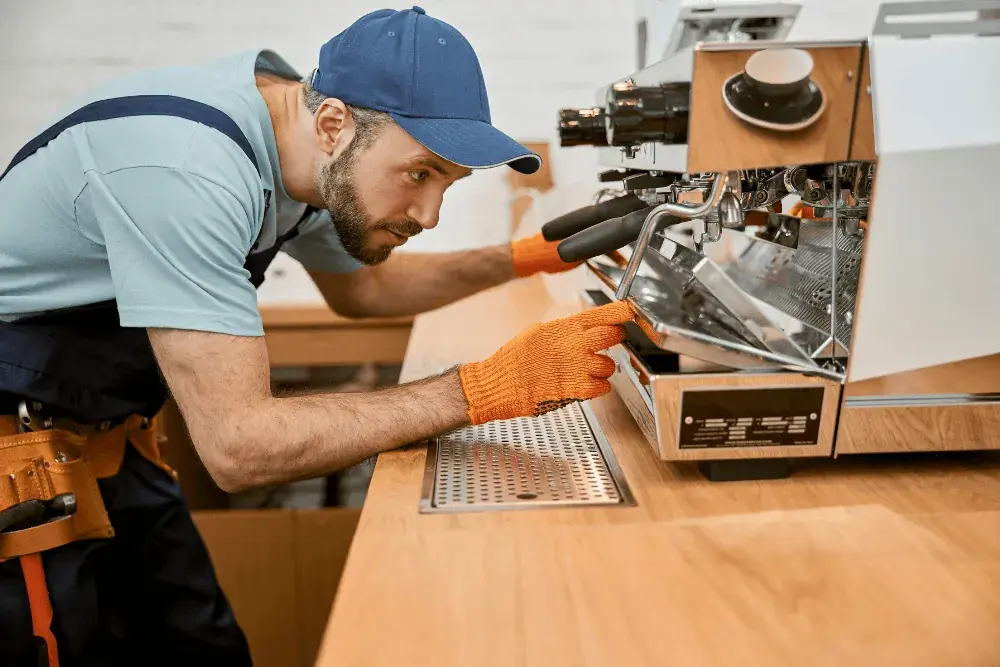
Overview
One Click Dubai handles coffee machine repair and coffee maker repair at your home or office across Dubai, with a technician sent the same day. We repair bean-to-cup machines, espresso machines, capsule machines, filter coffee makers and the commercial machines used in cafés, restaurants and hotels, in all the common brands.
Our first priority is to repair the machine where it stands. When a fault is complex, such as a control board that needs bench testing, we collect the machine, repair it in our workshop and bring it back. You are told which of the two it will be before any work starts, and the price is agreed first.
Below: how to tell which type of machine you own, then each common fault with its causes, what you can check safely and what the technician does. Limescale gets its own section, because it sits behind more coffee machine faults than anything else. After that come the brands, the point at which a repair stops being worth the money, and how often a machine needs servicing.
Coffee machine repair in Dubai: what we fix and what it costs
Coffee machine repair in Dubai from One Click Dubai starts with an AED 100 diagnostic visit, plus 5% VAT. The technician finds the fault and quotes a fixed price before touching anything, and you decide whether to go ahead. Repairs cost between AED 80 and AED 400, depending on the fault.
The price depends on the fault, so here is roughly where the common jobs fall inside that AED 80 to AED 400 range. This is a guide to the order of cost, not a quote. Your price is set after diagnosis.
We also service machines that still work. A coffee machine service covers descaling, cleaning the brew unit or group, new seals and gaskets, and a check of the pump and heater, so a small fault is caught before it becomes a repair. If you would rather do it yourself, our guide to descaling a coffee machine covers every type, and there is a separate Nespresso descaling guide.
Two things move the price more than any other. One is the part itself. The other is how many years of limescale the machine has behind it. A machine that has been descaled on schedule usually needs a seal or a pump. A machine that has not often needs a heating part as well, because scale is what kills them.
Which type of coffee machine do you have?
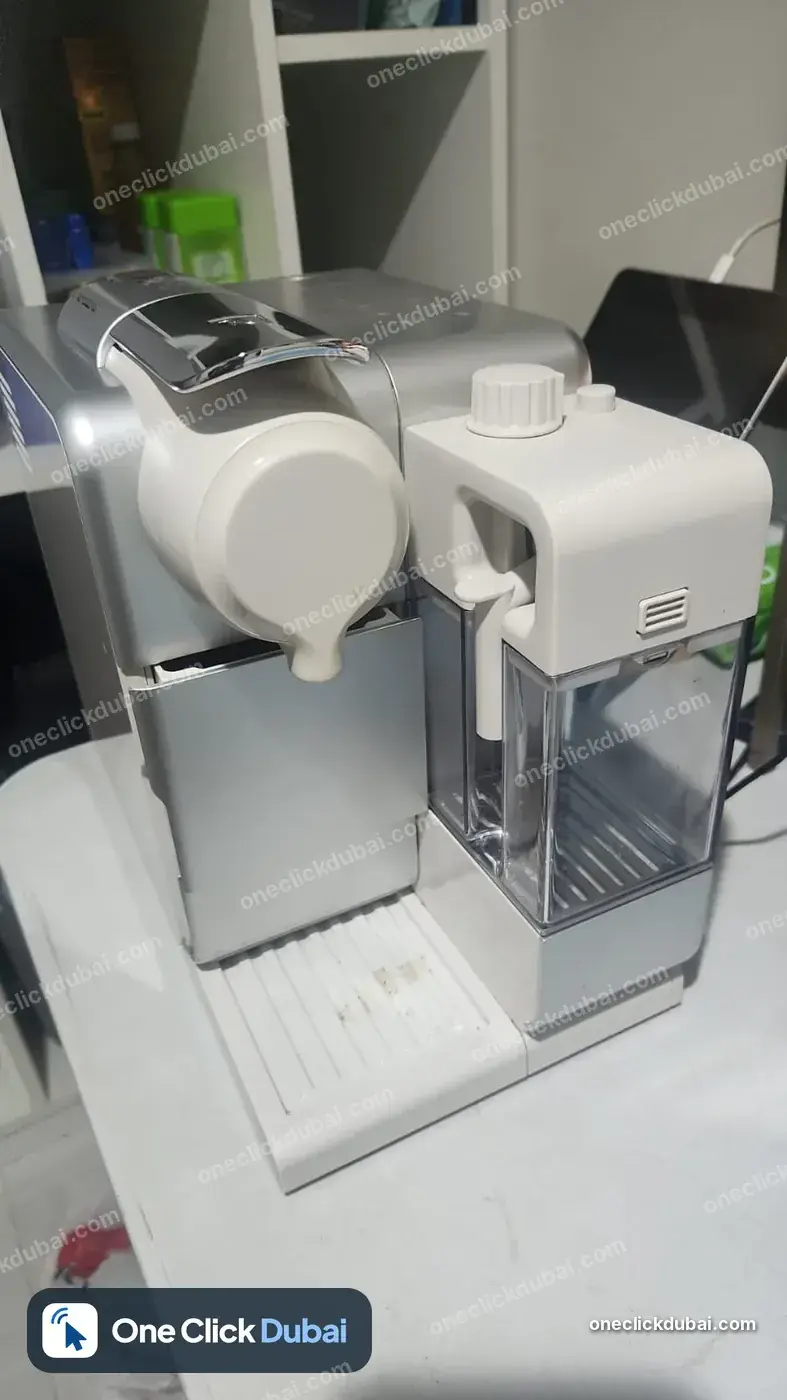
The type of machine decides where the fault is likely to be. A capsule machine has no grinder to jam, and a filter coffee maker has no pump to fail. Identify yours first and the rest of this page gets much easier to use.
Scale, a worn seal or a dead power supply can hit any of the five. Everything else is specific to the type: a bean-to-cup that grinds and makes no coffee is a different job from a Nespresso that leaks at the pod.
Finding the model number
Every machine has a rating plate with the model code, voltage and wattage. Look underneath the machine, behind the water tank, or inside the door that holds the brew unit. On De'Longhi machines the code starts with ECAM or EC. Nespresso machines are sold by name, such as Vertuo Next or Essenza Mini, and the plate carries the type code as well.
When you book, send a photo of the plate, and of the display if it shows a message. The technician then arrives knowing the machine, with the likely parts.
Coffee machine will not turn on
A coffee machine that shows nothing at all has lost power before the electronics, and the cause is often outside the machine. One that lights up and then shuts itself off is usually protecting itself from something else, such as a missing part or a water fault.
What you can check safely
What the technician does
The technician tests the cord and plug, then the power switch, the thermal fuse and the power supply board, in that order. A blown fuse or burnt board is treated as a symptom. The question is what made it blow: a short caused by a leak, a seized pump drawing too much current, or a heating element that has gone to earth. Replacing the board alone, without finding that cause, means it fails again.
Do not open a coffee machine that is plugged in. If water has run onto the electronics, unplug the machine and leave it off until it has been checked. A machine that dries out and seems to work again can still have corroded contacts that fail weeks later.
Coffee machine not heating, or coffee that is lukewarm
Lukewarm coffee has three common causes: a setting, scale on the heating part, or a failed temperature control. The first costs nothing to rule out. The second is the most frequent repair we see.
Scale insulates. A thin layer on a heating element makes the element push harder to get heat into the water, and the part runs hotter than it should. That is why a lukewarm machine is often one descale away from a blown thermal fuse.
What the technician does
The technician measures the resistance of the heating element and tests the temperature sensor, which is usually an NTC sensor that changes resistance with heat. A reading outside the maker's figure condemns the part. The technician also looks at what scale has done to the thermoblock or boiler. Where it can be descaled and cleaned out, we do that. Where the channels are blocked solid, the whole thermoblock is replaced, and that is one of the dearer repairs in the range.
If a thermal fuse has blown, we find out why before fitting a new one. A fuse is a one-time safety link, and replacing it without fixing a blocked water path or a scaled element just sets it up to blow again.
No water, or a pump that runs but delivers nothing
A pump that buzzes loudly while nothing comes out, or a machine that shows a fill-water message with a full tank, is a water path problem. Something between the tank and the heater is blocked, trapped by air, or has failed.
What you can check safely
Lift it off, check the small valve at the bottom for debris, and push it back until it clicks. A tank that is half seated lets in air and the pump cannot prime.
If the tank has a water filter cartridge, a new one that was not rinsed, or an old one that is clogged, can stop the flow. Take it out and run a cup of hot water. If the flow returns, the cartridge was the problem.
Fill the tank, put a large cup under the hot water outlet and run the hot water function until a steady stream comes out. Machines that ran dry often need this.
If the tank is empty or the circuit is not filling, stop. A vibration pump that runs dry overheats and wears.
When it is a fault
Many bean-to-cup and capsule machines have a flow meter, a small turbine that counts the water going through. If scale or grit jams it, the machine thinks no water is moving and stops with an error, even though the pump is working. The part is small and cheap, but a jammed one looks like a failed pump. The technician reads its signal with a meter instead of guessing.
The technician also checks the pump pressure on espresso machines, since a pump that still runs may no longer produce the 9 bar of pressure that espresso extraction relies on. A weak pump gives thin, fast coffee with little crema, which is a symptom people often put down to the beans.
Coffee machine leaking water
Where the water appears says most of what you need to know. Unplug the machine first. A leaking machine near a socket is a shock risk, and a leak that reaches the electronics is the most expensive kind.
A cracked water tank is one of the cheaper leaks to fix but one of the easiest to miss. Hairline cracks only show water when the tank is full, so a leak that stops when you remove the water and returns when you fill it points to the tank.
Rubber and silicone seals harden with heat over years. On an espresso machine, the group gasket sits against a very hot metal group head every time you brew, and it goes hard and flat. A hard gasket leaks around the portafilter and also makes the portafilter turn too far to lock. If your handle now ends up well past the position where it used to stop, the gasket is the first thing to replace.
A leak is the one fault we ask you not to leave. Water that finds its way onto the control board or the power supply turns a lower-end repair into an upper-end one. If you can see water moving where it should not, switch off, unplug and message us.
Weak, watery, bitter or slow coffee
When the machine works but the coffee is wrong, the fault is often in how it is being used or fed, not in the machine. Rule those out first. It saves a visit.
Beans matter more than people expect. Coffee loses its aroma within weeks of roasting, and beans left in a warm hopper in a Dubai kitchen go stale faster. Oily, dark-roast beans also coat the grinder chute and the brew unit, which leaves a bitter film that no setting will cover.
What the technician does
On a bean-to-cup machine, the technician takes out the brew unit and cleans it, checks the seals and the sieve for blockage and fits fresh food-grade grease to the moving parts. The brew unit sieve is a common hidden cause of slow coffee. It clogs with fine grounds and scale, and water cannot pass through it.
On an espresso machine, the technician checks the pump pressure, the gasket, the basket and the shower screen. Pressure that is low points to the pump or a leaking valve, which a pressure gauge or test portafilter shows at once. Where the machine has a three-way solenoid valve, we check that it relieves the pressure after each shot. A valve that sticks gives a wet, sloppy puck that is hard to knock out.
Coffee machine grinder problems
A grinder that is loud, grinds nothing, or grinds but sends no coffee down the chute has one of four problems: something hard in the hopper, a blocked chute, worn burrs, or a motor that has failed. The first two are common.
Adjusting the grind: the one thing to get right
On most bean-to-cup machines, the grind setting must be turned only while the grinder is running. Turning it while the grinder is stopped can strip the adjuster or jam the burrs. Your manual shows the method for your model. If the burrs have already jammed from a forced turn, leave it and book a visit.
What the technician does
The grinder is removed from the machine and opened. Foreign objects are cleared, the burrs are inspected for wear and chipping, and the motor and capacitor are tested. Ceramic burrs chip if they hit a stone, and steel burrs dull slowly with use. Burrs are replaced as a pair, since a new burr against a worn one gives uneven grinding.
Flavoured beans, caramelised beans and very oily beans are the usual reason a clean grinder blocks again. Maker manuals warn against them for this reason. If you use them, expect to need the chute cleaned far more often.
Steam wand and milk frother problems
A steam wand that gives weak steam, spits water, or gives none is often blocked by dried milk or choked by scale. The wand tip has very small holes, and a thin film of old milk closes them quickly.
What you can check safely
When it is a fault
If the tip is clean and steam is still weak, the cause is in the steam circuit: scale in the line or thermoblock, a steam valve that does not open fully, or a pump that cannot push enough water. On thermoblock machines, steam comes from the same heater that makes your coffee, so a machine that runs lukewarm tends to give weak steam too.
A wand that drips water or steam from the base needs a new valve seal. A machine that makes steam but will not release it may have a stuck valve. The technician descales the steam circuit, replaces the valve seal or the valve, and tests the steam at full pressure before finishing.
Error lights and messages that will not clear
Messages differ from brand to brand and from model to model, so no single code list is reliable for every machine. Your manual lists what yours means. What we can say is what the common messages usually point to, and what to do before you book.
A descale message resets only after a full descale cycle on most machines. Some have a way to reset the counter without descaling, and we advise against using it. The message is there because water has passed through the heater a set number of times. Hiding it leaves the scale where it is.
When a message does not clear after the obvious step, the technician reads the sensors directly: the tank sensor, the grounds container switch, the brew unit position switch, the flow meter and the temperature sensor. A message that says one thing often points to a different part. A machine that insists the grounds container is full, when it is empty, may have a worn switch, not a full container.
Limescale: why it is behind most coffee machine faults
Limescale is what is left when mineral-rich water is heated. Calcium and magnesium carbonate come out of the water and stick to whatever is hottest. In a coffee machine that is the heating part first, then the narrow channels, valves, the flow meter and the steam line.
It damages a machine in four ways:
Filtered water leaves less scale than raw tap water, and bottled water varies by brand, but none of it is scale-free. A filter cartridge helps only while it is fresh. An old one stops filtering and can restrict the flow.
How often to descale
Follow the machine's own counter or prompt where there is one. Where there is none, descale about every three months for daily use. Go to monthly if you notice white flakes or a film in the tank or on the spout, or if the machine heats slower than before.
How to descale properly
Descaling is maintenance, not repair. It will not revive a heating element, a pump or a valve that has already failed. And one case needs care. If a machine has never been descaled and is already slow, a first descale can loosen flakes that lodge in the pump or a valve and block it. In that case, book a visit. A technician can flush the circuit by stages and catch the flakes.
Coffee machine brands we repair
We repair all the common home, office and commercial brands. Each brand has its own faults, its own messages and its own parts, so each has a page of its own. The notes here are the short version.
If your brand is not on this list, message us. If it is a mains-powered coffee machine, the chances are we can repair it.
Repair or replace: when a repair is not worth paying for
A repair is worth it when the machine is good and the fault is ordinary. It is not worth it when the quote comes close to the price of a new machine of the same standard. As a rule of thumb, if the quote is more than about half the price of a comparable new machine, replacing is the better choice.
Check the maker's warranty first. If the machine is still covered, the dealer's repair keeps that cover intact and costs you nothing, so use that route. We will tell you if a fault is better handled that way.
We will also tell you plainly when we think a repair is not worth it. You pay only the diagnostic fee in that case, and there is no pressure to go ahead.
What a coffee machine repair visit involves
On WhatsApp, at any hour. Send the model plate, a photo of the display, and a line on what the machine is doing.
The technician checks the machine, reads what the sensors say, and tests the suspect parts. You are shown what has failed.
One fixed price for the part and the labour, given before any work starts. You can decline and pay only the diagnostic.
The part is fitted and the machine is cleaned and reassembled, at your home or office.
The technician brews real coffee, runs the steam, and checks for leaks before leaving.
A written invoice, with one month's warranty on parts and labour.
When the machine goes to the workshop
We aim to repair on site, because it is quicker for you and avoids moving a machine that may leak. Some jobs are better done on a bench:
In each case we tell you before we take it, we agree the price first, and we bring the machine back to you.
How often a coffee machine needs servicing
A machine that is cleaned and descaled on schedule has fewer faults, and the faults it has cost less. How often to service it, and how often to do the maintenance yourself, depends mainly on how many cups it makes.
Commercial machines need the most attention because they run for hours a day, and a machine that goes down in the morning rush costs real money. If you run a café, a regular service visit at a fixed interval is cheaper than emergency calls. Ask us about it when you book.
Coffee machine repair near me: areas we cover
We repair coffee machines across Dubai, including Dubai Marina, JBR, Palm Jumeirah, JLT, Downtown, Business Bay, Jumeirah, Al Barsha, Dubai Hills and Deira. If you are elsewhere in Dubai, message us. Same-day visits are the norm, and the technician comes to you.
Frequently asked questions
Who repairs coffee machines in Dubai?
One Click Dubai repairs coffee machines at home and in businesses across Dubai, the same day. Message us on WhatsApp at +971 55 209 9785.
How much does coffee machine repair cost in Dubai?
The diagnostic visit is AED 100 plus VAT. The repair costs between AED 80 and AED 400 depending on the fault, and is quoted at a fixed price before any work starts.
Can you repair my coffee machine at my home?
Yes. Repairing on site is our first choice. If a fault is complex and needs the workshop, we collect the machine, repair it and return it, and agree the price first.
Why is my coffee machine not heating water?
Common causes are scale on the heating part, a failed temperature sensor or a blown thermal fuse. A low temperature setting and cold cups can also make coffee feel lukewarm. A technician tests the element and sensor with a meter.
Why is my coffee machine leaking from the bottom?
Water under the machine when it is idle points to an internal hose, a tank valve seal or a leak in the boiler or thermoblock. Switch it off, unplug it and book a visit before water reaches the electronics.
Why does my coffee machine say fill water when the tank is full?
The tank sensor may be stuck, the flow meter may not be counting water, or air may be trapped in the circuit. Reseat the tank and run hot water to purge the air. If the message stays, the sensor or flow meter needs testing.
How often should I descale my coffee machine?
Follow the machine's counter if it has one. Without one, descale about every three months for daily use, and more often if you see white flakes or the machine slows down.
Can I descale with vinegar?
Most makers advise against it. Vinegar can damage seals and leaves a smell and taste that take many rinses to clear. Use the maker's descaler or one the maker approves.
Is it worth repairing a coffee machine?
For premium bean-to-cup, espresso and commercial machines, yes. For low-cost capsule and filter machines, only when the fault is cheap. If the quote is more than about half the price of a comparable new machine, replacing is usually the better choice.
Can you repair a coffee machine I bought abroad?
Yes, if it is built for 230 volts. Check the voltage on the rating plate first. A machine made for 110 to 120 volts will be damaged on the 230 volt supply in Dubai unless it runs through a transformer.
Do you repair commercial coffee machines?
Yes. We repair café, restaurant, hotel and office espresso machines, including group gaskets, shower screens, pumps, solenoids, steam valves and boilers.
Do you give a warranty on coffee machine repairs?
Yes. One month on parts and labour.
Book a coffee machine repair
Message us on WhatsApp at +971 55 209 9785, at any hour. Send the model plate, a photo of the display, and what the machine is doing, and we will confirm a visit time.