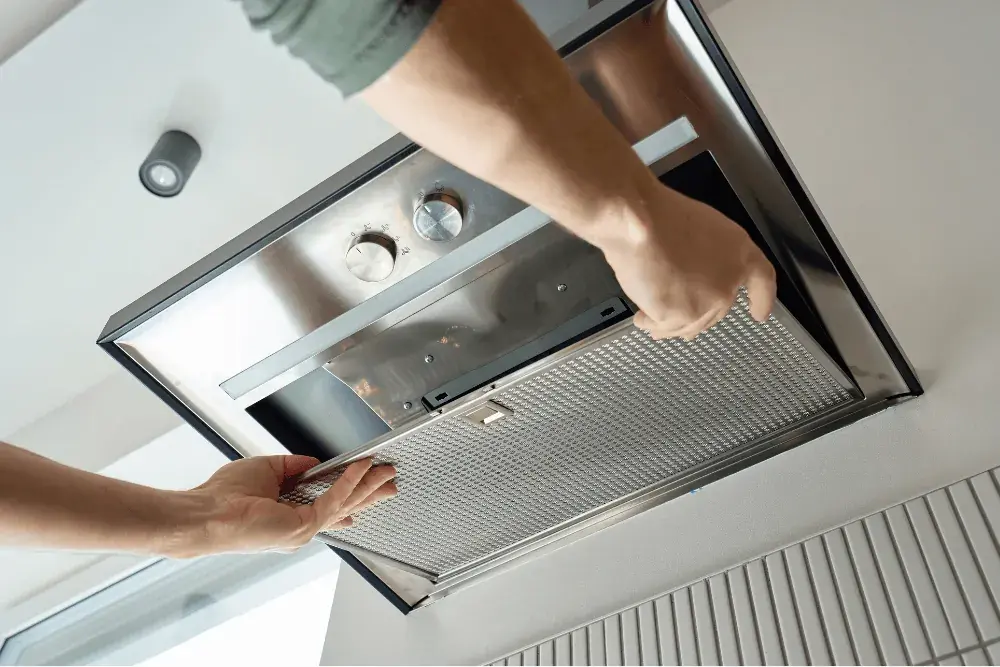
A kitchen hood or extractor fan that is not working can be sorted into three cases by one look. If nothing works, no fan and no lights, the hood has lost its power. If the lights work and the fan does not, the fault is on the motor side: the capacitor, the motor itself or the speed switch. If the fan works and the lights do not, it is the lamps, their driver or the light switch.
This guide follows that split. Each case has a short list of checks in order, most of which need no tools, and a clear point at which to stop, because a hood is a mains appliance fixed above a hob and its motor and electrics are not home repairs. It covers chimney, built-in, telescopic and island cooker hoods, and wall and ceiling extractor fans. If your hood runs and simply does not clear the air, that is a different problem with its own guide: range hood not extracting. For a repair, see kitchen hood repair in Dubai.
What worksWhat does notMost likely causeHome check?
NothingFan and lightsIsolator or socket switched off, plug out, tripped breaker, blown fuseYes
LightsFan, silentSpeed switch, motor, wiring, control boardNo
LightsFan, hums and does not turnCapacitor failed, or motor seized with greaseNo
Lights, fan on some speedsOne or two speedsSpeed switch or control boardNo
FanLights, all of themLight switch, transformer or LED driverPartly
FanOne lightThat bulb or its holderYes
Everything, then it cuts outFan stops after some minutesMotor overheating from grease or worn bearingsClean the filters. Then a repair
Nothing respondsTouch panel or remoteLock, moisture on the panel, dead remote battery, control boardPartly
Fan runsWill not switch offRun-on timer, stuck switch or relayPartly
Telescopic hoodNothing when pulled outSlide switchNo
Find your row, then go to the matching section. If you smell burning or see scorching at any point, switch the hood off at its isolator and leave it off.
Switch the hood off at its isolator or unplug it before removing filters, bulbs or covers. The wall switch on the hood itself does not make it safe.
Let the hob and any pans cool completely. You will be leaning over it.
Cover the hob with a thick towel or a board in case anything is dropped.
Use a stable step, not a chair, and do not rest your weight on the hood.
Grease filters and the inside of the hood are slippery and may have sharp metal edges. Gloves help.
Do not spray cleaner into the hood's switches, lamp holders or motor.
Home checks end at the filters, the bulbs and the power supply. The motor, capacitor, switches and control board are behind covers with live terminals.
A cooker hood is connected to the mains through a plug and socket or a fused switch. Finding that connection is the first job, and on many hoods it is the hardest.
Hoods are wired in one of three ways. Knowing which you have tells you where to look when it goes dead.
ArrangementWhere it isWhat to check
Plug and socket inside the chimneyBehind the stainless steel chimney covers, on the wall above the hoodThe socket's switch, and that the plug has not worked loose. The upper chimney section usually lifts or unscrews
Plug and socket in an adjacent cabinetIn the wall unit beside or above a built-in hoodOpen the cabinet. The socket may be shared or switched
Fused connection unit (fused spur)A switch with a small fuse carrier, on the wall near the hood or above the worktop, sometimes with a red lightThe switch is on, and the fuse has not blown
Isolator switchA plain switch at worktop level, often labelled HOOD or EXTRACTOR, sometimes in a row with the oven and hob switchesIt is on
Hard-wired with no local switchCable disappears into the wallOnly the breaker in the distribution board
1
Look for a labelled switch at worktop heightIt is the commonest arrangement in Dubai apartments, and it is easily switched off by mistake.
2
Check the distribution boardFor a tripped breaker or RCD. The hood may share a circuit with sockets or lighting.
3
If you can reach the socket safely, test itWith a phone charger or lamp.
4
On a fused spur, check the fuseWith the switch off, open the carrier. Replace a blown fuse with one of the same rating, commonly 3 amp for a hood.
If the fuse blows again, or the breaker trips when the hood is switched on, there is a fault in the hood. Stop there.
No fan and no lights means no power is reaching the hood's controls, or the controls themselves have failed.
CheckResultMeaning
Isolator or socket switchWas offSolved
Breaker or RCDTripped, resets and holdsA one-off, or an intermittent fault. Watch it
Trips again when the hood is switched onA short or earth leak in the hood: motor, lamp wiring or moisture. Leave it off
Fuse in the spur or plugBlown, new one holdsPossibly age. Monitor
Blows againA fault in the hood
SocketDead with the breaker onA wiring fault in the home. Electrician or building maintenance
SocketLive, hood still deadThe hood's own lead, internal fuse, switch bank or control board
Other appliances on the same circuitAlso deadThe circuit, not the hood
Steam and grease working into the switch bank or touch panel over years.
Water from cleaning running into the controls.
A power surge taking out an electronic board or an LED driver.
A wire chafed through where the cable passes the chimney bracket.
A failed motor shorting and blowing the fuse.
Some electronic hoods have a small fuse on their control board. It is not a user part. If the supply is proven good at the socket and the hood is dead, it needs a technician.
Working lights prove the hood has power. The fault is between the fan switch and the motor. Listen carefully when you select a speed, because the sound, or the silence, separates the causes.
What you hearLikely causeWhy
A steady hum, fan not turningCapacitor failedThe motor is energised and cannot start itself without the capacitor's kick
A hum, and the fan turns slowly or starts if nudgedCapacitor weak, or bearings stiff with greaseNot enough starting torque
A hum, fan locked solidMotor seized: bearings gummed with grease, or something jamming the impeller
A click and nothingRelay on the board switching, motor circuit open: winding failed or a wire off
SilenceSpeed switch failed, no signal from the control, or the motor's thermal fuse blown
A burnt smellMotor winding burnt outSwitch off
Works on high only, or low onlyOne contact in the switch, or one motor winding tap
1
Switch off at the isolator
2
Remove the grease filtersThey unclip or slide out from underneath.
3
Look up at the fanOn most hoods you will see a round drum with many small blades, inside a plastic or metal housing.
4
Turn it gently with a finger or a wooden spoon handleIt should spin freely and coast for a turn or two.
5
Note what you findFree and smooth: the motor is not seized, so suspect the capacitor, switch or winding. Stiff, sticky or gritty: grease in the bearings. Jammed: an object or a broken impeller. Thick grease everywhere: the hood has been run without clean filters.
Do not switch on and reach in to push-start the fan. Tell us what you felt when you turned it by hand. It usually decides which part comes on the visit.
The capacitor and the motor
A cooker hood motor is a small induction motor. It needs a capacitor to start and to run at the right speed, and both parts sit in the path of everything the filters let through.
PartWhat it doesHow it failsRepair
CapacitorGives the motor its starting push and sets its running currentLoses capacity with heat and age. The motor hums, starts slowly or runs weakReplaced with one of the same value and rating. A small, quick job
Motor bearingsCarry the shaftGrease vapour gets in, thickens and gums them. The fan slows, then seizesCleaning sometimes frees them briefly. A new motor is the lasting fix
Motor windingsCreate the magnetic fieldOverheat when the motor is stalled or labouring, and burn outNew motor
Thermal fuse or cut-outStops the motor when it overheatsA cut-out resets when cool. A thermal fuse blows once and stays openFind why it overheated. Fuse or motor replaced
ImpellerMoves the airCaked with grease, cracked or loose on the shaftCleaned or replaced
Grease gets past dirty or missing filters and coats the impeller and the motor. The fan slows. The motor runs hotter. The capacitor, mounted nearby, cooks. One day the motor will not start, hums, overheats and either trips its cut-out or burns out. Most dead hood motors were killed by filters that were not washed.
Motors are specific to the hood: the speed, the direction of rotation, the shaft and the mounting all differ. The model number on the label behind the filters identifies the right one. What replacement involves is on our kitchen hood repair page.
A fan that starts normally and stops after five, ten or twenty minutes is overheating and switching itself off. It restarts once it has cooled.
CauseSignFix
Grease filters blockedFilters dark and heavy. Fan sounds strainedWash or replace the filters
Charcoal filter saturated, on recirculating hoodsOver six months oldReplace
Duct blocked or flap stuckLoud fan, little air movingSee the weak suction guide
Motor bearings stiffSlow to start. Hot smellMotor
Capacitor weakRuns slowly, draws more current, heats upCapacitor
Very hot kitchen with every burner onHappens only during heavy cookingUse a lower setting on the hob, or a higher fan speed earlier
Hood fitted too low over a gas hobHeat reaches the motor and the electronicsCheck the installed height against the manual
Start with the filters. They are the cause more often than everything else in the table, and a motor that keeps tripping its cut-out is on its way to burning out.
SymptomLikely cause
One speed missing on a push-button or slider hoodA burnt contact in the switch bank
Only the highest speed worksSwitch bank or the motor's lower-speed windings
Speeds work in the wrong orderSwitch bank miswired after a previous repair
Button will not stay in, or is stuck inSwitch mechanism clogged with grease
Touch-control hood changes speed by itselfMoisture or grease film on the panel, or a board fault
Fan carries on after being switched offA run-on timer. Many hoods run for 5 to 15 minutes after cooking by design. An indicator usually shows it
Fan never stops, no timer shownStuck switch contact or a welded relay on the board
Fan starts by itselfA heat or air-quality sensor on some models, or a board fault
Wipe a touch panel with a barely damp cloth and dry it. Steam condensing on it is a common cause of ghost operation.
Check the manual for a timer or automatic mode before assuming a fault.
If the fan cannot be stopped from the controls, switch off at the isolator.
Switch banks and boards are replaced as assemblies, matched to the model.
Hood lights are the part that fails most often, and the one you are most likely to be able to fix.
SymptomLikely causeFix
One light outThat bulbReplace it
One light out, new bulb does not workLamp holder contacts burnt or looseA repair
Both or all lights out togetherLight switch, the transformer on halogen hoods, or the LED driverA repair, usually. Try one new bulb first
Lights flickerA loose bulb, a failing driver or transformer, or an LED bulb on an old halogen transformerReseat. Fit a matching driver
Lights dimWrong voltage bulb, or a failing driverCheck the bulb marking
Lights stay on faintly when switched offLED bulbs on an electronic switch that leaks a little currentAn LED-compatible control, or a different bulb
New bulb blows at onceWrong voltage, or a short in the holderCheck the marking. A repair
LED strip or sealed module deadModule or its driverReplaced as a unit, ordered by model
TypeLooks likeVoltageNotes
G4 halogen capsuleA tiny glass capsule with two thin pins12 VDo not touch the glass with bare fingers. LED versions exist
GU10A reflector lamp with two thick pins with feet. Twist to lock230 VLED replacements are common
GU4 / MR11 or GU5.3 / MR16A small reflector with two thin straight pins12 VNeeds a transformer or driver
E14 small screwA small screw-in bulb, candle or tube shaped230 VDo not exceed the wattage marked in the hood
Sealed LED puckA flat round light with a lead and plug12 V or as markedUnclips. Replace like for like
LED stripA strip behind a diffuserAs markedReplace with its driver if needed
1
Switch off at the isolator and let the bulb coolHalogens run very hot.
2
Remove the cover or lensMany twist a quarter turn or prise off at a small slot. Some lamps are released by pressing one edge so the unit tips out.
3
Take the old bulb out and read its markingsType, voltage and wattage are printed on it or beside the holder.
4
Fit the same type, at the same voltage, at or below the marked wattage
5
Refit the cover, switch on and test
A 12 V bulb and a 230 V bulb can look alike. Fitting the wrong one either does nothing or destroys the bulb instantly.
Touch controls, remotes and electronic hoods
SymptomCheckIf that does not fix it
Panel dead, hood has powerA lock function: some hoods lock the panel for cleaning. Look for a key symbol and hold it for a few secondsControl board
Panel responds slowly or to nothingClean and dry the glass. Dry your fingerTouch board
Panel operates by itselfSteam condensing on it. Wipe dry and run the fan earlier in the cookingTouch board
Remote does nothingBattery. Line of sight to the receiver. Re-pair as the manual describesReceiver board
Filter light on or flashingA reminder timer. Clean or replace the filters, then reset as the manual describes, usually by holding a button for several secondsNot a fault
Display shows a letter or codeRead the manual for the modelTell us the code
Hood beeps when a button is pressed and does nothingLock on, or a fault stateSwitch off at the isolator for a few minutes and try again
Switching an electronic hood off at its isolator for five minutes resets the control. It is worth doing once before anything else.
Telescopic, built-in, island and downdraft hoods
TypeParticular faultDetail
Telescopic (slide-out)Nothing happens when the front is pulled outA microswitch senses the slide. It wears, or its lever is bent. Some also have separate fan and light switches inside the front edge that have been turned off
Built-in or canopyDeadThe socket is in the cabinet above and has been switched off or unplugged when the cupboard was reorganised
Integrated behind a cabinet doorWorks only when the door is open a certain wayDoor-operated switch or its linkage
IslandLights or fan intermittentA connection in the long cable run through the ceiling
DowndraftWill not rise, or rises and does not runLift motor, limit switch or an obstruction on the worktop. Many will not run the fan until fully raised
Hob with a built-in extractorFan deadIts own filter or water-collection tray not seated. Check the manual
Hood linked to the hobDoes not start automaticallyThe wireless link between hob and hood needs pairing again
On a telescopic hood, check the two small switches on the underside of the slide before anything else. One is the fan and one is the light, and both stay where they were last left.
Wall and ceiling extractor fans in a kitchen
A kitchen may have an extractor fan in the wall, window or ceiling instead of, or as well as, a hood. These are simpler: a motor, blades and a switch.
SymptomCauseAction
DeadSwitch, isolator or fused spur off. Pull-cord switch worn. Motor failedCheck the switches. Then a repair or a new fan
Hums, blades stillBearings seized with grease, or the capacitor on larger fansClean. Usually a new motor or fan
Shutters do not openHinges gummed with grease, or the shutter actuator failedClean. Repair
Slow and noisyBlades and bearings loaded with greaseClean. Then judge the motor
Runs, extracts nothingShutters stuck, grille blocked, or blades refitted backwardsClean and check
Small wall fans are usually replaced complete. More on these is on our exhaust fan repair page.
A hood that worked until it was cleaned has usually had liquid in the wrong place, or a part refitted wrongly.
Degreaser sprayed upward has run into the switch bank, the lamp holders or the motor. Switch off at the isolator and leave it for a day to dry before trying again.
The isolator or socket was switched off for safety and not switched back on.
A lamp was knocked loose or its cover refitted so that it presses on the bulb.
A filter was refitted so that it touches the fan.
The plug inside the chimney was pulled when the chimney cover was moved.
On a telescopic hood, the slide switches were knocked to off.
Apply cleaner to a cloth, not to the hood. Clean the controls with a cloth that is barely damp.
Do not work on a hood with the isolator on.
Do not run a fan that hums without turning. It is overheating.
Do not keep replacing a fuse that blows.
Do not fit a higher wattage bulb than the hood is marked for.
Do not spray oil or lubricant into the motor. It attracts more grease and can reach the windings.
Do not take the motor housing or the control cover off.
Do not cook under a dead hood on a gas hob with the kitchen closed up. Open a window.
When to call a technician, and what a repair involves
The supply is proven good and the hood is dead.
The fan hums, is seized, smells of burning or cuts out with clean filters.
One or more speeds are missing.
All the lights are out and a new bulb does not help.
The breaker or fuse trips when the hood is switched on.
The touch panel is dead or erratic after cleaning and drying.
A telescopic or downdraft mechanism does not operate.
FaultRepairScale
CapacitorReplacedSmall
Bulb, holder, driver or transformerReplacedSmall
Switch bank or microswitchReplacedSmall
MotorHousing opened and cleaned, motor and capacitor replaced, tested on each speedMedium
Control or touch boardReplaced with the part for the modelMedium
WiringDamaged section renewedSmall to medium
Our diagnostic visit is AED 100 plus VAT, with a fixed price before any work. Send the model label from behind the filters and tell us which case you have: dead, lights only, or fan only. See kitchen hood repair in Dubai.
Wash metal grease filters every two to four weeks. This one habit prevents most motor failures.
Replace charcoal filters every three to six months on recirculating hoods.
Switch the hood on before you start cooking and leave it running for ten minutes afterwards.
Wipe the underside and the controls weekly with a damp cloth.
Use bulbs of the marked type and wattage.
Have the inside of the hood and the motor housing degreased once a year.
Listen for a change in the fan's sound. A slower, rougher note is the early warning.
Why is my kitchen hood not working?
+
If nothing works, it has lost power: check the isolator, socket, fuse and breaker. If the lights work and the fan does not, the capacitor, motor or switch has failed. If the fan works and the lights do not, it is the bulbs or their driver.
Why is my extractor fan not working but the light is?
+
The hood has power, so the fault is on the motor side: a failed capacitor, a seized or burnt-out motor, or the speed switch.
Why is my cooker hood humming and not spinning?
+
The capacitor has failed or the motor is seized with grease. Switch it off, since a stalled motor overheats.
Why are my cooker hood lights not working?
+
One light out is the bulb. All lights out is usually the light switch, the transformer or the LED driver.
Where is the fuse for a cooker hood?
+
In the fused switch on the wall near the hood, or in the plug if it has one. Some hoods also have a fuse on the control board, which is not a user part.
How do I reset a cooker hood?
+
Switch it off at the isolator for five minutes and back on. For a filter light, hold the reset button as the manual describes.
Why does my extractor fan stop after a few minutes?
+
It is overheating, usually because of blocked filters or a failing motor, and its thermal cut-out is operating.
Can a cooker hood motor be replaced?
+
Yes. It takes about an hour on most hoods, with the motor matched to the model.
What bulb does my cooker hood take?
+
Read the markings on the old bulb: type, voltage and wattage. Common types are G4, GU10, GU4 and E14.
Why did my hood stop working after I cleaned it?
+
Cleaner or water has got into the switches or lamp holders, or the isolator was left off. Let it dry for a day.
Is it worth repairing a kitchen hood?
+
Usually. Capacitors, bulbs, switches and motors are modest repairs. On a basic hood with both motor and board failed, compare with a new one.
Who repairs kitchen hoods in Dubai?
+
One Click Dubai sends a technician the same day. Call or WhatsApp +971 55 209 9785.
Power is on and the fan still will not run?A technician can find the cause on site. The diagnostic is AED 100 plus VAT, and repairs carry a 1-month warranty.