All Dubai areas · Homes and businesses · On-site, 24/7+971 55 209 9785
Home / Services / Kitchen Hood Repair

Kitchen Hood Repair and Cleaning in in Dubai

Same-day kitchen hood repair, cleaning and installation at home across Dubai. Motors, lights, filters and kitchen duct cleaning, all brands.

Reviewed by Abdul Suboor, Lead Engineer at One Click Dubai, 18 years of experience

Same day service at your homeAED 100 diagnostic visit, plus VATGenuine parts, 1-month warranty
WhatsApp us
One Click Dubai technician repairing a kitchen chimney hood

Overview

One Click Dubai repairs, cleans and installs kitchen hoods at home across Dubai, with a technician sent the same day. We work on residential cooker hoods, range hoods and stove hoods of every type: chimney hoods, built-in and telescopic hoods, island hoods, canopy and downdraft extractors, and on the ducts behind them.

A kitchen hood has only four working parts: a fan motor, lights, a control and a set of filters. When it stops clearing smoke, the cause is usually grease in the filters or the duct, not a failed part, which is why repair and cleaning belong on the same page. This page covers faults first, then filters, cleaning, duct cleaning, installation and cost.

Kitchen hood repair in Dubai: the short answers

Kitchen hood repair in Dubai from One Click Dubai starts with a AED 100 diagnostic visit, plus VAT. The technician tests the motor, the capacitor, the switches and lights, checks the filters and the duct for blockage, and gives a fixed price before any repair or cleaning.

QuestionAnswer
How soon can you come?The same day, at any hour
Which hoods?Chimney, built-in, telescopic, island, canopy, downdraft, ducted and recirculating, all brands
What do you do?Motor, capacitor, switch, control board and light repairs, filter supply, hood cleaning and degreasing, kitchen duct cleaning, installation and replacement
Which parts?Genuine parts and filters. About 90% of what we use is in stock
Is it done at home?Yes
What does the visit cost?AED 100 plus VAT, with no night or weekend surcharge
Is the repair covered?Yes. One month on parts and labour

The model number is on a label inside the hood, behind the grease filters. Take the filters out and photograph it when you book. Filters and motors are specific to the model.

Which kind of kitchen hood do you have?

A kitchen hood is either ducted, sending air outside through a pipe, or recirculating, passing it through a charcoal filter and back into the room. That one difference decides what weak suction means and which filters you need.

TypeHow to recognise itWhat it needs
Ducted (extraction)A duct runs from the top of the hood to an outside wall, a shaft or the roof. Air leaves the kitchenClean grease filters and a clear duct. No charcoal filter
RecirculatingNo duct. Air blows out of vents at the top or front of the hoodClean grease filters and a charcoal filter replaced on schedule
Chimney hoodWall-mounted canopy with a visible stainless or glass chimneyEither ducted or recirculating
Built-in, integrated or telescopicHidden in a wall cabinet. A telescopic hood has a pull-out front that switches it onUsually a smaller motor and a shorter duct. Slide switch faults are common
Island hoodHangs from the ceiling over an island hobLong duct run through the ceiling. Suction depends heavily on the duct
Over-the-range microwave with a built-in hoodA microwave oven mounted above the stove with a fan and filters in its baseSmall grease filters and often a charcoal filter. The fan is weaker than a full hood
Downdraft extractorRises from the worktop behind the hob, or is built into the hobLift motor and under-counter ducting add fault points

Many Dubai apartments have a hood connected to a shared building exhaust shaft, and many others have a recirculating hood with no duct at all. If you are not sure which you have, hold a sheet of kitchen paper at the top of the hood with the fan on high. Air blowing out means it recirculates.

Kitchen hood not working: troubleshooting what to check first

A kitchen hood that has stopped working altogether, with no fan and no lights, has lost its power supply. A hood with lights and no fan has a motor, capacitor or switch fault. A hood with a fan and no lights has a lamp or lamp driver fault. Splitting it that way finds most faults in a minute.

SymptomLikely causeRepair
Completely deadIsolator switch off, plug out behind the chimney, tripped breaker, blown fuse in the hood, failed control boardRestore power. Replace the fuse or board
Lights work, fan does notMotor capacitor failed, motor seized with grease, motor winding burnt out, fan switch failedNew capacitor or motor. New switch
Fan hums and does not turnCapacitor failed, or the impeller is stuck with greaseCapacitor. Clean or replace the motor
Fan works on one speed onlySpeed switch, or the control boardSwitch or board
Fan works, lights do notBulbs, LED driver or transformer, light switchReplace
Works, then cuts out when hotMotor overheating from grease or worn bearings. Thermal cut-out operatingClean or replace the motor
Telescopic hood does nothing when pulled outSlide microswitchNew microswitch
Touch panel dead or erraticGrease or moisture on the panel, or a failed touch boardClean. Replace the board
Fan will not switch offStuck switch or relay on the board, or a run-on timer setSwitch or board

Before you call, check the isolator. Most hoods are fed from a switched fuse spur on the wall or from a socket hidden inside the chimney cover, and it is easy for one to be switched off during cleaning. Our guide to a kitchen hood or extractor fan not working goes through each check.

Weak suction: smoke and smells staying in the kitchen

A kitchen hood with weak suction is nearly always choked, not broken. The motor is running, and the air cannot get through the filters or out through the duct. Six causes account for almost every case.

CauseHow to tellFix
Grease filters cloggedHold a filter to the light. If you cannot see through the mesh, it is blockedWash or replace
Charcoal filter saturatedRecirculating hood, smells linger, filter over six months oldReplace
Duct blocked, crushed or disconnectedStrong fan noise, little air at the outside ventClear, re-run or reconnect the duct
Backdraft flap stuck shutA small plastic flap at the hood outlet is glued shut by greaseFree and clean it
Duct too long, too narrow or with too many bendsNever extracted well, even when newRe-run with larger, shorter, smoother duct
Motor running slowFan sounds laboured, capacitor weak or bearings stiffCapacitor or motor
Hood too high or too small for the hobSteam escapes around the edgesReposition or replace
Charcoal filter fitted to a ducted hoodLeft in from a previous setup, halving the airflowRemove it

A simple test: with the fan on its highest speed, a sheet of kitchen paper held under the filters should be pulled up and held there. If it drops, the airflow is poor. Take the grease filters out and try again. If the paper now holds, the filters were the problem. If it still drops, the restriction is in the duct or the motor is weak.

More in our guide to a range hood not extracting.

Fan motor faults and motor replacement

The kitchen hood motor, also called the blower, is a small electric motor with a drum-shaped impeller, and grease is what kills it. Vapour that gets past the filters coats the impeller and works into the bearings, the motor runs hot and slow, and eventually it seizes or burns out.

FindingMeaningRepair
Motor hums, will not start, spins freely by handCapacitor failedNew capacitor. A small, quick repair
Motor stiff or seizedBearings dry or gummed with greaseClean and free it if caught early. Otherwise a new motor
Motor dead, burnt smellWinding failedNew motor
Runs, loud rumble or squealBearings wornNew motor
Runs, heavy vibrationImpeller caked unevenly with grease, or crackedClean or replace the impeller
Starts, cuts out after ten minutesThermal protection tripping on an overheating motorNew motor. Clean the housing
Twin-motor hood, one side silentOne motor or its capacitor failedReplace the failed one

Kitchen hood motor replacement takes about an hour on most chimney hoods. The filters and the motor housing come out from below, the old motor and impeller are released, and the new one is wired in and tested on every speed. We fit the motor specified for the hood, since speed, rotation direction and mounting all differ between models. Where the housing is thick with grease, it is cleaned before the new motor goes in, or the new motor inherits the problem.

Noise, rattle and vibration

A noisy kitchen hood has a mechanical fault, an airflow restriction or a loose panel. The kind of noise tells you which.

NoiseLikely causeFix
Rattle or buzzLoose filter, chimney cover, duct clip or backdraft flapSecure it
Rumble or grindingMotor bearingsNew motor
Rhythmic thump or wobbleImpeller out of balance from grease or damageClean or replace
Whistle or roarAir forced through a blocked filter or a duct that is too narrowClean filters. Improve the duct
Flapping or tapping in windBackdraft flap or outside vent coverFit a sprung or weighted flap
Loud hum, no airflowMotor stalledCapacitor or motor
Louder than it used to be on every speedRestriction building upClean filters and duct

A hood is never silent on high speed. What matters is a change. A hood that has grown louder while clearing less smoke is working against a blockage.

Lights and bulb replacement

Kitchen hood lights fail more often than any other part, and replacing a bulb is usually something you can do yourself once you know the lamp type. If a new bulb does not light, the fault is in the driver, the transformer, the holder or the switch.

Lamp typeHow to recognise itNotes
Halogen capsule (G4) or reflector (GU10, GU4)Small, very hot in use, yellowish lightDo not touch a new halogen capsule with bare fingers. Many can be swapped for an LED of the same base
LED lampCool running, white light, same bases as halogenCheck the voltage: 12 V and 230 V lamps look alike
LED strip or sealed LED moduleA flat strip or a sealed round light with a plugReplaced as a module, with its driver if needed
Incandescent or compact fluorescent (E14)Small screw-in bulb on older hoodsUse the wattage printed inside the hood, no higher
Switch off at the isolator before changing any lamp.
If both lights went out together, suspect the transformer, the driver or the light switch, not two bulbs.
If a 12 V LED flickers or glows faintly, the old halogen transformer may not suit it. A matching LED driver cures it.
A lamp holder browned by heat should be replaced with the lamp.
Use lamps of the wattage marked in the hood. Higher wattage overheats the holder and the lens.

Filters: grease filters and charcoal filters

A kitchen hood has a grease filter on every model and a charcoal filter on recirculating models. The grease filter protects the motor and duct. The charcoal filter removes smells. They are cared for differently, and mixing them up is the commonest cause of poor extraction.

FilterWhat it doesCareReplace when
Aluminium mesh grease filterTraps grease droplets in layers of meshWash every two to four weeks in hot water and washing-up liquid, or in the dishwasher if the maker allowsThe mesh is torn, crushed or will not come clean
Stainless baffle filterMakes air change direction so grease drains into a channelWash every two to four weeks. Very durableRarely
Fleece or paper grease filterDisposable pad on older and budget hoodsNot washableEvery one to two months, or when the pattern shows through
Charcoal (carbon) filterAbsorbs cooking smells in recirculating hoodsNot washableAbout every three to six months, sooner with heavy frying
Regenerable charcoal filterAs above, on some modelsBaked in the oven as the maker instructsAfter the stated number of regenerations

Getting the right filter

Filters are sized and shaped for the hood. Round charcoal filters clip to the sides of the motor. Rectangular ones sit behind the grease filters. Order by the hood's model number, not by measuring. We supply and fit grease and charcoal filters for the common brands, including Faber, Bosch, Siemens, Neff, Elica, Teka, Broan and Ikea hoods.

How often, really

The intervals above assume daily cooking. A household that fries, grills or cooks with a lot of oil should halve them. A filter saturation light on the hood is a timer, and it counts running hours, not grease.

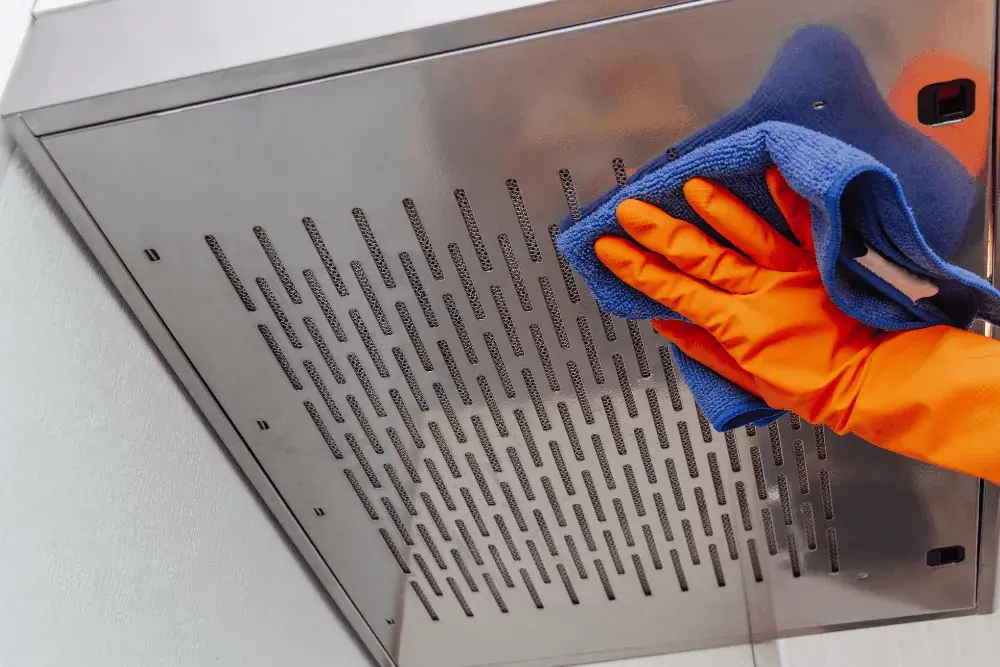
Kitchen hood cleaning and degreasing

Kitchen hood cleaning is the removal of grease from the filters, the inside of the canopy, the motor housing and the impeller. A wipe of the outside is not hood cleaning. A greasy hood interior cuts airflow and ventilation, drips back onto the hob, smells when warm and is a fire risk.

1
Protect the hob and worktop

Cover them, and switch the hood off at the isolator.

2
Remove and soak the grease filters

In hot water with a degreaser, then brush and rinse.

3
Remove the charcoal filters

On recirculating hoods, for replacement.

4
Degrease the inside of the canopy

Apply a food-area degreaser, leave it to work, and wipe out the softened grease. Light covers and the filter frame are cleaned at the same time.

5
Clean the motor housing and impeller

The housing is opened and the impeller blades are cleaned, without wetting the motor windings or the electrics.

6
Clean the backdraft flap and the first section of duct

Where grease collects most.

7
Clean the outside

Stainless steel is wiped along the grain and dried. Glass is cleaned and polished.

8
Refit, fit new charcoal filters and test

Every speed and both lights.

HouseholdClean the filtersFull interior degrease
Light cooking, little fryingMonthlyEvery 12 months
Daily cookingEvery two to four weeksEvery 6 to 12 months
Heavy frying, grilling or cooking for a large householdEvery two weeksEvery 3 to 6 months

What not to use

Caustic oven cleaner on aluminium filters. It turns them black and eats the mesh.
Abrasive pads on stainless steel or glass.
A wet cloth or spray on the motor, lamp holders or the control panel.
Chlorine bleach on stainless steel.

Kitchen duct cleaning

Kitchen duct cleaning removes the grease film from the exhaust duct between the hood and the outside. Kitchen exhaust duct is a separate job from air conditioning duct cleaning: the deposit is grease, not dust, and it needs degreasing and scraping, not brushing and vacuuming alone.

SignWhat it means
Extraction poor with clean filters and a good motorThe duct is restricted
Grease dripping from duct joints or down the chimney coverLiquid grease pooling in a low point of the duct
Stale cooking smell when the hood is offGrease in the duct, or a missing backdraft flap
Flexible duct sagging or crushed above the cabinetsGrease collects in every sag
Hood has run for years with no duct attentionA film is certain. How thick depends on the cooking
1
Inspect

The duct is opened at the hood and at any access point, and its route, length and material are checked.

2
Degrease

Accessible duct is scraped and degreased by hand. Rigid duct is cleaned through its length where access allows.

3
Replace what cannot be cleaned

Grease-soaked flexible foil duct is replaced, not cleaned. It is cheap, and it cannot be degreased properly.

4
Clean the outside vent or grille

And free its flap.

5
Reseal and test

Joints are taped or clamped, and the airflow is checked.

In apartments, the duct usually runs a short distance to a shared building riser. We clean your section up to the connection. The riser belongs to the building, and its cleaning is arranged through the building management.

For dust and mould in air conditioning ducts, see AC duct cleaning.

Grease dripping, condensation and smells

Liquid dripping from a kitchen hood is either grease or water, and the two have different causes.

What dripsCauseFix
Brown, sticky drops from the filters or the canopy edgeFilters saturated, grease pooled inside the canopyClean filters and interior
Grease from the chimney or a duct jointGrease running back down the ductDuct cleaning. Correct any sag
Clear water when boiling or steamingSteam condensing on a cold hood, often because the hood is switched on late or off earlySwitch on before cooking and leave running for ten minutes after
Water from the duct in humid weatherOutside air condensing in a cold duct, or rain entering at the ventBackdraft flap, insulated duct, weather cowl
Cooking smells from the hood when it is offGrease in the hood or duct, or air coming back down a shared shaftClean. Fit or free the backdraft flap
Smells never clear on a recirculating hoodCharcoal filter spentReplace

Buttons, touch controls and electronics

Hood controls are slider switches, push buttons, touch panels or a remote. They sit directly in the path of steam and grease, and that is what makes them fail.

SymptomCauseRepair
Push button stuck or will not latchGrease in the switch bankNew switch bank
One speed missingA contact in the speed switch burntNew switch
Touch panel responds by itself, or not at allMoisture or grease film on the glass, or a failing touch boardClean and dry. Replace the board
Hood beeps or flashes a filter symbolFilter reminder timerClean or replace the filters, then reset as the manual describes
Remote control does nothingBattery, or the receiver boardBattery. Receiver
Hood starts by itselfHeat sensor or automatic mode on models that have it, or a board faultCheck the mode. Board
Downdraft will not rise or lowerLift motor, limit switch or obstructionClear. Repair the lift mechanism

Control boards for hoods are model-specific. We identify the part from the model label and fit the correct board.

Kitchen hood installation and replacement

Kitchen hood installation covers fixing the hood at the right height, connecting it to a duct or setting it up to recirculate, and providing a safe electrical supply. We install new hoods and replace old ones, including the ducting.

PointGood practice
Height above the hobFollow the hood's manual. Typical figures are about 65 cm above an electric or induction hob and about 75 cm above a gas hob. Too low is a fire risk. Too high loses capture
WidthAt least as wide as the hob
Duct diameterMatch the hood's outlet, commonly 150 mm. Do not reduce it
Duct routeAs short and straight as possible. Each bend costs airflow
Duct materialRigid or semi-rigid smooth duct in preference to flexible foil. Flexible duct pulled taut, never sagging
Backdraft flapFitted at the hood outlet or the wall vent
Electrical supplyAn accessible isolator or socket, on a circuit of the right rating
Recirculating setupCharcoal filters fitted, outlet vents in the chimney left open

Replacing an old hood

A like-for-like replacement reuses the duct and the fixing height. A change of type, for example from a built-in hood to a chimney hood, usually means new fixings, a new chimney length and sometimes a new duct opening. Tell us the old and new models and the hob type when you book.

Adding a duct to a kitchen with none

Converting from recirculating to ducted needs a route to the outside and an opening through a wall or into a shaft. In an apartment that normally needs the building management's approval. We survey the route and tell you what is possible before any work.

Brands we repair

We repair, clean and fit filters to every make of kitchen hood sold in Dubai.

BrandNotes
FaberChimney and built-in hoods. Motor, capacitor, switch bank and filter work
Bosch, Siemens and NeffChimney, telescopic and integrated hoods. Filter saturation indicators, LED modules, control boards
ElicaDesigner and island hoods. Touch controls and LED drivers
Teka and FrankeChimney and built-in hoods
Ariston and IndesitChimney and telescopic hoods
BroanUnder-cabinet and insert hoods
IkeaBuilt-in and wall hoods, with their own filter sizes
Samsung, LG, Miele, Smeg, Whirlpool and ElectroluxChimney and built-in hoods
Primus, Baumatic and WolfChimney, canopy and professional-style hoods

For restaurant and other commercial canopies, see commercial kitchen exhaust hood repair. For bathroom and wall extractor fans, see exhaust fan repair.

What kitchen hood repair costs, and repair or replace

Most kitchen hood repairs are small. The hood is a simple appliance, and only the motor and the control board are significant parts.

JobScaleWorth doing?
Bulb, lamp holder or LED driverSmallYes
CapacitorSmallYes
Switch bank or microswitchSmallYes
Grease and charcoal filtersSmallYes
Full clean and degreaseSmall to mediumYes
Duct clean or duct replacementSmall to mediumYes
Fan motorMediumYes on a hood in good condition
Control or touch boardMediumYes on a mid-range or premium hood
Motor and board together on a budget hoodMediumCompare with a new hood
Downdraft lift mechanismMedium to largeUsually

Replace the hood when the motor and control have both failed on a basic model, when the body is corroded or the glass is broken and unavailable, or when the hood was never suited to the hob. The diagnostic visit is AED 100 plus VAT, and you have a fixed price before deciding.

Kitchen hood service at home in Dubai

Kitchen hood service is done in your kitchen. The hood stays on the wall for nearly every repair and for cleaning.

Clear the hob and the worktop beneath the hood.
Tell us the brand and model, and whether the hood is ducted or recirculating.
Tell us what works. fan, lights, some speeds.
For cleaning, tell us roughly when it was last done.

A repair takes 30 minutes to an hour. A full clean takes one to two hours, longer with duct work.

We cover all of Dubai, including Dubai Marina, JBR, Palm Jumeirah, JLT, Downtown, Business Bay, Jumeirah, Al Barsha, Dubai Hills and Deira.

Looking after a kitchen hood

A hood that is used properly and kept clean rarely needs a repair.

Switch the hood on a few minutes before you start cooking, and leave it running for ten minutes afterwards.
Use a lower speed for simmering and the highest for frying and searing.
Wash the grease filters every two to four weeks.
Replace charcoal filters every three to six months.
Wipe the underside of the canopy weekly, before grease hardens.
Never flambe under a hood, and never leave hot oil unattended beneath one.
Have the interior degreased and the duct checked once a year.

Frequently asked questions

Who repairs kitchen hoods in Dubai?

One Click Dubai repairs, cleans and installs kitchen hoods at home across Dubai, the same day. Call or WhatsApp +971 55 209 9785.

Why is my kitchen hood not working?

No power, a failed motor capacitor, a seized or burnt-out motor, a failed switch or a failed control board. Lights with no fan points to the motor side.

Why is my hood not sucking?

Clogged grease filters, a spent charcoal filter, a blocked or crushed duct or a stuck backdraft flap. The motor is rarely the cause.

How often should grease filters be cleaned?

Every two to four weeks with daily cooking.

How often should charcoal filters be replaced?

About every three to six months. They cannot be washed.

How often should a kitchen hood be cleaned inside?

Every 6 to 12 months in a home, and every 3 to 6 months with heavy frying.

Do you clean kitchen exhaust ducts?

Yes. We degrease the duct from the hood to the outside vent or the building riser connection.

Can a hood motor be replaced?

Yes, in about an hour on most hoods.

Do you install kitchen hoods?

Yes, including ducting and replacement of old hoods.

Do you supply filters?

Yes, grease and charcoal filters for the common brands.

How much does kitchen hood repair cost?

The diagnostic visit is AED 100 plus VAT. The repair or cleaning is quoted at a fixed price before work starts.

Is the repair guaranteed?

Yes, for one month on parts and labour.

Book a kitchen hood repair or cleaning

Call or WhatsApp +971 55 209 9785 at any hour, or use the booking form. Send the model label from behind the filters and tell us whether you need a repair, a clean, filters or an installation.

CallWhatsApp