Overview
One Click Dubai repairs, cleans and installs commercial kitchen exhaust systems for restaurants, cafes, hotels, cloud kitchens, catering units and staff canteens across Dubai. A technician is sent the same day, and within the hour when a kitchen cannot cook because its extraction has stopped.
A commercial kitchen hood is one visible part of a system: canopy, grease filters, duct, exhaust fan, often an ecology unit, a fresh air supply and a fire suppression system. A fault in any one shows up at the canopy as smoke, heat or dripping grease. This page explains how the system works, what fails, how it is cleaned and how often, and what installation and a maintenance contract involve.
We work on all of it, in restaurant and industrial kitchens alike: extractor fan motors and belts, cooker hood canopies and ducts, ecology units, fire suppression and new installations.
Commercial kitchen hood repair in Dubai: the short answers
Commercial kitchen hood repair in Dubai from One Click Dubai starts with a AED 100 diagnostic visit, plus VAT. The technician checks the exhaust fan, its motor, belt and bearings, the electrical supply and controls, the filters, the duct and the fresh air supply, and gives a fixed price before any work.
Extraction down during service: the first ten minutes
When a restaurant exhaust hood stops pulling, the kitchen fills with smoke and heat within minutes. These steps protect staff and equipment and give the technician what he needs to bring.
Charbroilers, fryers and woks first. Do not cook under a dead hood.
Is the exhaust fan running? Silent, humming, or running normally with no pull are three different faults.
Look for a tripped overload, a tripped breaker, a fault light on a speed controller or an emergency stop that has been pressed.
Reset a tripped overload or breaker one time. If it trips again, leave it off.
Filters matted with grease can cut the airflow to nothing while the fan runs perfectly.
If the supply fan has stopped, the kitchen goes into strong negative pressure and the hood stops capturing.
Fan silent, fan humming, fan running, breaker tripped. Each points to a different part.
If the fire suppression system has discharged, the gas and power to the cooking line will have shut off with it. Do not reset anything. The system must be recharged and recommissioned before the line is used.
How a commercial kitchen exhaust system works
A commercial kitchen exhaust system captures hot, greasy air at the canopy, strips out most of the grease at the filters, carries the rest through a sealed duct, cleans it in an ecology unit where one is required, and discharges it outside, while a second fan brings in fresh air to replace what was removed.
Because the parts depend on each other, the visible symptom is rarely next to the cause. Smoke rolling out of a canopy can be a slipping belt on the roof, a blocked ecology unit in the plant room or a supply fan that someone switched off because of a draught.
Exhaust fan repair: motor, belt and bearings
Commercial kitchen exhaust fan repair is the most common call, because the fan runs for every hour the kitchen is open, in heat and grease. Most failures are mechanical and are found by looking and listening.
Motor replacement
A commercial kitchen exhaust fan motor replacement matches the old motor's power, speed, frame size, mounting and enclosure. The pulleys are checked for wear and aligned, a new belt is fitted, and the running current is measured against the motor's rated figure before the fan is left in service.
Direct-drive fans
Inline and smaller hood fans are often direct drive, with the impeller on the motor shaft. There is no belt to slip, and the motor sits in the airstream, so grease reaches it sooner. These are cleaned at every service.
Troubleshooting weak extraction with the fan running
A commercial hood not extracting, with the fan running, has a restriction or a balance problem. Work from the canopy outward.
Negative pressure and make-up air
A kitchen exhaust fan can only remove as much air as can get into the room. If the fresh air supply is missing or stopped, the kitchen is pulled into a strong negative pressure and the hood loses its grip on the smoke, however large the fan.
The fix is a working supply fan delivering slightly less air than the exhaust removes, so the kitchen stays just negative and smells do not escape to the dining room. We check the supply fan, its filters, belts and dampers, and the interlock that should start it with the exhaust fan.
Baffle filters
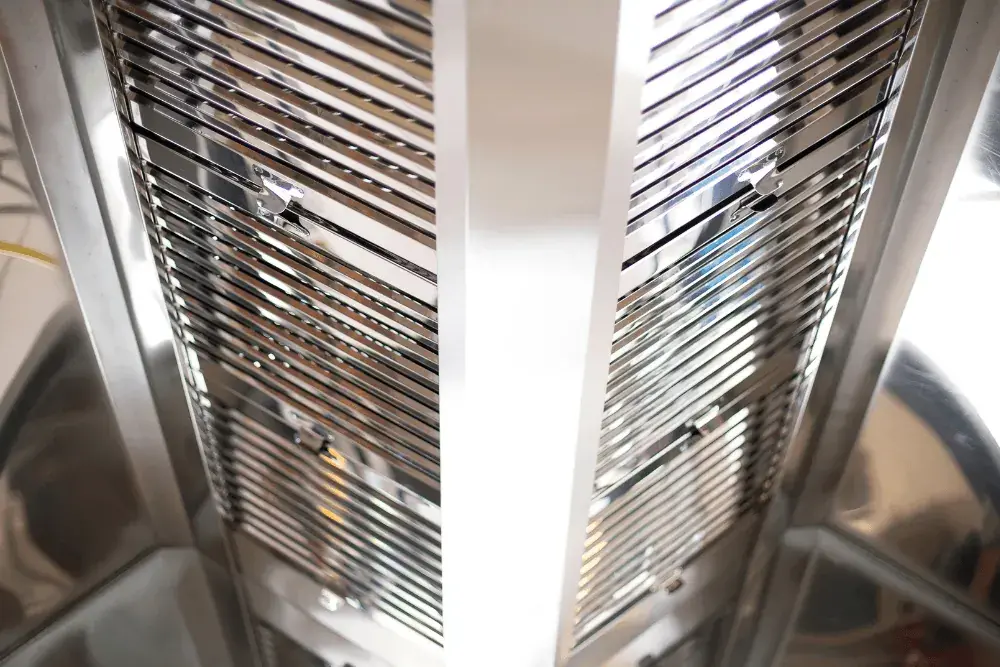
Baffle filters are the stainless steel or aluminium panels in the canopy. They force the air to change direction sharply so that grease is thrown out and drains to a collection channel, and they act as a barrier that stops flame from the cooking line reaching the duct.
We supply replacement commercial hood filters.
Hood, duct and fan cleaning
Commercial kitchen hood cleaning is the degreasing of the whole exhaust path: canopy, filters, plenum behind the filters, duct, fan and discharge. Cleaning only what can be seen from the floor leaves the fuel for a duct fire in place.
The cooking line is covered and the system is isolated. Access panels along the duct are located.
Removed and degreased.
Degreaser is applied, grease is scraped and the surfaces are washed down to bare metal, with the wash water collected.
Each section is reached through its access panels and scraped and degreased. Where there is no access, panels are added.
The housing is opened and the impeller and casing are cleaned. Belt, bearings and mounts are checked while it is open.
Pre-filters are changed, cells are washed and carbon is checked, where a unit is fitted.
Panels are resealed, filters refitted and the fan is run.
The date, the areas cleaned and the findings are written up for your file.
How often
Cleaning frequency follows the cooking, not the calendar. The schedule in the NFPA 96 standard, which is widely used as the reference for commercial kitchen exhaust, sets the pattern.
Your landlord, insurer or the authorities may set a shorter interval. Follow the strictest that applies to you.
Ecology unit maintenance
An ecology unit is the filtration plant between the kitchen and the discharge point. It removes grease, smoke and odour in stages so that the exhaust can be released near neighbours or at low level. It only works when every stage is clean, and a neglected unit is a common cause of poor extraction.
Fire suppression systems
A kitchen hood fire suppression system is a wet chemical system fixed inside the canopy. Detectors above the cooking line release the agent through nozzles aimed at each appliance, into the plenum and into the duct, and the system shuts off gas and power to the line at the same moment. A manual pull station allows staff to trigger it.
We install and service hood fire suppression systems. Fire systems in Dubai fall under Dubai Civil Defence, and the system and its service records must meet its requirements.
Grease leaks, noise and vibration
Grease dripping from a duct and a fan that has become loud are both early warnings, and both are cheaper to deal with early.
Grease on a roof is slippery, damages the roof membrane and is a fire path. A fan that sheds grease onto the roof needs a drain and a catcher, and the roof needs cleaning.
Lights, switches and controls
Hood lights and controls work in heat, steam and grease. Faults are frequent and usually simple.
An interlock that stops the gas when the fan is off is a safety device. If it is preventing cooking, the fault needs fixing. Bridging it out leaves a kitchen that can run gas appliances with no extraction.
Commercial hood installation
Commercial kitchen hood installation is the design and fitting of a canopy, duct, fan and fresh air supply matched to the cooking equipment beneath. We install complete systems, and we replace or extend parts of existing ones.
What decides the cost
The cost of a commercial hood installation is driven by five things: the length of the canopy, the length and route of the duct, whether an ecology unit is needed, the fire suppression system, and the fire-rated work where the duct crosses floors and walls. Two kitchens with the same hood can differ several times over in price because of the duct route alone. We quote after a site survey.
Food trucks and kiosks
Small hoods for food trucks and kiosks follow the same principles in less space: baffle filters, a short sealed duct, a compact fan and a suppression system sized for the appliances.
What inspectors and landlords look for
Kitchen exhaust is checked by food safety inspectors, by Civil Defence, by landlords and by insurers. They look at the same handful of things.
We provide a written record after each service visit for your file.
Maintenance contracts
A maintenance contract for a commercial kitchen exhaust system puts the cleaning, the fan service and the checks on a schedule, so that faults are found at a planned visit and not during service. Our contracts provide 9 to 10 visits a year.
The tasks carried out at each visit are set out in the contract to suit the cooking and the system.
Cost, downtime and repair or replace
Most commercial hood repairs are fan parts and are done in one visit. The larger cost of a breakdown is the service you lose while the line is off.
The diagnostic visit is AED 100 plus VAT, with a fixed price given before work starts. Tell us your service hours and we will schedule cleaning and planned work outside them.
For other kitchen equipment, see commercial ice machine repair. For home hoods, see kitchen hood repair, and for general ventilation fans, exhaust fan repair.
We cover all of Dubai, including Dubai Marina, JBR, Palm Jumeirah, JLT, Downtown, Business Bay, Jumeirah, Al Barsha, Dubai Hills and Deira.
Frequently asked questions
Who repairs commercial kitchen hoods in Dubai?
One Click Dubai repairs, cleans and installs commercial kitchen exhaust systems across Dubai, the same day and within the hour in an emergency. Call or WhatsApp +971 55 209 9785.
Why has my restaurant exhaust fan stopped?
A tripped overload, a broken belt, seized bearings, a failed motor or a control fault. Reset once only.
Why is the hood not pulling smoke when the fan is running?
Clogged filters, grease in the duct, a blocked ecology unit, a slipping belt or no fresh air supply.
How often should a commercial kitchen hood be cleaned?
Monthly for solid fuel, every three months for high-volume cooking, every six months for moderate use and yearly for low use, or sooner if your landlord or the authorities require it.
Do you clean kitchen exhaust ducts?
Yes, through access panels along the full length, and the fan as well.
Do you service ecology units?
Yes: pre-filters, electrostatic cells, carbon filters and the fan.
Do you install and service fire suppression systems?
Yes.
Do you install commercial hoods?
Yes, including ducting, fans, fresh air supply and controls.
How much does commercial hood installation cost?
It depends on the canopy length, the duct route, the ecology unit and the fire suppression system. We quote after a site survey.
Do you offer maintenance contracts?
Yes, with 9 to 10 visits a year.
How much does a repair cost?
The diagnostic visit is AED 100 plus VAT. The repair is quoted at a fixed price once the fault is found.
Is the repair guaranteed?
Yes, for one month on parts and labour.
Book a commercial hood repair, clean or survey
Call or WhatsApp +971 55 209 9785 at any hour, or use the booking form. Tell us what the fan is doing, what you cook, when the system was last cleaned and your service hours.