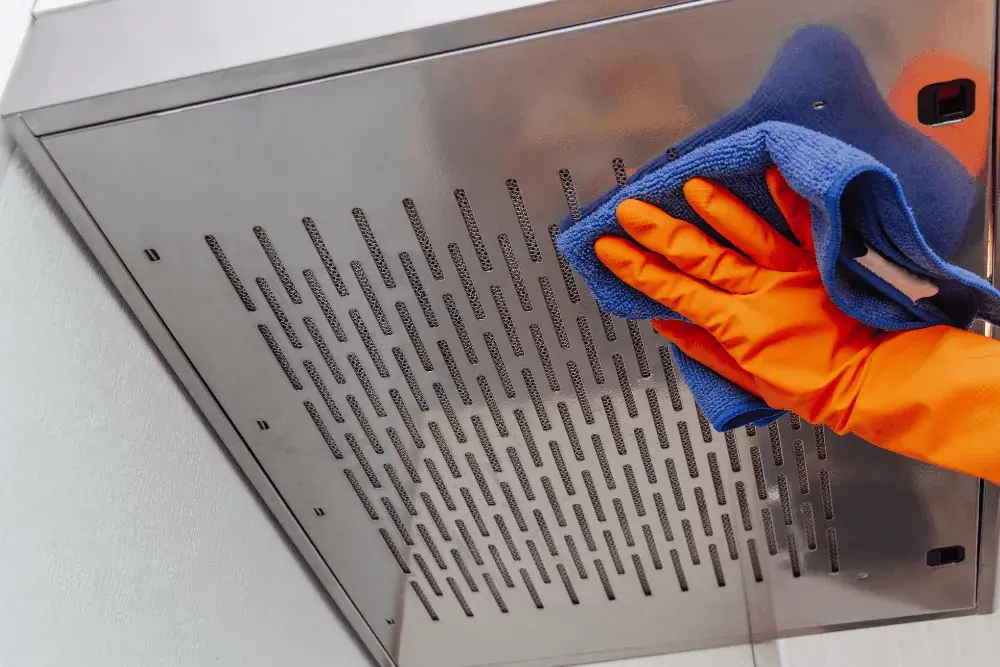
A range hood that runs and does not extract is choked, not broken. The fan is turning, and the air cannot get through the filters or out through the duct. In order of likelihood: the grease filters are clogged, the charcoal filter is spent, the duct is blocked, crushed, disconnected or badly run, a backdraft flap is stuck, or no replacement air can get into the kitchen. A weak motor comes well down the list.
This guide gives two simple tests that tell you where the restriction is, then takes each cause in turn. It also explains the difference between a hood that extracts to outside and one that recirculates, because they fail differently and are often confused, and it covers the cases where the hood never worked well because of how it was chosen or fitted. If your fan does not run at all, see kitchen hood or extractor fan not working. For a repair or a clean, see kitchen hood repair in Dubai.
OrderCauseClueWho fixes it
1Grease filters cloggedYou cannot see light through the mesh. Fan sounds strainedYou
2Charcoal filter saturatedRecirculating hood. Smells linger. Filter over six months oldYou
3Charcoal filter fitted in a ducted hoodLeft in from the factory or a previous setupYou
4Backdraft flap stuckLoud fan, almost no air leavingYou, if reachable
5Duct blocked, crushed or disconnectedExtraction poor with the filters out as wellA clean or a repair
6Duct too long, too narrow or too bendyNever worked well, even when newRe-run the duct
7No air entering the kitchenImproves when a window or door is openedYou
8Hood too high, too small, or defeated by a draughtSteam escapes round the edgesReposition or replace
9Fan running slowDull, low fan note. Weak on every speedCapacitor or motor
10Wrong speed, or switched on too lateWorks when used differentlyYou
11Building exhaust shaft not pulling, in apartmentsSeveral flats affected. Smells come back down the ductBuilding management
Do the two tests in the next section before anything else. They take five minutes and split this list in half.
A hood either sends air outside through a duct or cleans it and returns it to the room. You need to know which, because the remedies are different.
Ducted (extraction)Recirculating
Where the air goesThrough a duct to an outside wall, a roof or a building shaftThrough a charcoal filter and back into the kitchen from vents at the top or front of the hood
RemovesSmoke, steam, heat, grease and smellsGrease and most smells. Not steam or heat
FiltersGrease filter onlyGrease filter and charcoal filter
How to recognise itA duct leaves the top of the hood, inside the chimney or the cabinet. Air blows out at an outside grille when the fan runsNo duct. With the fan on, you can feel air blowing from slots in the chimney or the top of the hood
Weak suction usually meansBlocked filters, a stuck flap or a duct problemBlocked grease filters or a spent charcoal filter
Its limitsDepends on the ductWill always leave steam and heat in the room. That is how it works
2
Hold a strip of tissue at the top of the hood and round the chimneyIf air is blowing out into the room, the hood recirculates.
3
Look inside the chimney cover or the cabinet aboveA duct going into the wall or ceiling means it is ducted.
4
If there is a duct and air also blows from the chimney ventsThe duct has come off, or the hood is set up half and half. Check the connection.
Many Dubai apartments have recirculating hoods, or hoods connected to a shared building shaft. If yours recirculates and your complaint is steam and heat staying in the kitchen, nothing is wrong with it. It cannot remove them.
1
Switch the fan to its highest speed
2
Hold a single sheet of kitchen paper or tissue flat under the grease filtersA few centimetres below.
ResultMeaning
The sheet is pulled up and held firmly against the filterAirflow at the hood is good. The problem is capture: height, size, draughts or how the hood is used
The sheet lifts and flutters, or holds weaklyAirflow is reduced
The sheet dropsAirflow is poor
1
Switch off at the isolator and remove the grease filtersAnd the charcoal filters, if fitted.
2
Switch on, highest speedKeep fingers and the paper away from the fan.
3
Hold the sheet at the opening, well clear of the fan
Filters inFilters outConclusion
WeakStrongThe filters were the restriction. Clean or replace them
WeakWeakThe restriction is beyond the filters: flap, duct or outside vent. Or the fan is slow
StrongStrongAirflow is fine. Look at capture and use
Weak, on a recirculating hoodStrong with only the charcoal filter outCharcoal filter spent
If you can reach the outside grille safely, feel the airflow there with the fan on high. Strong at the hood and weak outside means a leak or a disconnected duct. Weak at both, with the filters out, means a blockage or a slow fan.
Do not run the hood for long with its grease filters removed. They are what keeps grease out of the motor and the duct.
The grease filter is the metal panel on the underside of the hood. Its layers of mesh or its baffles catch grease droplets. As they load up, the gaps close and the airflow falls, gradually enough that you do not notice until smoke hangs in the kitchen.
1
Switch off and release the filtersThey have a spring catch, a sliding latch or a simple lift-and-tilt fit.
2
Hold one up to a window or a lightClean mesh lets light through evenly. A blocked one is dark and heavy.
3
Soak in very hot water with washing-up liquid or a degreaserFor 15 to 30 minutes. A sink or a deep tray.
4
Brush both sides with a soft brushAlong the mesh, not across it hard.
5
Rinse with hot water until it runs clear
6
Or use the dishwasher, if the maker allows itOn a hot programme, standing upright, by themselves. Aluminium filters may dull or darken. That does not affect how they work.
7
Dry completely before refittingShake off, stand on edge, and leave for an hour or more.
Filter typeWash?Replace when
Aluminium mesh, several layersYes, every two to four weeksMesh torn, crushed, coming apart, or still blocked after a proper wash
Stainless steel baffleYes, every two to four weeksRarely
Fleece, paper or synthetic padNoEvery one to two months, or when the printed pattern shows through
Grease filter with a saturation indicatorAs its typeThe indicator is a guide
Do not use caustic oven cleaner or soda crystals on aluminium filters. They attack the metal.
A filter that has gone years without a wash may not recover. Replace it.
With daily frying, wash fortnightly. The interval on the hood's indicator assumes average use.
This is the most common fix. If the tissue test improved sharply with the filters out, you need go no further.
Recirculating hoods have a second filter of activated charcoal behind or above the grease filter. It adsorbs cooking smells, and once its pores are full it does two bad things at once: it stops removing smells, and it restricts the air.
PointDetail
Where it isRound cartridges clipped to each side of the motor housing, or a flat panel behind the grease filters
LifeTypically three to six months with daily cooking. Less with a lot of frying
Can it be washed?No. Washing ruins standard charcoal filters
Regenerable typesSome long-life filters can be refreshed in the oven at the temperature and time the maker gives, a limited number of times
How to tell it is spentSmells linger. The filter feels heavy or greasy. Airflow improves when it is removed
Buying a new oneBy the hood's model number. Shapes and fixings differ widely
Hoods are often supplied with charcoal filters fitted or in the box, so that they can be installed either way. If the hood is ducted to outside, the charcoal filters do nothing useful and cut the airflow considerably. Check behind the grease filters. If you find charcoal filters and the hood has a working duct, take them out.
A charcoal filter that clogs within weeks is being fed grease by a dirty or damaged grease filter. Sort that out first, or the new one goes the same way.
Where the duct joins the hood, and often again at the outside wall, there is a light flap that opens with the airflow and closes when the fan stops. It keeps outside air, insects and smells from a shared shaft out of the kitchen. It is a common and overlooked cause of a hood that roars and moves nothing.
FaultSignFix
Flap glued shut by greaseVery little airflow even with filters out. Fan noise highFree and degrease it
Flap fitted the wrong way round or upside downA new or recently refitted hood that never workedRefit
Transit tape left on the flapA new installationRemove it
Duct pushed too far onto the spigot, blocking the flapFlap cannot swingReposition the duct
Flap missing or stuck openSmells and warm air come in when the hood is off. Not a suction faultFit or free it
Outside louvres or cowl jammedPainted shut, clogged with fluff and grease, or a bird's nestClear
On most chimney hoods the flap is in the outlet collar on top of the motor housing, reached by removing the chimney cover. Switch off at the isolator first. If you cannot reach it comfortably, leave it for a technician.
If airflow is poor with the filters out and the flap free, the duct is the restriction. Ducting is where most permanently disappointing hoods go wrong, because a fan's rated airflow is measured with no duct at all, and every metre and every bend takes some of it away.
Duct faultHow it happensEffectFix
Flexible duct crushed or kinkedSqueezed behind a cabinet or bent sharply to reach the wallSevere lossRe-route with gentle curves, or replace
Flexible duct sagging in loopsToo long and unsupportedGrease and condensation pool in the sagsShorten, pull taut, support
DisconnectedDuct slipped off the hood spigot or the wall outletAir blows into the chimney or the ceiling voidReconnect and clamp
Grease build-upYears of useBore narrowed, fire riskDegrease or replace
Reduced diameterA 150 mm outlet joined to 100 or 125 mm duct with a reducerLarge loss and more noiseDuct of the full outlet size
Too many bendsEach 90 degree bend costs roughly as much as a metre or more of straight ductCumulative lossFewer, gentler bends
Too longA small hood pushing through many metresLittle air arrivesShorter route, or a more powerful or external motor
Rough flexible duct throughoutRibbed walls create dragModerate lossRigid or semi-rigid smooth duct
Blocked at the outsideGrille clogged, flap stuck, nestSevere lossClear
The same diameter as the hood's outlet, all the way.
As short and straight as the kitchen allows.
Smooth-walled, rigid or semi-rigid, with flexible duct used only for short connections and pulled tight.
No more than two or three bends, and wide ones where possible.
Sealed and clamped at every joint.
Falling slightly toward the outside, so condensation does not run back into the hood.
Ending in a grille or cowl with a free-moving flap.
Kitchen duct cleaning and re-running are jobs we do. See kitchen hood repair.
A hood can only take out as much air as can get into the kitchen. In a tightly closed, air-conditioned kitchen with the door shut and the windows sealed, a ducted hood pulls against a partial vacuum and its airflow collapses.
Open a window or the kitchen door a little and repeat the tissue test. If the pull improves noticeably, the room was starved of air.
You may notice the kitchen door being pulled shut, or whistling at gaps, with the hood on high.
The effect is strongest with powerful hoods and small, sealed kitchens.
A gap under the kitchen door, a door grille, or a window on the latch while cooking is the remedy.
With a gas hob, replacement air matters for safe combustion as well as for extraction.
Recirculating hoods are not affected, since they return the air they take.
The replacement air should come from across the room, not from a window right beside the hob, which sets up a draught across the pans and blows the steam out from under the hood.
Cause 6: capture, height and size
If the tissue test shows strong airflow and the kitchen still fills with steam, the hood is moving air and not catching the plume. That is about geometry.
ProblemEffectWhat can be done
Hood mounted too highThe plume spreads before it reaches the hood, and room air is drawn in insteadLower it to the height in the manual. Typical figures are about 65 cm above an electric or induction hob and about 75 cm above gas
Hood narrower than the hobSteam from the outer burners missesA hood at least as wide as the hob. Use the back burners for steamy cooking
Shallow built-in or telescopic hoodFront burners are outside its reachPull the slide fully out. Cook on the back burners
Cross-draughtAn AC vent, a ceiling fan, an open window or a doorway blowing across the hobRedirect the vent. Close the window nearest the hob
Tall pots or a wok flamePlume rises fast and wideHighest speed, started early
Island hoodNo wall behind to guide the plume, so draughts have more effectNeeds more airflow than a wall hood for the same hob
Downdraft extractorPulls steam sideways and down, against its natural riseWorks best with low pans near the vent. Limited with tall pots
A hood mounted too high is a common installation fault. Too low is a hazard over a gas hob. The maker gives a minimum and usually a maximum for each model.
A surprising amount of weak extraction is timing and speed.
Switch the hood on a few minutes before you start cooking. It takes time to set up a flow of air toward the hood.
Use the highest speed for frying, searing, wok cooking and boiling large pots, and step down for simmering.
Leave it running for ten minutes after you finish. Many hoods have a run-on timer for this.
Put lids on boiling pans.
Cook on the back burners when you can.
Do not rely on the boost setting alone. On many hoods it switches itself back to a lower speed after a few minutes.
Keep the kitchen door mostly closed and a little replacement air coming in, so smells are drawn to the hood and not through the home.
If the hood clears the air when used this way and not otherwise, there is no fault.
When the filters are clean, the flap is free, the duct is clear and the airflow is still weak with the filters out, the fan itself is underperforming.
SignLikely cause
Fan note lower and duller than it used to beRunning slow: weak capacitor or stiff bearings
Slow to get up to speedCapacitor
Rumble, rattle or vibrationBearings, or the impeller out of balance with grease
Impeller blades cakedGrease that got past the filters. Airflow falls sharply as the blades fill in
Little difference between speedsSpeed switch or control, or a motor that cannot reach high speed
Twin-motor hood, one side weakOne motor or its capacitor failed
Fan running backwards after a repairWrong motor or wiring. A drum fan running backwards still moves some air, much less
Cuts out when hotOverheating
An impeller thick with grease moves far less air, even with a healthy motor. Cleaning it means opening the motor housing, which is a technician's job. So are the capacitor and the motor. See kitchen hood or extractor fan not working for those faults.
Apartments and shared exhaust shafts
In many towers, each kitchen hood connects by a short duct to a vertical shaft shared by all the flats above and below, with a large fan on the roof pulling air up it. Your hood depends on that system.
SymptomLikely situation
Poor extraction in several flats at onceThe roof fan is off or has failed
Cooking smells from other flats arrive through your hoodYour backdraft flap is missing or stuck open, or the shaft is under positive pressure
Hood works better at some times of dayShaft pressure changing with how many flats are cooking
Air comes out of your hood when it is offBackflow from the shaft
Extraction fine at the hood, smells in the corridorA leak at your connection to the shaft
Your responsibility normally runs to the point where your duct joins the shaft. The shaft and roof fan belong to the building.
Make sure your own flap works and your duct is sealed to the shaft connection.
Report shaft problems to the building management, and mention if neighbours are affected.
Do not fit a much more powerful hood to overcome a weak shaft. It can push your cooking smells into other flats.
Some hoods have been underpowered since the day they were fitted. Two figures tell you.
A hood's extraction rate is given in cubic metres per hour on its specification sheet. A common rule of thumb is that it should be able to change the air in the kitchen about ten times an hour. Multiply the kitchen's length, width and height in metres to get its volume, and multiply by ten.
KitchenVolumeRule-of-thumb extraction rate
3 m x 3 m x 2.7 mAbout 24 m3About 240 m3 per hour
4 m x 3.5 m x 2.8 mAbout 39 m3About 390 m3 per hour
Open-plan kitchen and living area, 8 m x 5 m x 2.8 m112 m3About 1,100 m3 per hour
That figure is what should arrive at the outside, not the number on the box. Allow a generous margin for duct losses.
Gas hobs, wok cooking and frequent frying need more.
Open-plan kitchens need a great deal more, because the hood is working on the whole room.
Recirculating mode typically delivers noticeably less than the same hood ducted, because of the charcoal filter.
A hood that is too loud on its effective speed does not get used on that speed. If yours clears the air only on a setting nobody will tolerate, the practical answer is better ducting, which lowers noise and raises airflow together, or a hood with a larger, slower fan.
Condensation, dripping and smells
SymptomCauseFix
Water dripping from the hood when boilingSteam condensing on a cold hood, usually because it was switched on lateSwitch on early, run on after. Wipe dry
Water running back down the ductCondensation in a long or cold duct with no fall to outsideRe-run with a fall. Insulate
Brown dripsGrease from saturated filters or a greasy canopyClean filters and interior
Smell from the hood when it is offGrease in the hood and duct, or backflow from a shaftClean. Check the flap
Smells stay after cooking, recirculating hoodCharcoal filter spentReplace
Greasy film on cabinets round the hoodGrease escaping capture, or a hood run without filtersFilters. Capture. Use
Do not run the hood without its grease filters to get more airflow.
Do not wash a charcoal filter.
Do not reduce the duct to a smaller size to make fitting easier.
Do not vent a hood into a ceiling void, a cupboard or a loft.
Do not block the recirculation vents on a recirculating hood.
Do not mount a hood lower than the maker's minimum to improve capture.
Do not open the motor housing with the isolator on.
Do not fit a far more powerful hood on a shared shaft without asking the building management.
Airflow is weak with the filters out and the flap free.
You cannot reach the flap or the duct.
The duct is crushed, disconnected, sagging or thick with grease.
The fan sounds slow, rough or strained with clean filters.
The impeller is caked with grease.
The hood has never extracted well, and you want the duct or the installation assessed.
You want to convert from recirculating to ducted, or the reverse.
Grease or water is dripping from the hood or the duct.
Our diagnostic visit is AED 100 plus VAT, with a fixed price before any work. Tell us whether the hood is ducted or recirculating and what the tissue test showed with the filters in and out. We clean hoods and ducts, re-run ducting and replace motors. See kitchen hood repair in Dubai.
A maintenance routine
WhenTask
Every time you cookOn early, right speed, run on for ten minutes
WeeklyWipe the underside and the controls
Every two to four weeksWash metal grease filters
Every one to two monthsReplace disposable grease pads
Every three to six monthsReplace charcoal filters on recirculating hoods
YearlyHave the hood interior, fan and flap degreased, and the duct and outside grille checked
After any kitchen workCheck the duct has not been crushed or disconnected
Why is my range hood not extracting?
+
The grease filters are clogged, the charcoal filter is spent, the backdraft flap is stuck or the duct is blocked, crushed or disconnected. A closed-up kitchen with no incoming air and a hood fitted too high are the other common reasons.
How do I test my cooker hood's suction?
+
With the fan on high, hold a sheet of kitchen paper under the filters. It should be pulled up and held. Repeat with the filters out to see whether they are the restriction.
Why is my extractor fan running and not removing steam?
+
If it recirculates, it cannot remove steam at all. If it is ducted, the filters, flap or duct are restricting it, or the steam is escaping round a hood that is too high or too small.
How often should I clean the grease filters?
+
Every two to four weeks with daily cooking.
Can I wash a charcoal filter?
+
No. Standard charcoal filters are replaced every three to six months. Only filters sold as regenerable can be refreshed, in the oven, as the maker describes.
Why is my cooker hood blowing air out instead of sucking?
+
It is a recirculating hood returning cleaned air through its vents, or its duct has come off.
Does the length of the duct matter?
+
Yes. Every metre and every bend reduces airflow. A short, straight, smooth duct of the full outlet diameter makes the biggest difference.
Why does the hood work better with a window open?
+
The kitchen was short of replacement air. A ducted hood cannot remove air that is not being replaced.
How high should a hood be above the hob?
+
Follow the manual. Typical figures are about 65 cm above electric or induction and about 75 cm above gas.
How powerful should my hood be?
+
A common rule is ten air changes an hour: kitchen volume in cubic metres times ten, with a margin for duct losses.
Is weak suction a motor fault?
+
Rarely. It is the last thing to suspect, after filters, flap, duct and air supply.
Who cleans and repairs kitchen hoods in Dubai?
+
One Click Dubai sends a technician the same day. Call or WhatsApp +971 55 209 9785.
Filters clean and still no pull?A technician can find the cause on site. The diagnostic is AED 100 plus VAT, and repairs carry a 1-month warranty.