Overview
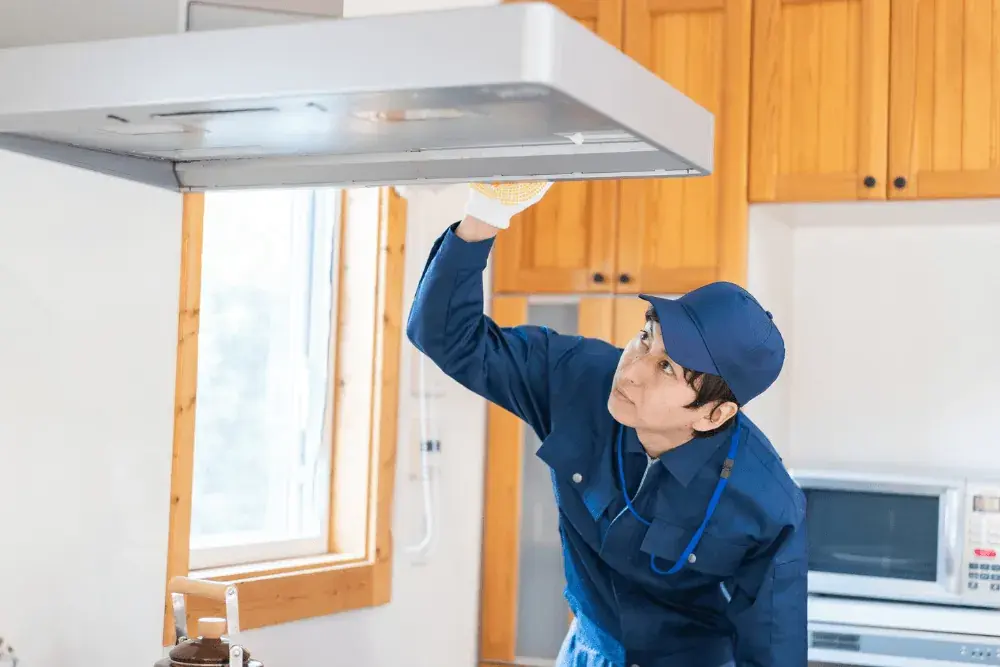
One Click Dubai repairs, replaces and installs exhaust fans across Dubai, with a technician sent the same day. We work on bathroom and toilet extractor fans, kitchen wall and window fans, ceiling and inline duct fans, villa roof fans and commercial and industrial exhaust fans, including the wiring and ducting.
An exhaust fan is a simple machine, and it fails in simple ways: the motor wears out, dust and grease clog it, the duct behind it is blocked or was never connected, or the switch that feeds it has failed. This page helps you tell which, explains when a fan is worth repairing and when a new one is the better buy, and sets out what a proper installation involves.
Exhaust fan repair in Dubai: the short answers
Exhaust fan repair in Dubai from One Click Dubai starts with a AED 100 diagnostic visit, plus VAT. The technician tests the supply, the switch, the motor and capacitor, checks the duct and the outside grille, and gives a fixed price to repair or replace before any work.
Types of exhaust fan and where each is used
An exhaust fan is chosen by where it sits and how far it has to push the air. The type decides what can go wrong and how it is repaired.
Most Dubai apartments have small ceiling fans in each bathroom ducted to a common building shaft. Villas more often have wall or window fans and a fan in the kitchen wall.
Exhaust fan not working: troubleshooting
An exhaust fan not working is either getting no power or has a failed motor. A fan that stopped working suddenly points to the supply or the capacitor. One that grew slow and noisy first has a worn motor.
Checks you can make
Do not open a fan's wiring with the circuit live, and do not work on a bathroom fan from a wet floor. Our guide to a kitchen hood or extractor fan not working covers the kitchen case.
Noisy exhaust fan
An exhaust fan making noise has worn bearings, something touching the blades, a loose mounting or a duct fault. A fan gets louder for a reason, and that reason nearly always ends in a stopped fan.
Cleaning cures more noisy fans than any part does. A layer of dust on the blades puts them out of balance, and the vibration then wears the bearings.
Fan runs but does not extract
An exhaust fan that runs and moves no air has a problem behind it. The fan is rarely at fault. The duct is blocked, disconnected or too long, a flap is stuck, or no air can get into the room to replace what the fan removes.
In apartment bathrooms the commonest finding is a fan whose flexible duct has come off above the false ceiling, so that it blows damp air into the ceiling void. The room never clears, and mould grows above the tiles.
Exhaust fan motor repair and replacement
Exhaust fan motor repair is worthwhile on larger fans and seldom on small ones. A small bathroom fan is built as a unit, and a complete new fan often costs less than a motor fitted to an old housing. On wall, roof and commercial fans, the motor, capacitor and bearings are all serviceable parts.
What a motor replacement involves
At the breaker, and tested at the fan.
Voltage, power, speed, shaft size, rotation and mounting.
Cleaned and checked for cracks.
With the motor, not the old one.
Against the motor's rated figure.
A new motor on a blocked duct will overheat like the last one.
On belt-driven roof and attic fans, the belt is replaced and the pulleys aligned at the same time.
Bathroom exhaust fans: damp, mould and smells
A bathroom exhaust fan exists to remove moisture before it condenses. In an air-conditioned Dubai home, a bathroom that stays damp grows mould on the ceiling, the grout and inside the false ceiling within weeks.
Run-on timers and humidity fans
A run-on timer keeps the fan going for a set time after the light is switched off, which is when most of the moisture is still in the air. A humidity-sensing fan starts and stops by itself. Either is a better answer to a damp bathroom than a bigger fan on the same switch.
Safety in bathrooms
Fans fitted within reach of a shower or bath must be rated for that position, with the right protection against water, and the circuit should be protected by a residual current device. We fit fans to suit the location.
Kitchen exhaust fans
A kitchen wall or window exhaust fan handles grease as well as steam, and grease is what stops it. The blades and motor become coated, the shutters stick, and the fan slows until the motor overheats.
For chimney hoods and built-in extractors, see kitchen hood repair, and for weak extraction over the hob see our guide to a range hood not extracting. For restaurant systems, see commercial kitchen exhaust hood repair.
Fans with lights and heaters
A bathroom fan and light combo, or a combined fan, heater and light unit, has separate circuits for each function inside one housing. One can fail while the others work.
Use lamps of the type and wattage marked inside the unit. Replacing the light in a sealed LED fan usually means replacing the LED module, which is ordered by the fan's model number.
Installing a new exhaust fan
Exhaust fan installation is four jobs: choosing a fan of the right capacity, making the opening, running a duct to outside air, and wiring it safely. We do all four, including cutting ceilings, walls and glass panels where needed.
Sizing
Fan capacity is the volume of air moved per hour. Multiply the room's volume in cubic metres by the number of air changes wanted per hour. Commonly used figures are about 8 to 10 changes an hour for a bathroom and 15 or more for a kitchen.
Fans sold with a rating in CFM use cubic feet per minute: 1 CFM is about 1.7 cubic metres per hour, so a 50 CFM fan moves about 85. Those are free-air figures. Every metre of duct and every bend reduces what the fan delivers, so a fan on a long duct needs a margin, or a centrifugal or inline type that holds its airflow against resistance.
The opening and the duct
Wiring
Adding a fan to a bathroom or kitchen that has never had one usually means approval from the building management in an apartment, because the duct joins a shared shaft or passes through an outside wall. We survey first and tell you what is possible.
Replacing an old exhaust fan
Exhaust fan replacement is quick when the new fan matches the old one's opening, duct size and wiring. It takes longer when the opening has to be enlarged or the duct or cable renewed, and an old installation often needs both.
We remove the old fan, check and reconnect the duct, fit and wire the new one, seal around it and test the airflow. We fit and repair the common makes, including Broan, NuTone, Panasonic, KDK, Manrose, Vent-Axia and Xpelair. If you have already bought a fan, tell us the model and the size of the existing opening when you book.
Cleaning an exhaust fan
Exhaust fan cleaning restores airflow, quietens the fan and extends the motor's life. Bathroom fans collect dust and fluff. Kitchen fans collect grease. Both should be cleaned at least twice a year.
Not just at the wall switch.
Wash it in warm soapy water.
Vacuum dust with a brush. For grease, wipe with a cloth and degreaser. Do not bend the blades.
And check the flap swings freely.
Wipe, do not spray.
With the tissue test at the grille.
Roof, attic and commercial fans are cleaned with the supply locked off, and their belts, bearings and mounts are checked at the same visit.
Roof, attic and villa fans
Roof and attic fans remove heat from roof voids, stairwells, garages and stores in villas and low buildings. They sit in full sun and weather, and that is what wears them.
Sand and dust load the blades of any outdoor fan in Dubai. A wash and a bearing check before summer avoids most mid-season failures.
Commercial and industrial exhaust fans
We repair commercial and industrial exhaust fans in restaurants, workshops, warehouses, laundries, car parks and plant rooms: wall and roof axial fans, centrifugal and inline fans, single and three-phase.
Motors on larger fans are replaced like for like or rewound, and bearings, belts and pulleys are renewed as a set where wear is shared.
What exhaust fan repair costs, and repair or replace
Small domestic fans are usually replaced. Larger fans are usually repaired. The dividing line is whether the motor and bearings are sold as separate parts.
The diagnostic visit is AED 100 plus VAT, and you have a fixed price before any work. The price of a new installation depends mostly on the duct route and the making good, not on the fan.
We cover all of Dubai, including Dubai Marina, JBR, Palm Jumeirah, JLT, Downtown, Business Bay, Jumeirah, Al Barsha, Dubai Hills and Deira.
Frequently asked questions
Who repairs exhaust fans in Dubai?
One Click Dubai repairs, replaces and installs exhaust fans across Dubai, the same day. Call or WhatsApp +971 55 209 9785.
Why has my exhaust fan stopped working?
No power from the switch or circuit, a failed capacitor, seized bearings or a burnt-out motor.
Why is my exhaust fan so noisy?
Worn bearings, dirt on the blades, a loose cover or mounting, or something touching the blades.
Why is my bathroom fan running without clearing the steam?
The duct is disconnected, crushed or blocked, the backdraft flap is stuck, or no air can enter under the door.
Can an exhaust fan motor be repaired?
On wall, inline, roof and commercial fans, yes. Small bathroom fans are replaced complete.
Do you install new exhaust fans?
Yes, including the opening, the duct to outside and the wiring.
Do you install bathroom exhaust fans?
Yes, ceiling, wall and window types, with timers or humidity control if wanted.
What size fan do I need?
Multiply the room volume by the air changes per hour: about 8 to 10 for a bathroom and 15 or more for a kitchen, with a margin for the duct.
How often should an exhaust fan be cleaned?
At least twice a year, and every one to two months in a kitchen with daily frying.
Do you repair commercial exhaust fans?
Yes, including three-phase, belt-driven and roof-mounted fans.
How much does exhaust fan repair cost?
The diagnostic visit is AED 100 plus VAT. The repair or replacement is quoted at a fixed price before work starts.
Is the work guaranteed?
Yes, for one month on parts and labour.
Book an exhaust fan repair or installation
Call or WhatsApp +971 55 209 9785 at any hour, or use the booking form. Tell us where the fan is, what it does or does not do, and send a photo of the fan and its grille. For a new fan, tell us the room size and where the nearest outside wall or shaft is.