Overview
One Click Dubai cleans air conditioners in flats, villas, offices and shops across Dubai, with same-day visits. Air conditioner cleaning, which many people call aircon cleaning, ranges from a filter wash to a full deep clean. An AC deep cleaning opens the indoor unit and washes the coil, the fan barrel, the drain pan and the filters, then cleans the outdoor unit, so the air smells fresh and the unit cools the way it did when it was new.
We remove mould, clear blocked drains, and offer steam cleaning and a sanitising treatment after the wash. Professional AC cleaning is done by AC technicians, not general cleaners, because a unit has to be opened, protected from water in the wrong places, and tested afterwards.
This page explains the three levels of AC cleaning and which one you need, how coils and mould are cleaned safely, what you can do yourself, and what AC cleaning costs in Dubai.
AC cleaning in Dubai: what we clean and what it costs
Air conditioning cleaning in Dubai from One Click Dubai covers every part of the unit that collects dirt: filters, the indoor evaporator coil, the fan barrel, the drain pan and pipe, the casing and louvres, and the outdoor condenser coil. Market prices run from AED 150 to AED 350 for a standard clean and AED 250 to AED 600 for a deep clean, per unit.
AC duct cleaning on a central system is a separate job from cleaning the unit, and is priced separately. If your AC has stopped cooling or is leaking, book AC repair first, because cleaning alone will not fix a failed part.
Filter wash, standard clean or deep clean: which do you need?
AC cleaning services, or aircon cleaning services, come in three levels: a filter wash, a standard clean and a deep clean. A filter wash takes minutes and only touches the filters, a standard clean adds the coil surfaces and the drain, and a deep clean opens the unit and washes every part the air passes over. The right level depends on smell, airflow and how long the unit has gone uncleaned.
A quick way to decide
A standard clean is part of every routine service, which is described on our AC service and maintenance page. The rest of this page is about deep cleaning.
What an AC deep cleaning includes
An AC deep cleaning has seven stages: protect the room, open the unit, wash the coil, wash the fan barrel, clean the drain pan and pipe, clean the outdoor unit, and reassemble and test. The unit is taken apart far enough to reach every surface the air touches, which a normal service does not do.
Sheets go over the floor and furniture, and a catch bag is fitted under the indoor unit to carry the wash water into a bucket.
The power is switched off at the isolator. The front cover, filters, louvres and, where the design allows, the drain pan are removed.
The control board and the fan motor are covered. Water in either is the commonest way a bad cleaning job breaks an AC.
Coil cleaner is applied to the evaporator fins, left to work, and rinsed through with a controlled flow of water.
The blower wheel is cleaned blade by blade. This is where most of the black growth sits, and where most of the smell comes from.
Slime is removed from the pan, and the pipe is flushed until water runs freely.
Dust and sand are washed out of the condenser fins from the inside outwards, and bent fins are straightened with a fin comb.
Parts are dried and refitted, the unit is run, and the air temperature and drainage are checked.
What you should see when it is finished
AC coil cleaning: evaporator and condenser
AC coil cleaning removes the layer of dust, grease and biological film from the two heat-exchange coils. AC evaporator cleaning deals with the coil inside, and condenser cleaning with the coil outside. A coated coil cannot pass heat properly, so the unit runs longer, cools less and, in the case of the indoor coil, can freeze over or grow mould.
Why the direction of washing matters
Dirt enters a coil from the side the air comes in. Washing from that same side pushes it deeper between the fins, where it sets like felt. Washing from the opposite side carries it back out the way it came. On an outdoor unit, that means removing the top or a side panel and rinsing from the inside. A technician who only sprays the outside face has cleaned what you can see and packed the rest.
Coil cleaners: what is used and what is not
Our technicians use a neutral or mildly alkaline AC coil cleaner, sold as evaporator coil cleaner or condenser coil cleaner, made for the purpose, and rinse it off fully. Strong acid cleaners make aluminium fins shine and thin them at the same time, and they attack the protective coating on newer coils. We do not use acid on indoor coils, and we do not leave any cleaner on the coil unrinsed.
Aerosol foaming coil cleaners sold for home use freshen a lightly soiled coil, but they cannot reach the fan barrel or the drain pan, and the loosened dirt has to go somewhere. On a unit with real build-up, they often end with a blocked drain.
Cleaning methods compared: coil cleaner, water pressure and steam
Three methods are used for AC chemical cleaning, also called an aircon chemical wash, and for deep cleaning in Dubai: coil cleaner with a rinse, water under pressure, and steam. Each suits a different kind of dirt, and each can damage a unit when used carelessly, so the method should be chosen for the unit and not for speed.
We offer steam cleaning on request. It works well where grease binds the dust, and for households that prefer the smell of nothing to the smell of cleaner. For most bedroom and living room units, coil cleaner and a proper rinse is quicker and just as thorough.
Methods to refuse
Mould in your AC: where it grows and how it is removed
Mould (also spelled mold) grows in an air conditioner wherever moisture and dust meet in the dark: on the indoor coil, in the drain pan, on the fan barrel and on the damp insulation inside the casing. An AC makes water every hour it runs, so any unit that is not cleaned will grow mould sooner or later, and Dubai's humid months speed it up.
Is mould in an AC a health concern?
The World Health Organization's guidelines on dampness and mould conclude that people living in damp or mouldy buildings have a higher risk of respiratory symptoms, respiratory infections and worsening of asthma. An air conditioner with mould on its fan blows air across that growth and into the room, so it deserves prompt cleaning, especially in homes with children, older people or anyone with asthma or allergies.
We are AC technicians and not doctors. If someone in the home has breathing symptoms, cleaning the units is a sensible step, and medical advice is a separate one.
How to keep AC mould from coming back
Self-clean modes on recent LG, Gree, Haier and other units help keep a clean coil dry. They do not remove dirt or growth that is already there.
AC sanitising and disinfection
AC sanitising is a treatment applied after cleaning to the coil, the fan barrel and the drain pan to reduce the bacteria and mould spores left on the surfaces. It is an addition to a deep clean and never a substitute for one, because a sanitiser sprayed onto a dirty coil only wets the dirt.
AC disinfection for offices and shared spaces follows the same order: clean first, treat second, and keep a record of the date for the premises file.
Signs your AC needs cleaning
An air conditioner needs cleaning when it smells musty on start-up, blows weakly with clean filters, takes longer to cool the room, drips water indoors, or shows black spots around the outlet. Any one of these means dirt has built up beyond what a filter wash can reach.
A rising electricity bill with no change in how you use the AC points the same way. A dirty unit runs longer to reach the same temperature.
AC filter cleaning you can do yourself
AC filter cleaning is the one cleaning job every owner can do safely, and DEWA advises doing it at least once a month in summer. It takes about five minutes per unit: switch off, slide the mesh filters out, rinse them from the clean side, dry them in the shade and refit them.
Use the remote, then the wall isolator if there is one.
On a wall split it lifts from the bottom edge and clicks open. On a cassette, the grille drops on two catches.
They are plastic mesh frames. Note which way they face.
Run lukewarm water through the mesh from the inside face outwards, so the dust is pushed off and not through. A soft brush helps with greasy filters.
Shake off the water and stand them somewhere airy. Sun and hot water warp the frames.
A filter that is not seated lets dust straight onto the coil.
What not to do yourself
Some units carry a second, finer filter strip behind the mesh. Those are replaced and not washed, and the manual says how often.
AC drain cleaning
AC drain cleaning clears the pan and pipe that carry condensate out of the unit. The pipe is narrow, always wet and fed with dust, so slime builds up inside until water backs up and drips into the room. Flushing it is part of every deep clean, and it is the fix for most indoor leaks.
If water is already dripping near sockets or onto a wooden floor, switch the unit off and book the visit as a repair.
AC cleaning by type: split, central, window and cassette
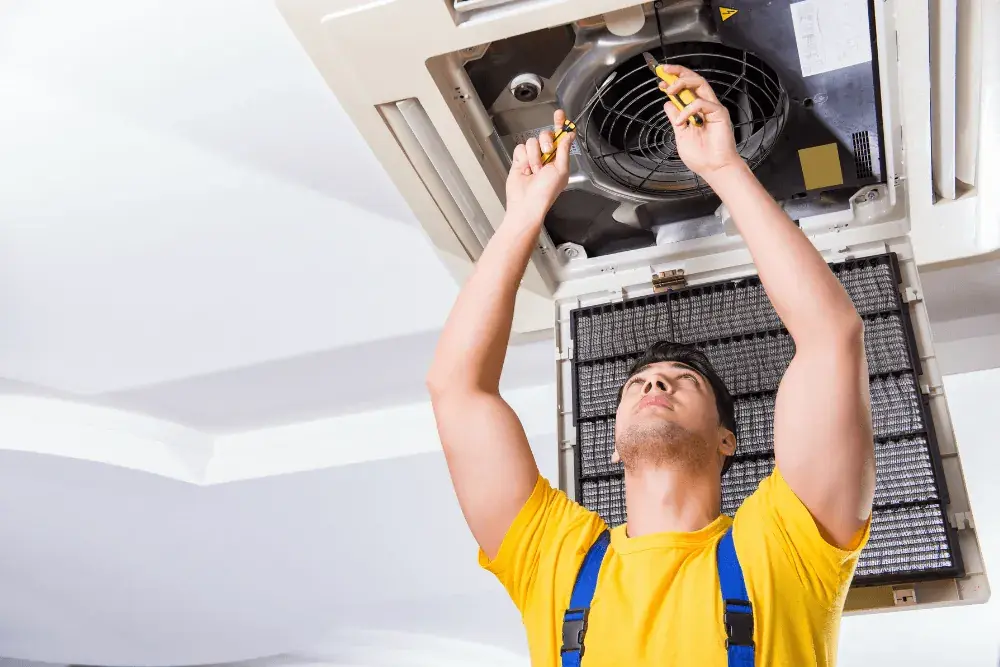
The type of unit changes how it is cleaned and how long it takes. Split AC cleaning is done from a ladder in the room, central AC cleaning means opening a unit above the ceiling and washing the grilles, and window AC cleaning often needs the unit slid out of its sleeve.
In a villa with several units, all of them are usually cleaned in one visit. Tell us how many there are and where the outdoor units sit.
AC cleaning cost in Dubai
AC cleaning cost in Dubai is typically AED 150 to AED 350 per unit for a standard clean and AED 250 to AED 600 per unit for a deep clean with coil cleaner. These are 2026 market prices published by AC companies in the city, before VAT, and they vary with the type of unit and how dirty it is.
They show what the market charges and are not our fixed price list. We quote your price when you book, once we know the number and type of units.
What changes the price
Reading a cleaning quote
Ask which level of cleaning the price is for, whether the fan barrel and the outdoor unit are included, and whether VAT is on top. A very low price per unit for a deep clean usually buys a filter wash and a spray of foam.
How often to clean each part
In Dubai, wash AC filters every month in summer, have a standard clean every three to six months, and book a deep clean every six to twelve months. Outdoor coils need cleaning once a year before summer, and drains should be flushed whenever the unit is cleaned.
Units in kitchens and restaurants collect grease as well as dust, and need a deep clean about twice as often as a bedroom unit.
Cleaning after renovation, sandstorms and moving in
Three events call for an AC clean outside the normal schedule: building or renovation work, a heavy sandstorm, and moving into a home where you do not know when the units were last cleaned. In each case fine dust reaches the coils in days, and it sets hard once it mixes with condensate.
After renovation or painting
Gypsum and cement dust are the worst things an AC can breathe. They pass through mesh filters, coat the wet coil, and dry into a crust that blocks airflow and the drain. If work is planned, switch the units off and cover the indoor outlets and return grilles while sanding and cutting are under way. Afterwards, have every unit that ran during the work deep cleaned before the dust hardens.
After a sandstorm
Outdoor coils take the load. Wash your indoor filters the same week, and look at the outdoor unit. If the fins are visibly matted, or the unit starts cutting out in the afternoon heat, the condenser needs washing.
When you move in
Ask the landlord or seller for the last service invoice. If there is none, run each unit for ten minutes and smell the air. A deep clean with sanitising at the start of a tenancy is modest in cost, and it means the air your household breathes starts from a known point.
Why an AC still smells after cleaning
When an AC still smells after cleaning, the usual reason is that the clean did not reach the source: the fan barrel was left in place, the drain pan was not removed, or wet insulation inside the casing is holding growth. Less often the smell comes from outside the unit, through the drain or the ducts.
If we cleaned the unit and a smell comes back, tell us. We would rather return and find the source than leave it.
AC cleaning for offices, shops and restaurants
Commercial AC and HVAC cleaning in Dubai follows the same steps as home cleaning, on a shorter cycle and around working hours. Offices, shops, clinics, gyms and restaurants run their units for longer, with more people and more dust, and a dirty unit there affects staff, customers and stock.
Regular cleaning for a whole building is usually arranged through a contract. See HVAC maintenance contracts.
AC cleaning near me: choosing a company and areas we cover
When you look for AC cleaning near me or aircon cleaning near me in Dubai, choose an AC cleaning company by what it will do inside the unit, not by the lowest price per unit. Ask whether the cover comes off, whether the fan barrel is washed, what cleaner is used, and whether the outdoor unit is included.
We clean air conditioners in every part of Dubai from our office in Al Quoz, including Al Barsha, Dubai Marina, JBR, JLT, Palm Jumeirah, Downtown, Business Bay, Jumeirah, Dubai Hills, JVC, Arabian Ranches, Deira, Bur Dubai, Karama, Al Qusais, International City and Dubai Silicon Oasis.
Frequently asked questions
Is AC cleaning the same as AC servicing?
No. A service is a routine clean plus electrical and gas pressure checks. A deep clean opens the unit and washes the coil, fan barrel and drain pan, and is booked when there is smell, mould or weak airflow.
Can I use the AC straight after cleaning?
Yes. The unit is dried and tested before the technician leaves, and can run normally.
Will cleaning make my AC colder?
If dirt was the cause of weak cooling, yes. A clean coil and fan move more heat and more air. If the unit is low on gas or has a failing part, cleaning will not cure that.
Does my unit's self-clean mode replace professional cleaning?
No. Self-clean and auto-dry modes dry the coil so that growth is slower. They do not wash the fan barrel, the drain pan or the outdoor unit.
Is the coil cleaner safe for children and pets?
The cleaner is rinsed off the coil and carried away in the catch bag, so nothing is left in the airstream. Keep children and pets out of the room while the work is done.
How long does a deep clean take for a whole flat?
Allow about an hour per wall split unit. A two-bedroom flat with three units usually takes a morning or an afternoon.
Should the outdoor unit be cleaned too?
Yes. The outdoor coil sheds the heat taken from the room. If it is clogged, the unit works harder however clean the indoor side is.
Do your AC cleaners also clean ducts?
Yes, as a separate job from cleaning the unit. Ducts are inspected first and cleaned when dust or growth is found.
Do you clean all brands?
Yes, including Mitsubishi, Daikin, LG, Samsung, Gree, Hitachi, O General, Carrier and Haier. The method is the same, and only the way the covers come off differs.
Is steam cleaning better than coil cleaner?
It is better for greasy coils and for households that want to avoid cleaner. For ordinary dust and mould, coil cleaner with a proper rinse is as thorough and quicker.
Book an AC cleaning in Dubai
To book, use the online form, send a WhatsApp message or call +971 55 209 9785. Tell us your area, how many units you have and their types, and what you have noticed: a smell, mould, weak airflow or a drip.
We confirm the level of cleaning, the price and the time before the technician sets off.