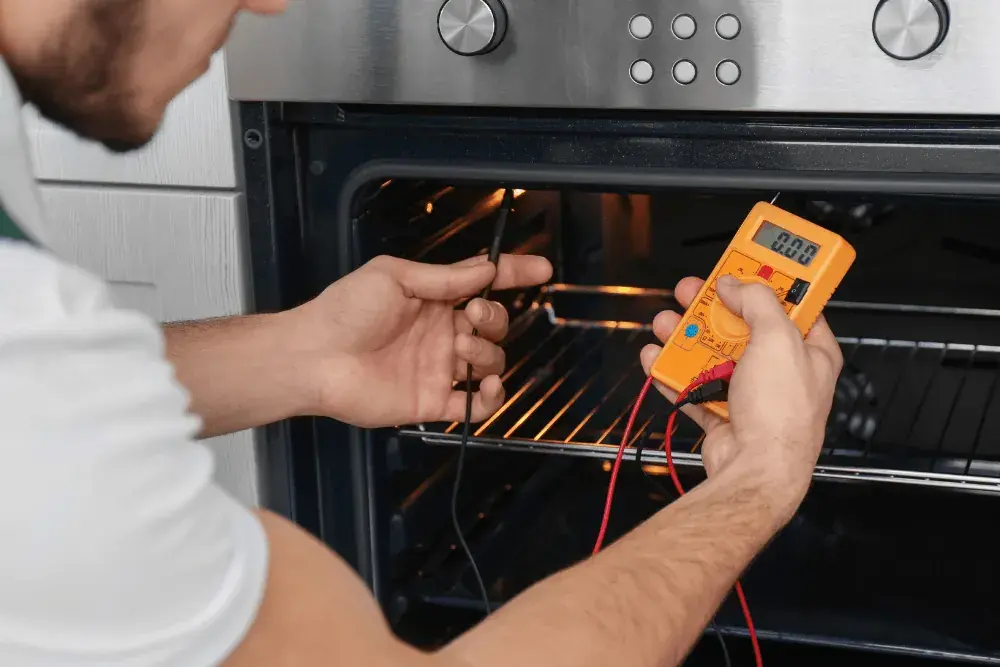
One Click Dubai repairs induction hobs, induction cooktops and induction cookers across Dubai, with a technician sent the same day. We repair built-in induction hobs and the induction tops of freestanding ranges at home, and we repair countertop induction cookers and hot plates of every make.
An induction hob is an electronic appliance, closer to a power supply than to a stove. There is no element to burn out. Instead a circuit board drives a copper coil at high frequency, and the pan itself becomes the heater. That makes it fast and efficient, and it means the faults are electronic: a hob that will not turn on, a zone that will not recognise the pan, a code on the display, a blown fuse. This page explains how induction works, what each symptom means, what can be checked at home and what a repair involves.
Induction hob repair in Dubai from One Click Dubai starts with a AED 100 diagnostic visit, plus VAT. The technician tests the supply, the power boards, coils, sensors, fan and controls, and gives a fixed price before any repair.
QuestionAnswer
How soon can you come?The same day, at any hour
Which appliances?Built-in induction hobs, flex-zone and domino hobs, induction ranges, countertop single and double induction cookers
What do you repair?Power boards, coils, temperature sensors, cooling fans, touch control boards, fuses, filter boards, supply connections and glass
Do you install?Yes, including the electrical connection
Which parts?Genuine parts. About 90% of what we use is in stock
Where is it repaired?Built-in hobs at home. Countertop cookers at home or in our workshop
What does the visit cost?AED 100 plus VAT, with no night or weekend surcharge
Is the repair covered?Yes. One month on parts and labour
An induction hob heats the pan directly. Under each zone is a flat copper coil. The electronics send a high-frequency alternating current through it, which creates a rapidly changing magnetic field. That field induces currents in the iron base of the pan, and the pan's own resistance turns them into heat. The glass gets hot only because the pan sits on it.
PartWhat it doesWhat happens when it fails
Mains filter board and fuseCleans up the supply and protects the hobHob completely dead, or tripping
RectifierTurns mains AC into DCDead zone or dead side, blown fuse
Power transistors (IGBTs)Switch the DC on and off tens of thousands of times a second to drive the coilBlown fuse, dead zone, tripping. The most common electronic failure
Resonant capacitorsWork with the coil to set the frequencyWeak heating, shutdowns, noise
Induction coilCreates the magnetic fieldZone does not heat. Rare, unless overheated or water-damaged
Temperature sensorsOne under the glass at each zone, one on the electronicsError codes, cutting out, or no power regulation
Cooling fanKeeps the electronics coolOverheat shutdowns, then board failure
Control and touch boardReads your fingers and tells the power board what to doDead or erratic controls
Pan detectionThe electronics sense whether a suitable pan is presentFlashing display, no heat
On a built-in hob, two zones usually share one power board, so a board fault takes out one side of the hob while the other side works normally.
Induction comes as a hob fixed in the worktop on its own circuit, or as a portable cooker with a plug. They are repaired differently, and the economics differ.
Built-in induction hobCountertop induction cooker
ZonesTwo to five, often with bridging or flex zonesOne, sometimes two
PowerAbout 3.5 kW to over 7 kW in totalAbout 1.2 to 2.2 kW per zone
SupplyDedicated cooker circuitOrdinary socket
Common faultsOne side dead, error codes, touch control faults, fan, cracked glass, supply connectionDead with a blown fuse, no heat with the fan running, pan error, overheating
PartsModel-specific boards and coils from the makerBoards, fuses, transistors, fans and sensors
Where repairedAt home, hob lifted from the worktopAt home or in the workshop
Worth repairing?Nearly alwaysUsually, for fuse, transistor, fan and sensor faults. Compare with new if the glass and the board have both failed
Countertop cookers are sold under many names, including Prestige, Bajaj, Philips, Pigeon, Preethi, Havells, Butterfly, Impex and Geepas, and are sometimes called an induction plate, an induction hot plate or an induction chulha. We repair all of them.
An induction hob not turning on is locked, has lost its supply or has an internal fuse or board fault. Check the first two before booking.
SymptomLikely causeWhat to do
Lock or key symbol showing, keys do not respondChild lockHold the lock key for a few seconds, as the manual describes
No lights at allBreaker tripped, cooker switch off, or a loose supply connectionCheck the breaker and the isolator
No lights, breaker is onInternal fuse blown, filter board or power supply failedService
Lights up, turns itself off in secondsLiquid or an object on the touch panelWipe dry. Clear the panel
Turns on, no zone will startNo suitable pan, or a control faultTry a known induction pan
Dead after a power cut or surgeSurge damage to the filter or power boardService
Trips the breaker when switched onShorted transistors or rectifier on a power board, or moisture insideService
One side works, the other does notOne power board, or one supply phase or terminal linkService. Check the connection
Demo or showroom mode: lights work, no heatA display mode set by accident on some modelsExit it as the manual describes
A blown internal fuse is a symptom. Fuses in induction hobs blow because a power transistor or the rectifier has short-circuited, and replacing the fuse alone blows the new one at once.
An induction hob not detecting the pan shows a flashing power level, a pan symbol or a code, and delivers no heat. The cause is usually the pan.
CheckHowResult
Is the base magnetic?Hold a fridge magnet to the bottom of the panIf it does not grip firmly, the pan will not work
Is the pan big enough?Compare the base with the ring marked on the glassA base much smaller than the zone is ignored
Is it centred?Place it in the middle of the zoneOff-centre pans are detected poorly
Is the base flat?Lay a ruler across itA dished base couples badly and heats slowly
Does a different pan work?Try a known induction pan on the same zoneIf yes, the first pan is the problem
Does the pan work on another zone?Move itIf yes, the first zone has a fault
CookwareWorks on induction?
Cast iron, enamelled cast ironYes
Carbon steelYes
Magnetic stainless steelYes
Stainless steel with an aluminium or copper base and a magnetic outer layerYes
Plain aluminium, copper, glass, ceramic, clayNo, unless it has a bonded magnetic plate
Non-magnetic stainless steelNo
If no pan is detected on one zone and every pan works elsewhere, the fault is in that zone's coil, its sensor or its half of the power board.
An induction zone that accepts a pan and then heats poorly or stops has a sensor, cooling or power-electronics fault.
SymptomLikely causeRepair
Zone on, pan detected, no heatPower board output stage failed for that zoneRepair or replace the board
Heats, pulses on and off at low settingsNormal. Low power is delivered in burstsNo fault
Cuts out after some minutes on highOverheat protection: fan failed, vents blocked, or the hob boxed in belowFan. Restore ventilation
Power drops when a second zone is switched onPower sharing between two zones on one board. Normal on many hobsNo fault. Use zones on opposite sides for two high-power tasks
Boost will not holdBoost is time-limited and shares power with its neighbourNo fault
Weak heating with every panResonant capacitor or coil connection, or low supply voltageService
Zone shuts down with a codeTemperature sensor under the glass, or an overheated panNew sensor. Do not heat empty pans
Whole hob shuts off after long cookingSafety time limit reached without any key being touchedSwitch on again. Normal
The cupboard or drawer under an induction hob must let air through. Makers specify gaps at the front of the worktop and the back of the cabinet. A drawer packed with tea towels against the underside of the hob is a common cause of overheating.
An induction hob reports faults as a letter and number code, usually beginning with E, F or U. The codes differ between makes and often between models of the same make, so a list from one brand does not apply to another.
Kind of codeWhat it generally points to
Pan symbol, or a flashing power levelNo suitable pan detected
Voltage codesSupply too low or too high, or a missing phase
Temperature codesA sensor fault, or overheating of the glass or the electronics
Communication codesThe control board and a power board are not talking to each other
Key or touch codesA key held down, or liquid or an object on the panel
Fan codesCooling fan not running
Write down the exact code and which zone it appears on.
Switch the hob off at the breaker for a few minutes and try again. A code that returns is a real fault.
Note whether it appears at once, or only after cooking for a while.
Send the code with the model number when you book.
We look the code up in the maker's documentation for that model. We do not print a general code table here because the same code can mean different things on different hobs. For Bosch, see Bosch hob repair.
Noises, the fan and what is normal
Induction hobs make sounds that gas and ceramic hobs do not. Most are normal.
SoundSourceNormal?
Low hum or buzz, louder at high powerThe pan base vibrating in the magnetic fieldYes. Heavier, single-piece pans are quieter
High-pitched whistle with two pans on adjacent zonesTwo zones working at slightly different frequenciesYes
CracklingPans made of layered metalsYes
ClickingPower electronics switching, especially at low settingsYes
Fan running during and after cookingCooling the electronicsYes
Fan rattling, grinding or very loudFan bearings worn, or something caught in itNo. Replace the fan
No fan sound at all on high power, followed by a shutdownFan failedNo. Replace before the board overheats
Loud bang, then deadA power transistor has failedNo. Board repair
A failed fan is cheap to replace. A power board that has been cooked because the fan was left failed is not.
Touch controls and displays
Induction controls are capacitive sensors under the glass. They respond to anything conductive, including water, which is why spills cause so many control complaints.
SymptomCauseFix
Beeps and switches offLiquid, a cloth or a utensil on the control areaClear and dry
A key does not respondGrease film, or a failing sensor under that keyClean. Replace the control board if it persists
Keys respond by themselvesMoisture, steam or a hot pan near the panelDry. Keep pans within the zones
Display dim or segments missingDisplay board failingNew control board
Slider does not track the fingerDirty glass or a failing sensor stripClean. Replace
Controls dead, the rest litLock active, or a board faultRelease the lock. Service
Blown fuses, tripping and power board repair
The power board is the heart of an induction hob and the part most often at fault. Its transistors switch heavy current at high speed and are stressed by heat, by voltage surges and by pans that boil dry.
FindingMeaningRepair
Internal fuse blownA short downstreamFind the shorted part before fitting a fuse
Power transistor shortedThe usual cause of a blown fuseReplace the transistor and its driver parts, or the board
Rectifier shortedOften fails with the transistorReplace
Capacitor bulged or crackedHeat and ageReplace
Burn marks on the boardOverheating or liquidBoard replacement
CorrosionA spill through a crack or a failed seal, or humidityClean if light. Replace if tracks are damaged
Board good, zone deadCoil, its connections or its sensorRepair the connection. New coil or sensor
On built-in hobs we fit the maker's board for the model. On countertop cookers, where boards are simple and replacement boards are not always supplied, component-level repair is normal: the fuse, transistor and rectifier are replaced together and the cooker is tested under load.
A countertop induction cooker is a single power board, one coil, a fan and a small control panel in a plastic case. Most failures are in a handful of parts.
SymptomLikely causeRepair
Completely deadFuse blown, with a shorted transistor or rectifier behind itReplace the set
Lights and fan work, no heat, pan error with every panCoil connection, resonant capacitor or the drive circuitRepair
Heats for a minute and stops with a codeTemperature sensor under the glass, or the fan not runningSensor or fan
Fan not runningFan failed or blocked with grease and dustClean or replace
Buttons do not respondControl panel membrane or its ribbon cableReplace
Trips the socket or sparks at the plugShort on the board, or a damaged leadRepair. Replace the lead
Cracked topImpact or a boil-dryReplace the glass if available, or the cooker
Plug a countertop cooker directly into a wall socket, not a multi-way extension. It draws close to the limit of a socket.
Keep the air inlet underneath and the outlet at the back clear, and do not stand it on a cloth.
Do not heat an empty pan.
Unplug it when it is not in use.
Settings and features that look like faults
Modern induction hobs have functions that limit or redirect power on purpose. Several of them are reported to us as faults.
What you seeWhat it isWhat to do
Hob never reaches full power on several zones at onceA power limit set at installation so the hob suits a smaller circuitIt can be raised in the settings only if the circuit and breaker allow it
A zone drops from boost to 9 after a few minutesBoost is time-limited to protect the electronicsNormal
Two zones in a row will not both run on boostThey share one power boardUse one zone from each side
A setting changes when the pan is moved along a flex zoneA move or zone-shift function that assigns heat levels by positionSwitch the function off if not wanted
Display shows a pause symbol and everything stopsPause or wipe function touched by accidentTouch it again to resume
Zone switches itself off after a set timeA zone timer was setClear the timer
Lights on, no heat on any zone, no pan errorDemo mode on some modelsExit it as the manual describes, usually within minutes of power-up
Low settings feel like nothing is happeningKeep-warm and melt levels deliver very little power in short burstsNormal
The power limit is the one worth checking after a hob has been replaced or moved. If the installer set it low to match a small breaker, the hob will feel weak for the rest of its life. Raising it is only safe when the circuit has been checked.
An induction hob is diagnosed from underneath, so a built-in hob has to come out of the worktop for most repairs.
1
Supply checkVoltage at the cooker switch and at the hob terminals, with the terminal links and tightness inspected.
2
Isolate and lift the hobThe clips or brackets are released and the hob is lifted out and turned over on a protected surface.
3
InspectThe base is opened. Burn marks, liquid tracks, bulged capacitors and loose connectors are looked for first.
4
TestThe fuse, rectifier and power transistors are measured, then the sensors, coils and fan.
5
QuoteYou are given a fixed price for the part and the work.
6
RepairThe board, fan, sensor or coil is replaced.
7
Refit and sealThe hob is seated on its seal and reconnected.
8
Load testEach zone is run with a pan of water at high power, and two zones together on each side.
Clear the cupboard or drawer beneath the hob before the visit, and have a couple of your usual pans to hand for the test.
A cracked induction hob should not be used. The glass is the barrier between spilled liquid and electronics carrying mains voltage. Switch the hob off at the breaker and keep it off.
A crack cannot be glued, filled or polished out. The glass is replaced.
The replacement is the maker's glass for the model, printed with the zone markings and controls.
The coils, sensors and boards are transferred to the new glass, or the glass comes with its frame.
Where original glass has to be ordered, it usually arrives in about two days.
On an older or basic hob, the price of the glass can approach that of a new hob. We give you both figures.
The full detail, including causes and prevention, is on our glass cooktop replacement page.
Supply and installation
We install induction hobs and connect them to the cooker circuit. Induction is more demanding of its supply and its ventilation than any other hob.
PointRequirement
CircuitA dedicated circuit with the breaker and cable size given for the hob's total rating
ConnectionTerminal links set for single-phase or three-phase supply as the hob's diagram shows. Terminals fully tightened
IsolatorA cooker switch within reach
Cut-outTo the maker's dimensions, with clearance so the glass is not stressed
VentilationThe air gaps the maker specifies under the hob, at the front of the worktop and behind the cabinet
Above an ovenOnly where both makers allow it, with the stated clearance
SealSeated all round so that liquid cannot run under the glass
CommissioningEvery zone tested with a pan at high power, and the fan checked
If you are replacing a gas or ceramic hob with induction, check the circuit first. Many kitchens wired for a gas hob have only a socket for the ignition and no cooker circuit at all.
Brands we repair
We repair induction hobs and cookers of every make.
TypeMakes
Built-in induction hobsBosch, Siemens, Neff, Miele, AEG, Electrolux, Zanussi, Smeg, Beko, Ariston, Indesit, Hotpoint, Candy, Hoover, Gorenje, Teka, Samsung, LG, Ikea
Induction rangesSamsung, LG, Whirlpool, GE, Bosch, Smeg
Countertop induction cookersPrestige, Bajaj, Philips, Butterfly, Impex, Geepas, Nikai and others
The model number is on a plate on the underside of a built-in hob and in its booklet, and on the base of a countertop cooker.
What induction hob repair costs, and repair or replace
Induction repairs are board-level work. They cost more than a ceramic element and far less than a new hob.
RepairScale of jobWorth doing?
Supply connection, terminal links, lock or settingsSmallYes
Cooling fanSmall to mediumYes
Temperature sensorSmall to mediumYes
Touch control boardMediumYes
Power board repair or replacementMedium to largeYes on a built-in hob in good condition
CoilMediumYes
Countertop cooker: fuse, transistor, rectifier, fan, sensorSmall to mediumUsually
GlassLargeCompare with a new hob on older or basic models
Two power boards, or glass and a boardLargeOften the point to replace
The diagnostic visit is AED 100 plus VAT, with a fixed price before any work. For other types see stove and hob repair, electric stove repair and gas stove repair.
We cover all of Dubai, including Dubai Marina, JBR, Palm Jumeirah, JLT, Downtown, Business Bay, Jumeirah, Al Barsha, Dubai Hills and Deira.
Induction hobs last well when they are kept cool, dry and unscratched.
Keep the space under the hob clear so air can circulate.
Wipe spills from the control panel at once.
Use flat, heavy-based induction pans that match the zone.
Lift pans. Sliding grit across the glass scratches it.
Never heat an empty pan on boost.
Clean with a ceramic hob cleaner and a soft cloth.
If the fan becomes noisy or the hob starts cutting out, book a visit before the electronics overheat.
Who repairs induction hobs in Dubai?
+
One Click Dubai repairs built-in induction hobs and countertop induction cookers across Dubai, the same day. Call or WhatsApp +971 55 209 9785.
Why is my induction hob not working?
+
The child lock is on, the supply is off, an internal fuse has blown because of a board fault, or the pan is not suitable.
Why is my induction hob not detecting the pan?
+
The pan base is not magnetic, is too small or is off centre. Test it with a magnet.
Why does my induction hob keep switching off?
+
Liquid on the controls, overheating from a failed fan or blocked vents, or the safety time limit.
Can an induction hob be repaired?
+
Yes. Power boards, control boards, fans, sensors and coils are all replaceable.
Why did my induction cooker's fuse blow?
+
A power transistor or the rectifier has short-circuited. The fuse is replaced together with the failed parts.
Is a buzzing induction hob faulty?
+
No. A hum or buzz from the pan is normal, especially at high power.
Can I use a cracked induction hob?
+
No. Switch it off at the breaker until the glass is replaced.
Do you repair countertop induction cookers?
+
Yes, including Prestige, Bajaj and Philips.
Do you install induction hobs?
+
Yes, including the electrical connection.
How much does induction hob repair cost?
+
The diagnostic visit is AED 100 plus VAT. The repair is quoted at a fixed price once the fault is found.
Is the repair guaranteed?
+
Yes, for one month on parts and labour.
Call or WhatsApp +971 55 209 9785 at any hour, or use the booking form. Tell us the make and model, whether it is built-in or countertop, which zones are affected and any code on the display.