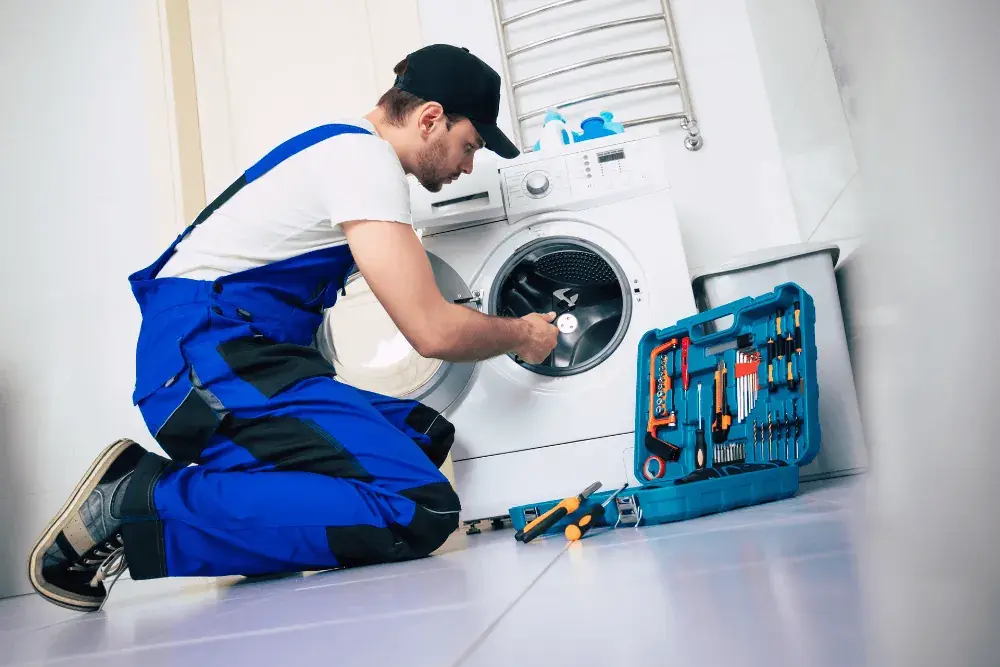
A washing machine making noise is telling you which part is in trouble, and the kind of noise is the clue. A deep roar on spin is the drum bearings. Banging is an unbalanced load or worn shock absorbers. A metallic scrape or click that follows the drum round is an object caught behind it. A rattle while draining is something in the pump. A squeal is a belt.
This guide is organised by sound. Find yours in the table, then go to its section for how to confirm the cause and what to do about it. Two simple tests with the machine switched off, turning the drum by hand and lifting its front edge, settle most cases in a minute. It covers front load and top load machines. The checks are the same on every make, including Samsung, LG, Bosch, Siemens, Whirlpool, Beko, Hotpoint, Indesit, Electrolux, Zanussi, Hoover, Candy, Haier, Kenmore and Frigidaire. For a repair, see washing machine repair in Dubai.
NoiseWhenMost likely causeUrgency
Deep rumble or roar, like a jet or a trainSpin, louder as speed risesDrum bearings wornBook soon. Do not run for months
Heavy banging or thumpingSpinUnbalanced load, machine not level, transit bolts in, worn shock absorbersStop the cycle and rebalance
Knock or clunk once per turnWash and spinLoose drum paddle, loose counterweight, heavy item in the load, broken drum spiderInvestigate before the next wash
Scraping or metallic scratchingWhenever the drum turnsBra wire, coin or screw between drum and tubStop. It can pierce the tub or seal
Clicking or tapping in rhythmWashZips, buttons, coins in the drum. A small object behind the drumCheck the load first
Squeal, squeak or screechStart of spin, or all throughBelt slipping. Door seal rubbing on the drum. Dry bearingBook
Grinding or rattlingDrainObject in the pump, or the pump's impeller damagedClear the filter
Loud hum or buzz, drum stillWash or spinMotor stalled, capacitor, jammed drumSwitch off
Hum or buzz, shortFillInlet valve. Normal if briefNone
Hammering in the pipesWhen filling stopsWater hammer in the building's pipeworkPlumbing, not the machine
High-pitched whine or whiningSpinNormal on brush-motor machines. A new or louder whine suggests motor wearMonitor
Gurgling or suckingDrainNormal. Louder if the hose is siphoningCheck hose routing if new
BeepingStart, end or with a codeSignals and fault alertsRead the display
If a noise is new, loud or changing, treat it as a fault until you have ruled it out. Machines do not become noisy with age for no reason.
Do these with the machine empty, switched off and unplugged. They take a minute.
What you feel and hearMeaning
Smooth and quiet, with a soft whirr on belt machinesDrum, bearings and belt are probably sound
A low rumble or grittiness you can feel through your fingersBearings worn
A scrape, tick or scratch at one point in each turnObject between drum and tub, or a wire poking through a drum hole
A knock as it turnsLoose paddle, or a loose weight shifting
Rubber squeakDoor seal touching the drum
Completely free and silent on a belt-driven machineBelt off
Stiff or stuckJammed object or seized bearing. Do not force it
1
Grip the inside top of the drum at the frontWith the door open.
2
Lift it up and let it downAnd push it back and pull it forward.
3
Compare the drum with the tubThe inner drum should not move separately from the outer tub. The whole assembly swinging gently on its springs is normal.
ResultMeaning
No movement of the drum relative to the tubBearings sound
A few millimetres of up-and-down play, perhaps with a clunkBearings worn
Drum tilts and can touch the door seal or the tubBearings failed, or the drum spider is broken
Whole tub bounces several times when pushed down and releasedShock absorbers worn
Tell us what both tests showed when you book. It lets us judge the size of the job before we arrive.
A deep rumble that rises with spin speed and has been getting worse over weeks or months is the sound of worn drum bearings. It is the most recognisable washing machine noise and the most serious.
1
It starts as a hum on the fastest spinsEasy to ignore.
2
It grows to a roarAudible from other rooms.
3
The drum develops playAnd may start to knock or scrape as it sags.
4
Water gets past the worn sealA leak appears at the back on spin.
5
If left, the shaft or spider breaksAnd the drum drops inside the tub.
CheckBearing fault if
Hand-turn testRumble felt and heard with the drum empty
Lift testDrum has play
Empty spinRoar is present with no laundry inside
Back of the tub, panel offRusty or oily streaks from the centre
LaundryGrey or brown marks
Bearings fail because the seal in front of them lets wash water in. Overloading, constant low-temperature washing with heavy detergent residue, and age all shorten the seal's life. Once the noise has started it does not go away, and oil or grease cannot be added from outside.
Whether the repair is worth doing depends on the machine and on whether its outer tub can be opened or is welded shut. Both are explained on our washing machine parts page. You can go on using a machine with early bearing noise for a short time on lower spin speeds, and you should not plan on months.
Banging and thumping on spin
Banging on spin means the tub is swinging far enough to hit the cabinet. The load is the cause far more often than the machine.
CauseHow to tellFix
Unbalanced loadHappens with single heavy items, bedding, or a duvet cover that has swallowed the rest of the washStop, redistribute, add or remove items, spin again
OverloadingDrum packed tightRemove some
Machine not levelRocks when a top corner is pressedAdjust the feet and tighten their lock nuts
Transit bolts still fittedA new or recently moved machine that shakes violentlyRemove the bolts from the back
Floor not solidMachine on a plinth, loose tile or soft flooringMove it to a firm base
Worn shock absorbersBangs on ordinary mixed loads. Tub bounces repeatedly in the push testReplace in pairs
Spring unhooked or brokenSudden loud bang, tub sitting low on one sideRefit or replace
Counterweight loose or crackedDull heavy knock, even at low speedTighten or replace
Machine touching a cabinet, wall or another applianceNoise stops when pulled forward a littleLeave a gap all round
A machine that bangs badly should be stopped, not left to finish. Each impact loads the bearings, the tub mounts and the cabinet. If an empty Spin only cycle runs smoothly, the machine is sound and the load was to blame. More on balancing is in our guide to a washing machine not spinning.
A single knock that repeats with each revolution of the drum is something loose that falls as the drum turns.
CauseHow to confirmFix
Something heavy in the load: a shoe, a belt buckle, a toyNoise gone with the drum emptyWash such items in a bag, or not at all
Drum paddle (lifter) looseWiggle each of the three plastic paddles inside the drumClip or screw it back, or replace it
Object inside a paddlePaddles are hollow. Coins and small items get in through the slotsRemove the paddle and empty it
Counterweight bolt looseDull knock from the top or front of the tubTighten. Technician
Drum spider crackedDrum wobbles, knocks the door seal, may scrapeStop using it. Major repair
Bearings badly wornKnock with play in the drumBearing repair
Motor or pulley looseKnock from the back at low speedTechnician
Paddles are held by a clip or a screw from inside the drum and are a quick fix. A broken spider, the aluminium frame that carries the drum, is not. The sign is a drum that sits off-centre or can be rocked a long way.
Scraping, scratching and clicking: objects in the machine
A metallic scrape or a sharp tick that follows the drum round is nearly always a foreign object. The usual culprits are bra underwires, coins, hair grips, screws, keys and collar stiffeners. They slip between the drum and the door seal, or through the drum's holes, and end up in the gap between the inner drum and the outer tub.
Where it isSoundHow it is retrieved
In the drum, looseRattle that comes and goesTake it out
Poking through a drum holeRegular tick or scratch. You can often see or feel the tipTurn the drum to bring it to the top and pull it through with pliers, or push it back and retrieve it from below
Between drum and tubScrape, or a tick at one point per turnThrough the heating element opening or the sump hose. Technician
In the door seal foldScrape near the doorPull back the fold and remove it
In the sump or pumpRattle when drainingThrough the pump filter
Inside a paddleRattle or knockRemove the paddle
1
Stop the machineA wire between drum and tub can puncture the tub, tear the door seal or jam the drum.
2
Empty the drum and turn it slowly by handListen for where in the turn the noise occurs.
3
Shine a torch through the drum holesTurn the drum a little at a time. A coin or wire often shows as a glint.
4
Check the door seal fold all the way roundAnd the pump filter.
5
If you can see it and cannot reach it, leave it and callFishing with wire hooks through the holes usually pushes it further in.
An underwire can sit harmlessly for weeks and then catch the heating element or the tub wall. If you know one is missing from a bra and the machine has started to scrape, that is where it is. Mesh laundry bags prevent this entirely.
Squealing, squeaking and screeching
A squeal is rubber or metal slipping. Where in the cycle it happens points to the source.
WhenLikely causeConfirmFix
At the start of the spin, as the drum acceleratesBelt slipping on the motor pulleyBlack dust under the machine, belt shiny or crackedNew belt. Check the pulleys and bearings
Throughout the wash, a squeak with each turnDoor seal rubbing on the drum edgeSqueak when turning the drum by hand. Shiny rubbed patch on the sealReseat or replace the seal. Check for drum sag from worn bearings
A new machine, first few washesNew seal rubbingFades within a few cyclesA light wipe of the seal lip with water. Normally settles
Continuous on spin, getting worseBearing running dryRumble followsBearing repair
Squeak as the tub moves at the start and end of spinShock absorbers or springs dry or wornSqueak when the tub is pushed by handReplace the shock absorbers
Top loader, screech on agitation or spinBelt, clutch or pump pulleyTechnicianReplace the worn part
Do not spray lubricant into a washing machine. On a belt it causes slip, on a door seal it attacks the rubber, and it cannot reach a bearing.
Noise that starts when the machine pumps out comes from the drain pump, and most of it is something caught in the pump.
NoiseCauseFix
Rattle or clatterCoin, button, hair grip or grit in the pump chamberClean the pump filter and the cavity behind it
GrindingImpeller blades broken, or a hard object jammedClear. Replace the pump if blades are damaged
Loud hum, little or no water movingPump blocked or airlocked by foamClear the filter. Use less detergent
Buzz that stops and startsPump struggling against a partial blockage in the hoseClear the hose
Harsh vibration felt at the front cornerPump loose on its mounting, or its bearings wornTechnician
Gurgle and suck at the endNormal. The pump has run dryNothing
The filter is behind the small flap at the bottom front of most front loaders. Drain the machine first. The method is in our guide to a washing machine not draining. A pump that has been run with a coin in it for long enough loses its impeller blades and then has to be replaced.
A hum with no movement means a motor is energised and cannot turn. Switch the machine off. A stalled motor overheats quickly.
SituationLikely cause
Hum from the base, water not drainingDrain pump jammed
Hum from the back, drum still, on a front loaderDrum jammed by an object, seized bearing, or a motor fault
Hum on a top loader, agitator or tub stillStart capacitor failed, or something jammed under the agitator or pulsator
Brief buzz at the back during fillingInlet valve. Normal
Loud buzz from the valve with no water arrivingTap closed or supply off
Hum from the door area at the startDoor lock engaging. Normal if brief
Low hum all the time the machine is on standbyNormal on some electronic models
Noises when filling, and in the pipes
Sounds as water enters are usually normal. The exception worth knowing is water hammer, which is in the building's plumbing and is often blamed on the washing machine.
SoundCauseWhat to do
Hiss and rush of waterNormal fillingNothing
Brief buzz or click as filling starts and stopsInlet valve opening and closingNothing
Whistle or squeal while fillingWater forced through a partly closed tap or a clogged inlet filterOpen the tap fully. Clean the hose filter
A bang or series of knocks in the wall when filling stopsWater hammer. The valve shuts quickly and the moving water slams to a stopTurn the tap down slightly. Have loose pipes clipped. A water hammer arrestor can be fitted at the tap
Vibration or chatter from the tapWorn tap washerPlumber or building maintenance
Sloshing during the washWater in the drum, or in the balance ring on top loadersNormal
Water hammer is worse where pressure is high. If the knocking began after work on the building's water system, mention it to the building maintenance team.
Top loaders have a gearbox or clutch, an agitator or pulsator, and suspension rods, so their noises differ.
NoiseWhenCause
Clicking or ratcheting from the agitatorAgitationNormal on dual-action agitators. If the top half no longer moves, the drive dogs are worn
Grinding or growling from belowAgitation or spinGearbox or tub bearing
Loud bang against the cabinetSpinUnbalanced load or worn suspension rods
ScreechStart of spinBelt or clutch slipping
Rattle from under the pulsatorWashCoin or hair grip beneath it
Hum, nothing movesAnyCapacitor or a jam
Clunk when the cycle changesBetween agitate and spinNormal shift of the clutch or gearbox on many models
Lid lock clicking repeatedlyBefore spinLid lock fault
Twin tubs add a spin-tub rattle when clothes are packed unevenly, and a squeal from the spin brake as it stops. Press the load down flat and fit the inner cover.
Modern machines make a range of sounds that are part of normal operation, and newer inverter and direct drive models make some that older machines did not.
Clicks from the door lock at the start and a minute or two after the end.
A short buzz from the inlet valve each time water enters.
The drum turning slowly back and forth, pausing, and trying again before a spin. It is balancing the load.
A rising whine as the spin builds, most noticeable on brush-motor machines.
A hum or pulsing tone from an inverter or direct drive motor at low speeds.
Gurgling as the pump empties the last of the water.
Water running in bursts during rinses.
A fan or pump running on briefly after the cycle on washer dryers.
Beeps at the start and end, which can usually be turned off in the settings.
The useful comparison is with how the machine sounded when it was working well. A phone recording of the noise, with a note of the stage it occurs at, helps a technician a great deal.
Beeping and codes
Beeps are signals. A few at the end of a cycle are a finish alert. Repeated beeping with a flashing light or a code is the machine reporting a fault and asking for attention.
Look at the display and note any code, or count the flashes on machines without a screen.
Check the simple things the code points to. door closed, tap open, filter clear, load balanced.
Switch off at the wall for five minutes and restart once.
If the same code returns, book a visit and tell us the code.
Codes are specific to each make. The ones we have confirmed from the makers are listed on the brand pages, including Samsung, LG, Bosch and the other brands we repair.
Do not keep running a machine that scrapes, grinds, bangs hard or hums without turning.
Do not spray oil or lubricant into the drum, onto the belt or at the seal.
Do not wedge the machine with wood or weigh it down to quieten it. Level it.
Do not poke wire through the drum holes to hook an object unless you can see and grip it.
Do not remove panels with the machine plugged in.
Do not ignore a growing rumble. Bearing damage only goes one way.
When to call a technician, and what it costs
Call when the hand-turn or lift test shows roughness or play, when there is a scrape you cannot trace, when a pump is damaged, when a belt squeals or when the machine bangs on balanced loads.
FaultRepairTypical Dubai market range, fitted
Object behind the drumRetrieved through the heater opening or sumpSmall job
Loose paddle, weight or mountRefit or replaceSmall job
BeltNew belt, pulleys checkedAED 150 to 300
Drain pumpNew pumpAED 200 to 400
Door seal rubbing or tornNew sealAED 250 to 500
Shock absorbersNew pairGenerally at the lower end of repair prices
BearingsTub opened, bearings and seal replacedAED 350 to 700, more for sealed-tub assemblies
MotorBrushes, sensor or motorAED 300 to 1,000 for a motor
These are ranges published in 2026 Dubai price guides, not our price list. Our diagnostic visit is AED 100 plus VAT, with a fixed price before work starts.
Check every pocket, and close zips and fasten hooks.
Wash bras, socks and small items in mesh bags.
Load evenly and do not overload.
Keep the machine level, with lock nuts tight, on a firm floor.
Clean the pump filter every month or two.
Use the right amount of detergent and run a hot maintenance wash monthly, which protects the bearing seal from residue.
Leave a gap between the machine and its neighbours.
Act on a new noise while it is still a small repair.
Why is my washing machine so loud when spinning?
+
A deep roar is worn drum bearings. Banging is an unbalanced load, a machine that is not level or worn shock absorbers. Test with an empty spin.
Why is my washing machine making a banging noise?
+
The tub is hitting the cabinet. Rebalance the load, level the machine and check that transit bolts were removed. If it bangs on ordinary loads, the shock absorbers are worn.
Why is it making a grinding noise?
+
During draining, something is in the pump. When the drum turns, it is the bearings or an object between drum and tub.
What is the scraping sound when the drum turns?
+
Usually a bra wire or coin caught between the drum and the tub. Stop using the machine until it is removed.
Why does my washing machine squeal?
+
A slipping belt, a door seal rubbing on the drum or a dry bearing.
How do I know if the bearings have gone?
+
A rumble that grows with spin speed, roughness when the empty drum is turned by hand, and up-and-down play when the drum's front edge is lifted.
Can I keep using a washing machine with noisy bearings?
+
For a short while on low spin speeds. It will get worse, start to leak and eventually fail.
Why is there a knocking in the pipes when the machine fills?
+
Water hammer in the plumbing, caused by the valve shutting quickly. It is not a machine fault.
Is a humming noise normal?
+
Brief hums from the valve, the pump and the motor are. A hum with nothing moving is a stalled motor or pump: switch off.
My new machine is very noisy. Why?
+
Check that the transit bolts were removed and that it is level on a firm floor.
How much does it cost to fix a noisy washing machine?
+
It depends on the cause. Published Dubai ranges run from about AED 150 to 300 for a belt to AED 350 to 700 for bearings.
Who repairs noisy washing machines in Dubai?
+
One Click Dubai sends a technician the same day. Call or WhatsApp +971 55 209 9785.
Rumble, scrape or bang that will not go?A technician can find the cause on site. The diagnostic is AED 100 plus VAT, and repairs carry a 1-month warranty.