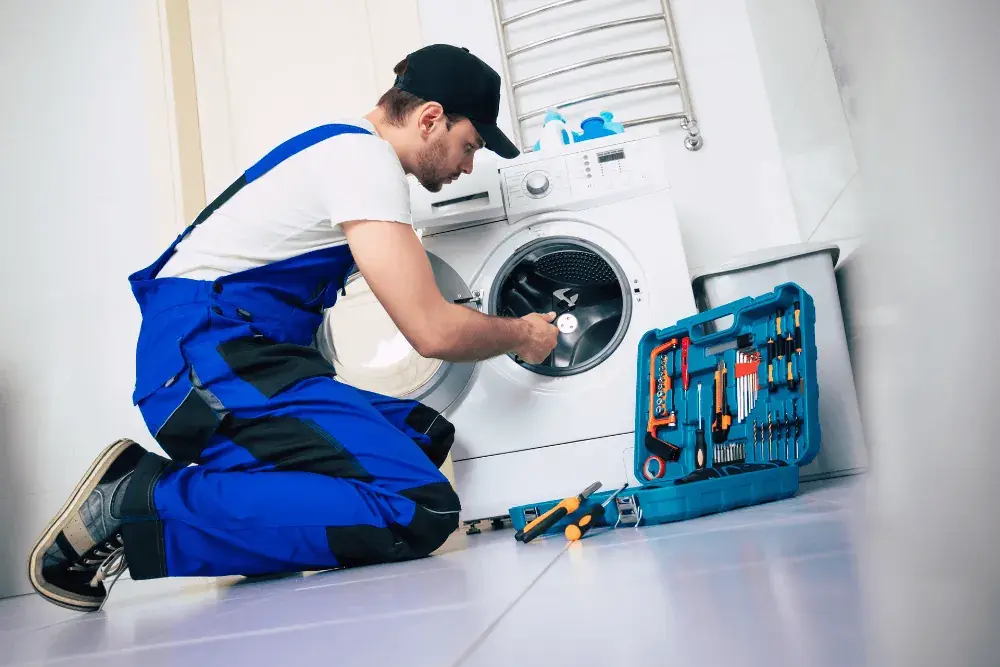
Overview
A washing machine not draining has a blocked pump filter, a blocked or kinked drain hose, a blocked household drain or a failed drain pump, in roughly that order of likelihood. The first three you can check and clear yourself in half an hour with a towel and a shallow tray.
This guide starts with how to get the water out safely, because nothing else can be done with a full drum. It then takes you through the checks in order, explains each cause and how to confirm it, and tells you where to stop. It covers front load and top load machines. The checks are the same on every make, including Samsung, LG, Bosch, Siemens, Whirlpool, Beko, Hotpoint, Indesit, Electrolux, Zanussi, Hoover, Candy, Haier, Kenmore and Frigidaire. If the checks do not cure it, washing machine repair in Dubai has the booking details.
Washing machine not draining: the short answer
Water left in the drum at the end of a cycle means the pump could not push it out, or was never told to. Work through these in order.
If the machine drains and then will not spin, the fault may still be drainage: most machines refuse to spin with water inside. If it spins and the clothes are simply wetter than usual, see our guide to a washing machine not spinning.
Before anything else: get the water out safely
You cannot clear a filter or move a machine that is holding 15 to 40 litres of water without planning where that water will go. Take ten minutes to drain it under control.
Water and mains electricity are both present. Unplug at the wall before you touch anything.
If the machine stopped during a hot wash, wait until the door glass is cool to the hand.
Plug back in, select Drain or Spin only, and listen. If the water goes, the original stoppage may have been a one-off. If the pump hums and nothing moves, unplug again and carry on.
Open the small flap at the bottom front. Many front loaders have a thin rubber tube beside the filter with a plug in its end. Pull it out, hold the end over a shallow tray, remove the plug and let it run. Refit the plug each time the tray is full.
Unhook the drain hose from the standpipe or sink at the back and lower its end into a bucket or a floor drain. Water runs out by gravity as long as the end is below the water level in the drum.
With towels down and a tray pushed against the machine, turn the filter cap anticlockwise a quarter turn until water runs, then close it to empty the tray. This is slow and wet, and it works.
Lower the drain hose into a bucket or floor drain, or bale the water out with a jug.
Expect more water than you think. A shallow oven tray holds about two litres, so a full drum needs a dozen or more trips. A wet-and-dry vacuum on the end of the drain hose is the quick way if you have one.
Do not tip the machine to pour water out, and do not force the door. The door stays locked while the machine senses water, and it releases once the level has dropped.
Read the symptom first
What the machine does at the point where it should drain tells you a good deal before you open anything.
One detail catches many people: on a new sink trap or waste disposer, the spigot where the washing machine hose connects is supplied sealed. If nobody cut out or knocked through that blanking cap, the machine has nowhere to pump.
Check 1: the pump filter
The pump filter, also called the debris filter or coin trap, sits in front of the pump and catches whatever comes out of pockets and off clothes. A blocked filter is the cause of most draining faults, and clearing it takes ten minutes once the water is out.
On most front loaders it is behind a small rectangular or round flap at the bottom right or left of the front panel. Some have it behind the plinth strip, which clips or screws off.
Machine unplugged, water drained as far as you can, towels and a tray in place.
It may be stiff. Turn steadily. More water will come.
Remove lint, hair, coins, buttons and anything else. Rinse it under the tap.
Take out anything lying in the cavity. You may see the pump impeller at the back or side: small plastic paddles on a spindle.
It should turn with a slight, notchy resistance, a little at a time. If it is jammed solid, something is caught in it and the pump is clogged. If it spins completely freely or wobbles, it may have come off its shaft.
Line up the thread carefully and turn clockwise until it stops firmly. A filter that is cross-threaded or not fully home leaks on the next wash.
Run a Rinse and Spin or Drain programme and watch the filter cap for drips.
Top loaders and machines without a front filter
Many top loaders, and some front loaders, have no filter you can reach. Their pump is under the machine or behind the back panel. On these, check the hose and the household drain, and leave the pump to a technician.
Check 2: the drain hose
The drain hose is the grey corrugated pipe at the back. It is easily kinked when the machine is pushed against the wall, and its ridges collect lint and sludge over the years.
Carefully, without stretching the hoses or cable.
Look for sharp bends, flattened sections where the machine or a cabinet has pressed on it, and splits.
The last few centimetres often clog where the hose enters the standpipe or spigot.
Lower the end into a bucket. If the drum still has water in it, water should run freely. A trickle means the hose or the sump inside the machine is blocked.
If you can detach the hose at the machine end, which usually needs the back panel off and is a job for a technician, it can be flushed through. Otherwise, run water into the free end with it held high, then lower it into a bucket to see whether water passes.
See the next section. Routing matters as much as cleanliness.
Check 3: how the hose is connected
A washing machine pump is small. It can lift water about a metre and no more, and the hose has to be arranged so that water can neither run out by itself nor come back. Installation faults cause drain errors, long cycles and poor washing that are often blamed on the machine.
Signs of siphoning
Use the plastic U-shaped hook that came with the machine to hold the bend in the hose. If it has been lost, a cable tie to the standpipe or the wall at the right height does the same job. The exact heights for your model are in its installation instructions.
Check 4: the sink trap, standpipe and floor drain
If the hose and filter are clear and the pump is working, the water has to go somewhere. A blocked household drain sends it back up the standpipe, into the sink, or out over the floor.
In apartment kitchens, the washing machine usually shares the sink waste. Grease from the sink and lint from the washer combine into a firm plug in the spigot and the first bend. If water rises in the sink when the machine pumps out, that plug is the reason.
A blockage further along, in the building's pipework, is the building maintenance team's job. If several fittings in the home are slow, report it to them.
Check 5: the pump itself
The drain pump is a small sealed motor with a plastic impeller, bolted to the filter housing. It either runs or it does not, and it either moves water or it does not.
A pump that is silent is not always dead. The machine may not have reached the drain stage because of another fault, or a wire may be off. That is why a technician measures the supply at the pump connector before fitting a new one.
Pump replacement is a short repair on most machines. What it involves and what it typically costs are on our washing machine parts page.
Causes inside the machine
If the filter, hose, household drain and pump all check out, the cause is deeper. These need the machine opened.
Too much detergent deserves a mention. A drum full of foam drains badly because the pump cannot grip froth. If you see suds, wait an hour, run a rinse with no detergent, and use less next time, particularly with soft water and small loads.
Front load and top load: the differences
The principles are the same on both types. The access and the common faults differ.
Some top loaders, particularly Asian-market models, drain through a valve at the bottom of the tub by gravity, with no pump at all. These must drain to a floor-level outlet, and they fail to drain if the hose is lifted above the base of the machine. Check the manual before raising the hose on a top loader.
Error codes that mean not draining
Most machines show a code when a drain takes too long. These are the codes we have confirmed from the makers' own documentation. For any other make, or any other code, note it exactly and look it up in the manual for your model.
A code tells you which stage failed, not which part. A drain code with a clean filter and a clear hose still leaves the pump, its wiring and the household drain to check. Brand detail is on the pages for Samsung, LG, Bosch and the other brands we repair.
What not to do
When to stop and call a technician
Stop and book a repair when any of these is true.
These are market ranges published in 2026 Dubai price guides, not our price list. Our diagnostic visit is AED 100 plus VAT, and the repair price is fixed before work starts. See our guide to washing machine repair cost in Dubai.
How to stop it happening again
A full cleaning routine is in our guide to how to clean a washing machine.
Frequently asked questions
Why is my washing machine not draining?
The pump filter is blocked, the drain hose is kinked or blocked, the household drain is blocked or the drain pump has failed. Check them in that order.
How do I drain a washing machine that is full of water?
Unplug it. Use the small emergency hose beside the filter, or lower the main drain hose into a bucket or floor drain, or open the filter a little at a time over a tray.
Where is the filter on a washing machine?
Behind a small flap at the bottom front on most front loaders. Many top loaders do not have one you can reach.
The pump is humming and no water comes out. What is wrong?
Something is blocking the filter, the impeller or the hose, or the impeller has come loose from the pump.
The pump makes no sound. Is it broken?
Possibly. It may also be getting no power because of a wiring, lock or control fault. A technician tests the supply before replacing it.
Why does water come back into the drum after draining?
The drain hose is not looped high enough, or sink waste is running into it. Fix the hose at the height the manual gives.
Why does my machine fill and drain at the same time?
It is siphoning. The hose end is too low or pushed too far into the standpipe.
Can I use drain cleaner to unclog a washing machine?
No. It damages seals and hoses. Clear the filter and hose by hand, and treat the household drain separately with the hose disconnected.
How often should the filter be cleaned?
Every one to two months.
How much does a drain pump replacement cost in Dubai?
Published market ranges are about AED 200 to 400 fitted. We give a fixed price after diagnosis.
Will the door open with water inside?
No. Drain the water first and the lock releases after a minute or two.
Who can fix a washing machine that will not drain in Dubai?
One Click Dubai sends a technician the same day. Call or WhatsApp +971 55 209 9785.
A technician can find the cause on site. The diagnostic is AED 100 plus VAT, and repairs carry a 1-month warranty.