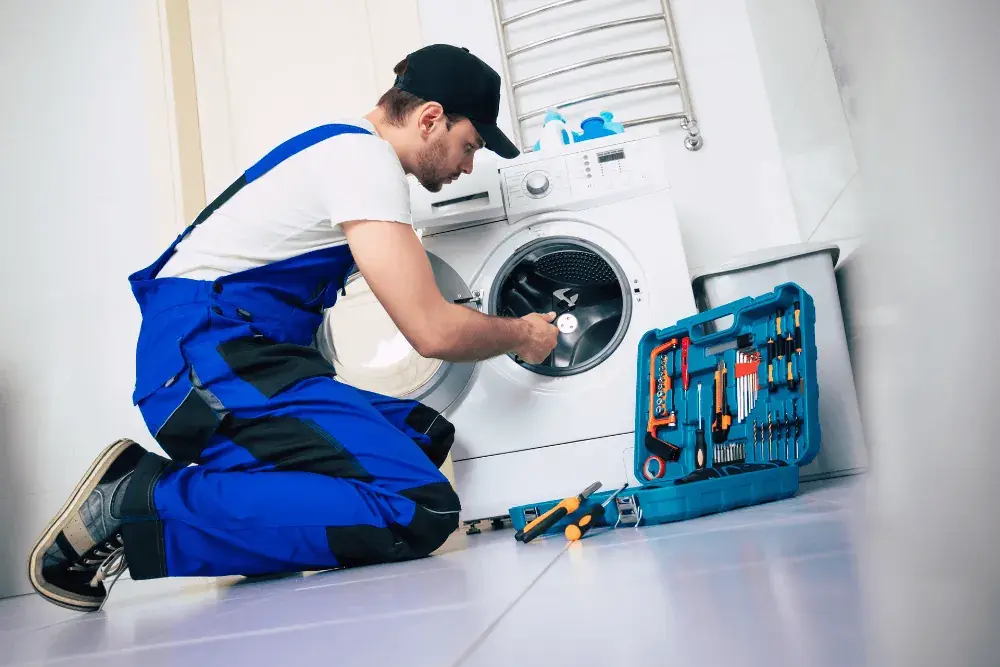
Overview
A washing machine not spinning is refusing to spin on purpose in most cases. It has detected an unbalanced load, water still in the drum, too much foam or a door that is not locked, and it has skipped the spin to protect itself. Those four causes need no parts. A drum that cannot turn at all is a different matter and points to the belt, the motor or its control.
So the first question is which of two faults you have: a machine that washes and drains but will not spin fast, or a drum that does not turn in any part of the cycle. This guide separates them, gives the checks for each in order, and explains what the mechanical causes are and how they are confirmed. It covers front load, top load and twin tub machines. The checks are the same on every make, including Samsung, LG, Bosch, Siemens, Whirlpool, Beko, Hotpoint, Indesit, Electrolux, Zanussi, Hoover, Candy, Haier, Kenmore and Frigidaire. If the checks do not cure it, see washing machine repair in Dubai.
Washing machine not spinning: the short answer
Spin is the last and most demanding stage. The machine checks several things before it will start, and any one failing leaves the clothes wet.
Start with the top five. They account for the majority of no-spin complaints and cost nothing.
Which fault do you have?
Watch one cycle from the end of the wash. What the drum does in the next five minutes sorts the fault into one of four groups.
Two quick tests
Select the spin or drain-and-spin programme with nothing inside. If it spins up to full speed, the machine is mechanically sound and the problem is the load, the balance or the foam. If it will not spin empty, it has a fault.
It should turn smoothly with some weight and a soft whirr from the motor on a belt machine. Completely free and silent suggests a belt. A scrape, a knock or a stiff spot suggests an object or bearings.
The empty spin test is the most useful thing you can do before calling anyone. Tell us its result when you book.
Unbalanced loads: the commonest cause
A washing machine will not spin a load it cannot balance. At 1,200 revolutions a minute, a kilogram of wet laundry stuck to one side of the drum pulls with a force of well over a hundred kilograms. So before spinning, the machine tumbles the load slowly to spread it, measures the wobble, and only accelerates if the wobble is small enough. If it cannot get a balance after several tries, it spins slowly or not at all.
Do not force it.
Shake items out and spread them evenly round the drum.
To get an even, medium load.
And watch.
On machines that show a code for imbalance, the confirmed ones are Samsung UE, Ub or Ur, LG UE, Bosch and Siemens E32 or F32, and Whirlpool Ofb or uL. A machine that shows the imbalance code on every load, including well-mixed ones, has a level or suspension problem.
Water still in the drum
No machine will spin with water inside. If the drain stage fails, the spin is cancelled, and what looks like a spin fault is a drain fault.
A partial blockage is more deceptive. The machine drains slowly, runs out of time, and goes into a reduced spin or none. If cycles have been getting longer and the clothes wetter over weeks, the filter is the first suspect. The full procedure, including how to empty the drum safely, is in our guide to a washing machine not draining.
Too much foam
Foam stops a spin in two ways. It airlocks the drain pump, so water is left behind, and it acts as a brake on the drum, which the machine reads as an overload. Makers call the worst case a suds lock.
Foam collapses by itself in 30 to 60 minutes.
Cold, with the load in.
It should now reach speed.
To clear the residue that feeds the next foam problem.
Confirmed foam codes are Samsung SUd or 5Ud, LG Sud, Bosch and Siemens E33 or F33, Whirlpool Sud or Sd, and Miele F16. If you see foam at the glass during the rinse, you are using too much.
Programme and settings
Several programmes and options reduce or remove the spin by design. Check these before assuming a fault.
Machines remember the last spin speed on some programmes. If someone washed wool on the same programme slot, the next cottons load can come out wet.
Level, feet and transit bolts
A machine that rocks cannot balance a load, and one that still has its transit bolts fitted cannot move at all.
On a newly installed front loader, look at the back for three or four large bolts with plastic spacers. They lock the tub for transport and must be removed before use. A machine that bangs and walks across the floor on its first spin almost always has them in.
Press down on each top corner in turn. Any movement means a foot is not on the floor.
Wind the loose foot down until the machine is solid, then tighten its lock nut up against the body. A spirit level on the top, front to back and side to side, should read level.
A machine on a raised plinth, a loose tile, carpet or a flexible floor will always shake. It needs a firm base.
A dryer stacked on top must be on a proper kit, or it adds to the vibration.
Feet work loose over time from vibration, which is why the lock nuts matter. A machine that started walking after years of standing still has usually lost a lock nut or worn out its shock absorbers.
Door lock and lid switch
The control will not spin unless it has confirmation that the door or lid is locked. On a front loader the lock is engaged for the whole cycle. On many top loaders the lid locks only for the spin, which is why a top loader with a failed lid lock washes normally and then stops.
Confirmed door and lid codes are Samsung dC, dE or dS, LG dE, Bosch and Siemens E16 or F16, Whirlpool F5 E2 on front loaders and LdL on top loaders, and Miele F34. Locks are replaced, not repaired. More on stuck doors is in our guide to a washing machine door that is locked.
The drive belt
On a belt-driven machine a ribbed rubber belt runs from a small pulley on the motor to a large one on the back of the drum. If it snaps or comes off, the motor runs and the drum stays still. If it stretches, the drum turns empty and slips under a wet load.
A belt rarely comes off without a reason. The usual ones are drum bearings worn enough to let the big pulley tilt, a motor loose on its mounts, or a pulley damaged. A technician checks all three when fitting a belt, since a new belt on a wobbling pulley lasts a few washes.
Direct drive machines, which include most current LG models and many Samsung, have no belt. The motor is on the drum shaft.
Motor, brushes and the direct drive sensor
What can go wrong with the motor depends on which of three kinds your machine has.
Worn brushes are the classic no-spin fault on a brush-motor machine of about five to ten years old. The brushes are small carbon blocks that wear down like pencil leads, and replacing them is one of the best-value repairs there is, provided the motor's commutator is still in good condition.
Confirmed motor codes are Samsung 3C, 3E or bE, LG LE, Bosch and Siemens E80 for the drive circuit, Whirlpool F7 E1 and Miele F53. For LE on an LG, unplug for five minutes and try a smaller load once. If it returns, it needs testing.
Shock absorbers and suspension
Shock absorbers hold the tub steady as it accelerates. When they wear out, the tub swings too far, the machine senses the movement as imbalance, and it aborts the spin on loads it used to handle.
Shock absorbers are replaced in pairs and suspension rods as a set of four. Springs at the top of the tub occasionally unhook or break, with a loud bang and a tub that sits low on one side.
Top loaders and twin tubs
Top load and twin tub machines have their own spin faults.
In a twin tub's spin tub, pack the clothes evenly round the sides, press them down and fit the plastic safety cover on top before closing the lid. Most twin tub spin complaints are packing.
What not to do
When to stop and call a technician
Book a repair if the drum will not spin empty on a Spin only programme, or if any of these applies.
These are ranges published in 2026 Dubai price guides, not our price list. Our diagnostic visit is AED 100 plus VAT, with a fixed price before work starts. Each part is explained on our washing machine parts page.
How to avoid spin problems
Frequently asked questions
Why is my washing machine not spinning?
Most often an unbalanced load, water left in the drum, too much foam or a low-spin programme. If the drum will not spin even when empty, it has a belt, motor, lock or control fault.
Why does my washing machine wash but not spin?
It is refusing the spin because of imbalance, undrained water or foam, or the door or lid lock is not confirming. On a top loader, suspect the lid switch.
Why are my clothes still soaking wet?
The spin was skipped or slow. Check the spin speed setting, the load balance and whether the water drained fully.
How do I test whether the spin works?
Run Spin only with the drum empty. If it reaches full speed, the machine is sound and the load was the problem.
The drum will not turn at all. What is it?
A broken belt, worn motor brushes, a failed motor sensor or capacitor, or a control fault. If it will not turn by hand either, something is jammed or the bearings have seized.
My LG drum jerks back and forth and shows LE. What does that mean?
LE means the motor is locked or the tub is not turning. Unplug for five minutes and try a smaller load. If it returns, the rotor position sensor or motor wiring needs testing.
Why does my machine bang and shake on spin?
An unbalanced load, feet not level, transit bolts left in on a new machine, or worn shock absorbers.
Can too much detergent stop the spin?
Yes. Foam airlocks the pump and brakes the drum. Wait, rinse without detergent, then spin.
Is it worth repairing a washing machine that will not spin?
Usually. Belts, brushes, locks, sensors and shock absorbers are all modest repairs.
How much does it cost to fix?
It depends on the cause. Published Dubai ranges run from about AED 150 to 300 for a belt up to AED 300 to 1,000 for a motor. We fix the price after diagnosis.
Can I spin clothes that are still wet from a failed cycle?
Yes. Rebalance the load and run Spin only.
Who repairs washing machines that will not spin in Dubai?
One Click Dubai sends a technician the same day. Call or WhatsApp +971 55 209 9785.
A technician can find the cause on site. The diagnostic is AED 100 plus VAT, and repairs carry a 1-month warranty.