All Dubai areas · Homes and businesses · On-site, 24/7+971 55 209 9785
Home / Services / Washing Machine Parts Replacement

Washing Machine Parts and Replacement in in Dubai

Same-day washing machine parts replacement at home across Dubai. Bearings, door seals, pumps, belts, motors, valves and boards, fitted with genuine parts.

Reviewed by Abdul Suboor, Lead Engineer at One Click Dubai, 18 years of experience

Same day service at your homeAED 100 diagnostic visit, plus VATGenuine parts, 1-month warranty
WhatsApp us
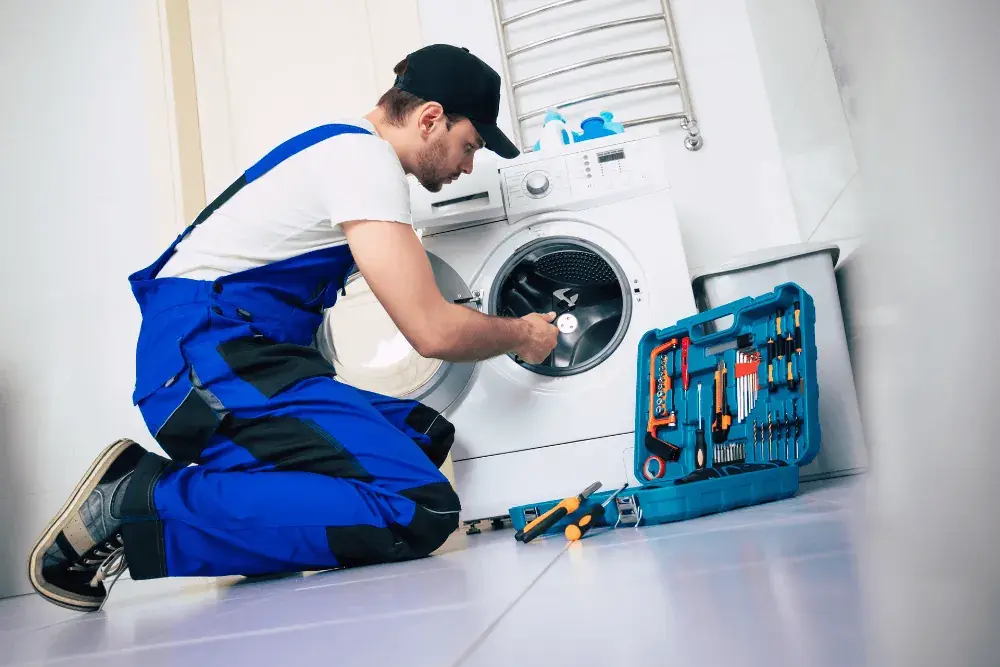
One Click Dubai technician replacing a washing machine drain pump

Overview

One Click Dubai replaces washing machine parts at home across Dubai, with a technician sent the same day. We fit bearings, door seals, drain pumps, inlet valves, belts, motors, heating elements, door locks, shock absorbers, control boards and hoses on every brand, using genuine parts.

We supply parts as part of a fitted repair. We do not sell parts over the counter. The reason is practical: most washing machine parts are specific to a model and often to a production run, and a part fitted to a machine that had a different fault is money wasted. So every job starts with a diagnosis, and you get one price for the part, the fitting and the test.

This page takes each part in turn: what it does, how you can tell it has failed, what replacing it involves and whether the repair is worth doing.

Washing machine parts replacement in Dubai: the short answers

Washing machine parts replacement in Dubai from One Click Dubai starts with a AED 100 diagnostic visit, plus VAT. The technician confirms which part has failed, checks what caused it, and gives a fixed price for the part and fitting before any work.

QuestionAnswer
How soon can you come?The same day, at any hour
Which parts?Bearings, drum and spider, door seal, drain pump, inlet valve, belt, motor, brushes, heating element, door lock, shock absorbers, springs, control board, pressure switch, hoses
Which machines?Front load, top load and washer dryers, all brands
Are parts genuine?Yes. About 90% of what we use is in stock
Can I buy a part from you?No. We fit parts as part of a repair
Is it done at home?Most replacements, yes. Bearing and drum jobs on some machines go to our workshop
What does the visit cost?AED 100 plus VAT, with no night or weekend surcharge
Is the repair covered?Yes. One month on parts and labour

Finding your model number

Every washing machine part is ordered by the machine's model number, and on many brands by a second code that identifies the production version. Two machines with the same name on the front can use different pumps, seals and boards.

BrandWhere the rating label isWhat to send
SamsungInside the door rim or on the back panelModel code beginning WW, WF, WD or WA
LGInside the door rim or on the backModel code beginning F, FH, WM or T
Bosch and SiemensInside the door rimE-Nr and FD
Whirlpool, Ariston, Indesit and HotpointInside the door or behind the filter flapModel and the 12-digit service code
BekoInside the door rimModel and product number
Electrolux, AEG and ZanussiInside the door rimModel and PNC, the product number code
MieleInside the door rimModel and serial number
Top loaders, including Whirlpool, Maytag and KenmoreUnder the lid or on the backModel and serial number

Photograph the whole label and send it when you book. It lets us bring the right part on the first visit.

Which part has failed? A symptom guide

The symptom usually narrows the fault to two or three parts. This table is a starting point, and the visit confirms it with tests.

SymptomParts to suspect, most likely first
Loud roar or rumble on spin, getting worse over weeksDrum bearings
Water under the machine at the frontDoor seal, detergent drawer hose, door glass seating
Water under the machine at the back or beneathDrain pump, sump hose, inlet valve, tub seal with failed bearings
Water left in the drum, will not drainBlocked pump filter, drain pump, drain hose
No water enteringInlet valve, blocked valve filter, closed tap, pressure switch
Fills and never stopsInlet valve stuck open, pressure switch or its hose
Motor runs, drum does not turnBelt
Drum will not turn, no motor soundMotor, brushes, control board, door lock
Cold wash, long cyclesHeating element, temperature sensor
Door will not lock or will not openDoor lock, handle, control board
Bangs and walks on spinShock absorbers, springs, transit bolts left in, load out of balance
Dead, or lights and no responseControl board, door lock, mains filter
Trips the breakerHeating element, motor, wet wiring

Our guides go deeper on each symptom: not draining, not spinning, leaking, making noise, not filling, won't start and door locked.

Drum bearings

Washing machine drum bearings are two ball bearings pressed into the back of the outer tub. They carry the drum shaft and let it spin at up to 1,400 rpm or more. A rubber seal in front of them keeps the wash water out. When that seal wears, water reaches the bearings, washes out the grease and rusts them.

SignWhat it tells you
Rumbling or roaring on spin, like a jet engineBearings worn
Noise present when the empty drum is spun by handConfirms bearings, not a loose object
Drum lifts or rocks at its front edge when pushed upPlay in the bearings
Rusty or brown streaks down the back of the tubThe seal has failed and water is passing
Grey or oily marks on laundryGrease washing out past the seal
Leak from the back, worst on spinAdvanced failure
1
Strip the machine

Top, back, front, door seal, weights, motor, belt, pulley, shock absorbers, springs and all hoses and wiring to the tub.

2
Remove the tub and split it

A bolted tub is opened along its seam.

3
Withdraw the drum and inspect the shaft and spider

A scored shaft or a corroded spider is replaced with the bearings.

4
Drive out the old bearings and seal

Clean the housing.

5
Press in new bearings and a new seal

With the correct grease on the seal lip.

6
Rebuild with a new tub seal

And test on a full spin.

Sealed tubs

Many current machines have an outer tub that is welded shut. The bearings cannot be reached without cutting the tub, so the maker supplies a complete tub and drum assembly. That part can cost a large share of a new machine. We tell you which kind you have before quoting.

Is it worth it?

Bearing replacement is the largest routine repair on a washing machine. It is worth doing on a good machine with a bolted tub, usually worth doing on a premium machine under eight to ten years old, and often not worth doing on a budget machine with a sealed tub. Running on with noisy bearings ends with the shaft or spider breaking and the drum dropping, which damages the tub and the heater.

Drum, spider and paddles

The drum is the stainless steel basket that holds the laundry. It rarely fails itself. What fails is the aluminium spider bolted to its back, which carries the shaft, and the plastic paddles inside.

FaultSignsRepair
Spider arm corroded or crackedDrum wobbles, knocks the door glass or scrapes on spin. White powdery deposit behind the drumNew spider where sold separately, otherwise a new drum
Broken washing machine drum, loose in the tubLoud banging, drum sits low or at an angleStop using it. Drum, bearings and often tub
Paddle (lifter) loose or brokenRattle, clothes snagging, a hole in the drum wall where it satNew paddle. A small job
Object trapped between drum and tubScraping or clicking as the drum turns. Bra wires and coins are usualRetrieve through the heater opening or the sump
Drum will not turn by handSeized bearings or a jammed objectInvestigate before forcing

Spider corrosion is driven by detergent residue and standing moisture behind the drum. A hot maintenance wash every month and leaving the door ajar between washes slow it.

Door seal (gasket or door boot)

The washing machine door seal, also called the gasket or door boot, is the large rubber bellows between the door opening and the tub on a front loader. It flexes with every movement of the tub and keeps water in. It fails by tearing, by perishing, or by mould eating into the rubber.

SignCause
Water running down the front or pooling at the doorSplit or hole in the seal, usually at the bottom fold
Small tear with rust marksA coin, wire or zip trapped and dragged round
Black spots that will not wash offMould in the rubber
Seal pulled out of its grooveRetaining band slipped or broken
Leak only on the highest water levelsHole higher up the seal
Seal intact, still leaks at the doorDoor glass dirty or hinge dropped, so the glass does not seat
1
Release the outer retaining band

And peel the seal off the front panel.

2
Remove the front panel or top as the design requires

To reach the inner band.

3
Release the inner band and remove the seal

With any drain or recirculation spout attached to it.

4
Clean the tub lip

Old residue stops the new seal seating.

5
Fit the new seal with its marks and drain holes at the bottom

And refit both bands.

6
Test on a fill and a spin

For leaks and for rubbing.

Rubber seal replacement takes about an hour on most machines. Patching a torn seal with glue or tape does not last, because the rubber flexes thousands of times per wash. After fitting, wipe the fold dry after the last wash of the day and leave the door open.

Drain pump

The washing machine drain pump is a small electric pump at the bottom of the machine that pushes used water up the drain hose. It runs at the end of each wash and rinse and during spin. Blockage is far more common than failure, so the filter is always checked first.

SymptomCauseRepair
Water left in the drum, pump hummingFilter blocked, or a coin, hair grip or sock jamming the impellerClear the filter and the pump chamber
Water left in the drum, pump silentPump motor failed, or no power from the boardNew pump. Test the supply
Drains slowly, spin cancelledPartial blockage, kinked drain hose, worn impellerClear. New pump if the impeller is loose
Loud rattling or grinding while drainingObject in the pump, or broken impeller bladesClear or replace
Leak from the bottom front cornerPump body cracked, filter seal perished or filter cross-threadedNew seal or pump
Drains, then water comes backDrain hose too low or pushed too far into the standpipeRe-route the hose

The filter is behind a flap at the bottom front on most machines. Put a tray under it, open it slowly and let the water out before unscrewing fully. Clearing it every month or two prevents most pump calls. Pumps are specific to the make: Samsung, LG, Bosch and Whirlpool pumps differ in fitting and connector, and some machines have a second pump that recirculates water.

Water inlet valve

The washing machine water inlet valve is the electrically operated tap where the fill hose joins the back of the machine. The control board opens it to fill. Machines with separate hot and cold fill, or with several detergent compartments, have a valve with two or three coils.

SymptomCauseRepair
No water enters, hum at the backValve filter clogged with grit, or tap closedClean the mesh filter. Open the tap
No water, no humValve coil open circuit, or no signal from the boardNew valve. Test the board
Fills very slowlyClogged filter, low pressure, kinked hoseClean. Check supply
Water trickles in when the machine is offValve not sealingNew valve. Close the tap until then
Overfills or floodsValve stuck open, or the pressure switch is not telling the board to stopNew valve or pressure switch
Detergent not taken from one compartmentOne coil of a multi-coil valve failedNew valve
Leak at the back top cornerValve body cracked or the hose seal perishedNew valve or hose washer

A valve that lets water through with the power off will slowly fill the drum and can flood a kitchen overnight. If you find water in a machine that has not been used, close the tap and book a repair.

Drive belt

The washing machine belt carries the motor's rotation to the large pulley on the back of the drum. It is a flat, ribbed rubber belt. Direct drive machines, including most current LG models and many Samsung ones, have the motor on the drum shaft and no belt at all.

SymptomCauseRepair
Motor runs, drum does not turnBelt snapped or come offNew belt. Find why it came off
Drum turns empty, stalls with a loadBelt stretched and slippingNew belt
Squeal on start or on spinBelt slipping, glazed or misalignedNew belt. Check pulleys
Burning rubber smellBelt slipping against a seized drum or an overloaded machineFind the cause before fitting a belt
Black dust under the machineBelt wearingNew belt
New belt keeps coming offWorn bearings letting the drum pulley tilt, or a bent motor pulleyFix the underlying fault

A belt that has come off once is a warning. The usual reason is drum bearing play, which lets the big pulley wobble until the belt walks off it. Belts are sized by length and number of ribs, printed on the belt itself.

Motor and carbon brushes

The washing machine motor turns the drum for washing and spinning. Older and budget machines use a brush motor with a belt. Newer ones use a brushless inverter motor, belt-driven or direct drive, controlled by an electronic module.

Motor typeCommon failureRepair
Brush (universal) motorCarbon brushes worn to their limit. Drum stops, turns weakly or sparks are visible at the motorNew brushes, if the commutator is in good condition
Brush motorCommutator burnt or windings failed. Burning smell, trippingNew motor
Brush motorTacho sensor on the motor failed. Drum spins flat out or not at allNew tacho or motor
Inverter motor, belt-drivenMotor or its inverter module failedTest both. Replace the failed one
Direct drive motorRotor position sensor (hall sensor) failed. Drum jerks and stops with an errorNew sensor. A small part
Direct drive motorStator winding failed, or rotor magnets crackedNew stator or rotor
Top load machineMotor capacitor, clutch or gearboxReplace the failed part

Carbon brushes are a wearing part on brush motors and are cheap to replace, which makes it the best-value repair on an older machine. On a direct drive machine, a drum that jerks back and forth and gives up is far more often the small hall sensor than the motor.

Heating element and temperature sensor

The washing machine heating element sits in the bottom of the tub and heats the wash water. A temperature sensor, usually clipped into the element's mounting, tells the control board when the target is reached.

SymptomCauseRepair
Washes cold, cycles take much longer or stop with an errorElement open circuitNew element
Trips the breaker a few minutes into the washElement insulation broken down, leaking to earthNew element
Clothes come out poorly cleaned, powder undissolvedNo heatTest the element and sensor
Water too hot, or a temperature errorSensor reading wrongNew sensor
Element coated in thick scaleHard deposits insulating it until it overheatsNew element. Descale routinely
Element tested good, still no heatRelay on the control boardBoard repair or replacement

The element is reached from the back or the front, below the drum, and is changed in under an hour. While it is out, the opening gives access to the bottom of the tub, and anything that has fallen through the drum can be retrieved.

Door lock, handle and hinge

The washing machine door lock, or interlock, holds the door shut and tells the control board it is safe to start. If the board does not see the lock engage, nothing happens.

SymptomCauseRepair
Door closes, machine will not start, door symbol flashingLock not engaging or failedNew door lock
Door will not open after the cycleLock stuck, water still in the drum, or the handle brokenDrain first. Release and replace the lock or handle
Door will not latchLatch hook on the door broken, or hinge droppedNew latch or hinge
Handle snappedForced against a locked doorNew handle
Clicks repeatedly at the startLock trying and failingNew lock
Door opens during a washLock or latch worn. A safety faultStop using it. Replace

Most locks release one to two minutes after the cycle ends. If the door will not open, do not pull on the handle. Wait, then check for water in the drum. Our guide to a door that is locked and won't open explains the emergency release.

Shock absorbers, springs and weights

A front loader's tub hangs on springs from the top and rests on shock absorbers at the bottom, with concrete weights bolted on to steady it. Together they absorb the forces of spinning.

SymptomCauseRepair
Bangs against the cabinet on spinShock absorbers worn outNew pair. Always replace both
Machine walks across the floorWorn shock absorbers, feet not level, or a soft floorShock absorbers. Level the feet
Loud knocking from the topSpring unhooked or broken, or a weight looseRefit or replace. Tighten
Cracked concrete weightBolts worked looseNew weight
Violent shaking on a new machineTransit bolts not removedRemove them
Spin aborted, clothes left wetMachine detecting imbalance, sometimes from weak shock absorbersTest and replace

Top loaders use suspension rods in place of shock absorbers, one at each corner, and they are replaced as a set of four.

Control board, pressure switch and sensors

The control board, also called the PCB or module, runs the programme. It switches the valve, pump, heater, lock and motor in sequence and watches the sensors. It is the most expensive electrical part and the one most often blamed wrongly.

SymptomPossible cause other than the boardWhen it is the board
Dead, no lightsSocket, plug fuse, mains filter, door lockPower reaches the board and nothing lights
Stops mid-cyclePump, heater, lock or motor fault the board is reacting toParts test good and the board is not switching them
Wrong programme times, random behaviourLow voltage, damp connectorsAfter drying and reseating, still erratic
Buttons or dial do not respondChild lock, stuck buttonDisplay board failed
Burn mark or smell at the boardA shorted part downstream took a relay or track with itBoard, and the part that caused it

A pressure switch senses water level through a thin air hose from the tub. If the hose is blocked or split, the machine overfills, underfills or will not spin. The part is small and inexpensive, and it is checked before any board is condemned. Where a board has a single failed relay or component, repair is sometimes possible. Otherwise it is replaced with the correct programmed part for the model.

Top load parts: agitator, clutch, timer and lid switch

Top load washing machines have a different set of wearing parts from front loaders. There is no door seal and usually no heater. The drive train under the tub does the work.

PartWhat it doesSigns of failureRepair
Agitator and its drive dogsThe central post that moves the laundry. Small plastic dogs let the top half ratchet one wayTop of the agitator spins freely or does not move, clothes not turning overNew dogs or agitator. A small job
PulsatorThe ribbed disc in the base of the tub on machines without an agitatorLoose, noisy or not rotatingNew pulsator or its fixing
Clutch and gearboxSwitch the drive between washing and spinningWashes and will not spin, spins and will not wash, grinding, oil under the machineNew clutch or gearbox
Motor coupling or beltJoins the motor to the gearboxMotor runs, nothing turnsNew coupling or belt
Lid switch or lid lockStops the spin when the lid is openWill not spin or will not startNew switch or lock
Suspension rodsHang the tub and damp its movementTub bangs the cabinet on spin, unbalance errorsNew set of four
Mechanical timerSteps the programme on older machinesSticks at one point, will not advanceNew timer
Drain pump or drain motorEmpties the tubWater left in the tubClear or replace
CapacitorStarts the motorMotor hums and will not turnNew capacitor

Twin tub machines add a separate spin motor and brake. Most top load and twin tub repairs are small, and the machines are worth keeping going.

Detergent dispenser drawer

The detergent dispenser drawer and the housing behind it carry water from the inlet valve through the powder, liquid and fabric softener compartments into the tub. Faults here are nearly always blockages.

SymptomCauseFix
Powder left in the drawerLow water pressure, blocked jets in the drawer housing roof, or damp powder caked in placeClean the housing. Check the pressure and valve filter
Fabric softener not taken, or water left in its compartmentSiphon cap blocked with residueLift out the cap and wash it
Softener or bleach taken at the wrong timeSiphon cap missing, or one coil of the inlet valve at faultRefit the cap. New valve
Water dripping or pouring from the drawer frontHousing or the hose below it blocked with sludge, or pressure too highClean the housing and hose
Drawer will not open or closeRunner or release catch brokenNew drawer or catch
Black mould in the drawer recessResidue and dampRemove the drawer and scrub the recess. Leave it ajar to dry

Pull the drawer right out once a month, wash it under the tap and wipe the recess, including its roof where the water jets are.

Hoses

A washing machine has an inlet hose, a drain hose and several internal hoses. All are rubber or plastic, and all harden with age.

HoseFaultFix
Inlet (fill) hoseBulge, split or weeping at the crimp. Perished washer at the tapNew hose. Replace every five years or so as a precaution
Drain hoseKinked, split, blocked with lint, or pushed too far into the standpipeClear, re-route or replace
Sump hose, tub to pumpSplit at a fold, or holding a trapped sockNew hose. Clear
Drawer to tub hoseBlocked with powder, or splitClean or replace
Pressure hoseBlocked or perishedNew hose

A burst inlet hose is the leak that floods apartments. If your hoses are original and the machine is over five years old, changing them is cheap insurance. To connect a washing machine drain hose correctly, hook it at least 60 cm above the floor so the machine cannot siphon, and push it no more than about 15 cm into the standpipe.

Genuine parts and why the model number matters

We fit genuine parts made for the model. The difference from a copy part is not the name on the box. It is fit, rating and life.

A copy door seal that is slightly the wrong shape rubs on the drum or weeps at the band.
A pump with the wrong outlet angle kinks the hose behind it.
A heating element of the wrong length touches the drum.
Bearings of a lower grade last a fraction of the time, and the labour to fit them is the same.
A control board must carry the right software for the model, or the programmes do not match the machine.

Where a genuine part has been discontinued for an old machine, we will tell you, and tell you what the alternatives are, before any work.

What washing machine parts cost to replace in Dubai

These are typical market ranges in Dubai for a fitted repair, part and labour together, as published in 2026 price guides. They are not our price list. Your price is fixed after the diagnostic visit, and depends on the brand, the model and the part.

RepairTypical Dubai market range, fittedWorth doing?
Drain hose or clampAED 100 to 200Yes
Drive beltAED 150 to 300Yes
Water inlet valveAED 150 to 300Yes
Drain pumpAED 200 to 400Yes
Heating elementAED 200 to 450Yes
Door sealAED 250 to 500Yes
Drum bearingsAED 350 to 700On a bolted tub, usually
Control boardAED 400 to 800On a machine in good condition
MotorAED 300 to 1,000Depends on the motor type and the machine's age

Premium brands and sealed-tub assemblies fall above these ranges. Door locks, brushes, shock absorbers and pressure switches generally sit at the lower end. A fair rule is to repair when the cost is under half the price of an equivalent new machine and the machine is otherwise sound. Our guide to washing machine repair cost in Dubai covers the decision in more detail.

Our diagnostic visit is AED 100 plus VAT, with a fixed price for the repair given before work starts.

How a parts replacement visit works

A parts replacement is one visit when the part is in stock, which it is for about 90% of what we fit.

1
You send the model label and describe the fault

So the likely parts are on the van.

2
The technician tests

The suspected part and whatever feeds it, so that a pump is not fitted to a machine with a board fault.

3
You get a fixed price

For the part, the fitting and the test.

4
The part is fitted

And the cause of failure is dealt with: a blocked filter, a loose hose, a leak onto a motor.

5
The machine is run

Through fill, wash, drain and spin.

For the machine as a whole see washing machine repair, for combined machines washer dryer repair, and for each make the brands we repair.

We cover all of Dubai, including Dubai Marina, JBR, Palm Jumeirah, JLT, Downtown, Business Bay, Jumeirah, Al Barsha, Dubai Hills and Deira.

Frequently asked questions

Who replaces washing machine parts in Dubai?

One Click Dubai fits washing machine parts at home across Dubai, the same day. Call or WhatsApp +971 55 209 9785.

Do you sell washing machine spare parts?

No. We supply parts only as part of a fitted repair, after a diagnosis.

How much does washing machine bearing replacement cost?

Typical Dubai market ranges are AED 350 to 700 fitted, more for sealed-tub assemblies and premium brands. We quote a fixed price after the diagnostic visit.

Is it worth replacing washing machine bearings?

On a good machine with a bolted tub, usually yes. On a budget machine with a sealed tub, often not.

How do I know my drain pump has failed?

Water stays in the drum and the pump is silent, or it hums with a clear filter. Check the filter first.

Can a torn door seal be repaired?

No. It is replaced. Glue and patches fail within a few washes.

Why does my washing machine belt keep coming off?

Worn drum bearings or a bent pulley. A new belt alone will not last.

How long does a parts replacement take?

Under an hour for most parts. Bearings take several hours and may be done in our workshop.

Are the parts genuine?

Yes.

Do you replace parts on all brands?

Yes, including Samsung, LG, Bosch, Siemens, Whirlpool, Beko, Ariston, Indesit, Hotpoint, Electrolux and Miele.

What does the visit cost?

AED 100 plus VAT. The repair is quoted at a fixed price once the fault is found.

Is the repair guaranteed?

Yes, for one month on parts and labour.

Book a washing machine parts replacement

Call or WhatsApp +971 55 209 9785 at any hour, or use the booking form. Send the rating label and tell us what the machine is doing.

CallWhatsApp