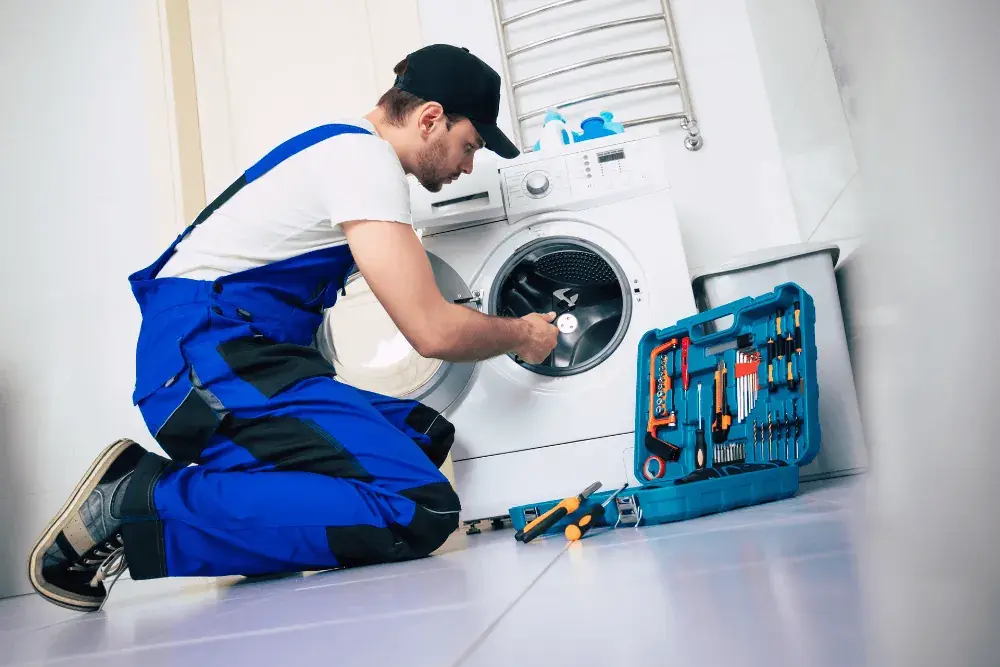
A washing machine that won't start or is not turning on is in one of two states, and they have different causes. Either it is completely dead, with no lights and no sound, which is a power problem. Or it has lights and will not begin a cycle, which is the door lock, a setting, the water supply or a control fault.
Most of the first group are found at the socket, and most of the second at the door. This guide takes them in the order worth checking, tells you what each test proves, and marks clearly where home checks end, because several of the remaining faults involve mains electricity inside the machine. It covers front load, top load and twin tub machines. The checks are the same on every make, including Samsung, LG, Bosch, Siemens, Whirlpool, Beko, Hotpoint, Indesit, Electrolux, Zanussi, Hoover, Candy, Haier, Kenmore and Frigidaire. For a repair, see washing machine repair in Dubai.
StateCauseWho fixes it
Dead: no lights, no soundSocket switched off, plug loose, plug fuse blownYou
DeadBreaker or RCD trippedYou, once. If it trips again, a technician
DeadExtension lead or adaptor failedYou: plug directly into a wall socket
DeadNo power in that socket circuitElectrician or building maintenance
DeadPower cable, mains filter, on/off switch or control board failedTechnician
Lights on, will not startDoor or lid not closed or not lockingYou, or a new lock
Lights onChild lock onYou
Lights onDelay start, pause, or a programme not properly selectedYou
Lights onWaiting for water: tap closedYou
Lights onA stored fault: code or flashing lightsDepends on the code
Lights on, clicks and gives upDoor lock failedTechnician
Starts, then stops within a minuteFill, drain, motor or leak fault detectedSee the matching guide
Display on, buttons deadControl or display board, or a stuck buttonTechnician
Decide first which state you are in. If any light or display comes on when you press the power button, skip to the section on lights on and no start.
A machine with no lights is not receiving power, or the power is stopping just inside it. Work from the wall inward.
1
Check the socket switchIt sounds obvious. Sockets behind machines and inside cabinets get switched off during cleaning.
2
Push the plug fully homeA plug that has worked loose with vibration makes poor contact.
3
Test the socket with something elseA phone charger or a lamp. If that does not work either, the socket has no power.
4
Check the distribution boardLook for a breaker in the off or middle position, or an RCD that has tripped. Reset it once.
5
Check the plug's fuseOn a UK-type plug with a fuse, a blown fuse stops everything. Replace it with one of the same rating, 13 amp for a washing machine.
6
Remove any extension lead, adaptor or multi-way blockPlug the machine straight into a wall socket.
7
Try another socketOn a different circuit if you can reach one safely, to rule out the socket.
8
Press and hold the machine's power buttonSome need a firm press of a second or more.
ResultMeaning
Socket was off, or plug looseSolved
Socket dead, breaker was tripped, resets and holdsA one-off trip. Watch whether it happens again
Breaker trips again as soon as the machine is plugged in or switched onA fault in the machine: heater, motor, pump, filter or damp wiring. Leave it unplugged
Socket dead, breaker is onA wiring fault in the home, or a blown fused spur. Electrician or building maintenance
Plug fuse had blown, new one blows againA fault in the machine. Do not fit a larger fuse
Socket works with other appliances, machine still deadThe fault is in the machine: cable, mains filter, switch or board
If the plug or the socket face is discoloured, warm, cracked or smells of burning, stop. That is an overheated connection and needs the socket and usually the plug replaced before the machine is used again.
Breakers, RCDs and why they trip
A washing machine draws its highest current when heating water, and it sits in a wet environment. Both make it a common cause of tripped breakers.
What tripsWhenLikely cause
RCD (earth leakage)As soon as the machine is switched on at the wallMains filter, wet wiring or connector, damaged cable
RCDA few minutes into a wash, as heating startsHeating element leaking to earth
RCDWhen the motor starts or at spinMotor insulation, carbon dust in a brush motor, water reaching the motor from a leak
RCDWhen drainingDrain pump
Breaker (overload)When the machine heats, with other appliances onCircuit overloaded: too much on one circuit
BreakerAt onceA short circuit in the machine or its cable
EitherOnly in humid weather or after the floor was washedMoisture in the plug, socket or base of the machine
An RCD trip means current is leaking to earth. It is a safety device doing its job. Resetting it repeatedly does not fix anything.
Note what the machine was doing when it tripped. That one fact usually identifies the part.
Do not run a washing machine and a dryer, heater or oven from the same socket circuit through an adaptor.
If the machine has leaked, water may be sitting in the base. Leave it unplugged.
A machine that trips the RCD is one for a technician. The faulty part is found by measuring insulation resistance, part by part, with the machine disconnected.
EventWhat may have happenedWhat to try
Power cut during a washThe machine has stopped mid-programme, sometimes with water inside and the door lockedRestore power. Many machines resume. If not, select Drain or Spin, then restart. Samsung, LG and Whirlpool show PF for a power failure during the cycle
Power returned and the machine is deadA surge has taken out the mains filter, a fuse on the board or the board itselfUnplug for ten minutes and try again. If still dead, technician
Flickering or low voltageThe control refuses to run, or behaves erraticallyWait for stable power. Confirmed voltage codes on Samsung are 9C1, 9C2 or UC
Machine moved or newly installedCable damaged or trapped, plug wired wrongly, transit bolts still inCheck the cable along its length. Remove transit bolts before the first run
Left unused for monthsStuck pump, seized valve, perished hosesRun an empty rinse and watch for leaks
After a spill or a leakWater in the electronics or the baseLeave unplugged to dry, then have it checked
An electronic control can also lock up, much like a computer. Unplugging for five to ten minutes clears it. That is the one reset worth doing on any modern machine before assuming a fault.
The control will not fill, heat or turn the drum until it has confirmation that the door is locked. A door that is not quite shut, or a lock that has failed, is the commonest reason a lit machine sits doing nothing.
1
Open the door and lookIs a sleeve, a sock or the seal's lip caught in it?
2
Check the loadAn overfull drum pushes back against the door and stops the latch reaching.
3
Clean the latch and the catchDetergent residue and lint build up on the hook and in the slot.
4
Close firmly until it clicksOn some machines you need to press at the latch side.
5
Press Start and listenWithin a few seconds there should be one clear click from the lock.
6
Watch the door or lock indicatorSteady means locked. Flashing means it has not confirmed.
What happensMeaning
One click, lock light steady, still nothingDoor is locked. Look at settings, water and codes
No clickLock is getting no power, or has failed
Click, pause, click, repeatedLock is trying and failing
Door will not stay closedLatch hook broken, hinge dropped
Works if you lean on the doorLatch or hinge worn, or the lock is on its way out
Top loader: nothing until the lid is pressed down hardLid switch or strike
Confirmed door codes are Samsung dC, dE or dS, with ddC or dC3 for the small add-door, LG dE, dE1 or dE2, Bosch and Siemens E16, F16 or E34, Whirlpool F5 E2 on front loaders and LdL on top loaders, and Miele F34. A lock that has failed is replaced. See our guide to a washing machine door that is locked for the opposite problem.
Electronic machines have several features that deliberately stop a cycle from starting. All are easy to clear once you know they exist.
FeatureHow it showsHow to clear it
Child lockA key or padlock symbol, or CL. Buttons beep and do nothingHold the marked button or pair of buttons for three to five seconds. Samsung, LG, Bosch and Whirlpool all show CL or a key symbol
Delay start (delay end, timer)Hours counting down. Machine silentSet the delay to zero, or cancel and reselect the programme
PauseStart/Pause light flashingPress Start
Programme not selectedDial at Off or between positionsTurn to a programme. Some machines need the dial turned away and back
Start not registeredNothing after a quick tapPress and hold Start for a full second
Demo or shop modeLights cycle, nothing runsFollow the manual to exit
Control lock after a cycleDoor locked, End showingTurn the dial to Off, wait, reselect
Rinse hold from the last washWater in the drum, waitingSelect Spin or Drain
Standby or eco power-downDisplay dark but the machine is onPress the power button
Smart control enabledRemote or Wi-Fi symbol lit. Panel may be lockedTurn remote control off at the panel
If the machine was working yesterday and nobody has changed anything, child lock and delay start are the two to check first. Both are switched on by accident more often than on purpose, usually when the panel is wiped.
A machine can also refuse to start, or stop within the first minute, because of something it has detected.
BehaviourCauseWhere to go
Locks the door, hums briefly, then shows a fill error after a few minutesNo water arrivingTap, hose and filter. See not filling Starts by pumping, and keeps pumpingIt believes there is water or a leak insideCheck for water in the drum. A leak code needs a technician
Starts, drains, stopsDrain fault left from the last cycleSee not draining Fills, then the drum does not turnBelt, motor or controlSee not spinning Shows a code as soon as it is switched onA fault stored from the last runNote it. Reset once by unplugging for five minutes
All lights flash togetherA general fault signal on machines without a displayCount the flashes or note which lights. Check the manual
Starts only on some programmesA fault in a part that those programmes do not use, such as the heaterTell the technician which work
Machines with a leak-protection tray in the base will not start, and may run the drain pump continuously, if a float there has been lifted by water. Confirmed leak codes are Samsung LC, LE or 1C, LG AE, Bosch and Siemens E23 or F23, and Miele F138. Close the tap, unplug and book a visit.
The door lock, or interlock, is a small unit behind the front panel next to the latch. It does two things: it mechanically blocks the latch so the door cannot be opened, and it closes a switch that tells the control it is safe to start.
TypeHow it worksHow it fails
Thermal (bimetal or wax) lockA small heater warms an element that moves a pin. Takes a few seconds to lock and one to two minutes to releaseHeater burns out, or contacts wear. No click, no start. Or it locks and will not release
Solenoid lockAn electromagnet throws the pin at once, with a sharp clickCoil or mechanism fails. Rapid clicking without locking
Motorised lockA small motor drives the boltMotor or position switch fails
Lid lock on top loadersLocks the lid for the spin, or for the whole cycleFlashing lock light, will not spin or will not start
A lock that works when the machine is cold and fails when warm, or the reverse, is worn.
A lock damaged by a forced door usually has a broken latch hook to go with it.
The control board can also be the reason a good lock gets no power. A technician measures the supply at the lock before replacing it.
Never bypass a door lock to get a wash done. It is the only thing stopping the door being opened on a spinning drum full of hot water.
Lock replacement is one of the quicker repairs. On many machines it is reached by peeling back the door seal. The part is specific to the model.
If power is reaching the machine and the door is locking, and it still will not start, the fault is in the controls.
SymptomLikely cause
Display lit, no button respondsChild lock, or a failed display or touch board
One button does nothingThat button's switch has failed, or its plastic actuator has snapped
A button seems pressed all the timeStuck switch, often from liquid or cleaning spray in the panel
Programme dial turns, selection does not changeSelector switch worn
Display dim, flickering or showing part charactersDisplay board or its power supply
Random lights, relays clicking, restarts by itselfBoard fault, low voltage, or moisture on the board
Dead, with power proven at the cableMains filter, on/off switch, board fuse or the board
Worked until the panel was cleaned with a wet cloth or sprayLiquid inside the panel
Clean control panels with a barely damp cloth. Never spray cleaner at them.
If liquid has got in, unplug the machine and leave it for a day to dry before trying again.
Boards are sometimes repairable when a single relay or component has failed. Otherwise they are replaced with the programmed part for the model.
A board is the last thing to suspect. Most machines that will not start have a lock, a setting or a supply fault.
Confirmed control and communication codes on Samsung are 8C, AC, AE or tE. On other makes, note what the display shows and tell us.
A machine that begins a programme and stops is not a start fault, although it is often reported as one. Where it stops tells you which system to look at.
StopsLikely causeFirst check
Within a minute, before any waterDoor lock dropping out, or no water arrivingDoor, tap, inlet filter
After filling, drum not movingBelt, motor or its sensorTurn the drum by hand. Is it free and silent?
Ten to twenty minutes in, on warm or hot washes onlyHeating element or temperature sensor. The machine waits for a temperature it never reaches, or trips the RCDTry a cold wash. If that completes, the heating circuit is at fault
At the first drainPump filter, hose or pumpClean the filter
Before the spin, clothes wetUnbalanced load, foam, lid lockRebalance and run Spin only
At random points, different each timeLoose connector, failing board, unstable supply voltageNote each stopping point for the technician
At the same minute every timeThe part used at that stageNote the time remaining on the display
With the time display stuck at 1 minuteDrain not completing, or the door lock not releasingCheck for water in the drum
The cold wash test is worth knowing. A machine that runs a full cold programme and fails every warm one has a heating fault, and nothing else. Tell us that and we will bring an element and a sensor.
Top load and twin tub machines
MachineSymptomCause
Top load, electronicLights on, will not startLid open or lid switch failed, child lock, water supply off
Fills, then stopsLid lock, pressure sensor, or drive fault
Flashing lock lightLid lock
DeadSocket, plug, cable, board
Top load, mechanical timerNothing when the knob is pulled or pushedTimer not in a start position, lid switch, timer failed
Hums and does not moveCapacitor or a jam
Twin tubWash motor does not runTimer not wound, selector position, capacitor, motor
Spin does not runSpin lid not fully closed: its safety switch. Timer. Capacitor
DeadSocket, plug, cable
Confirmed Whirlpool lid codes are LdL when the lid will not lock, LdU when it cannot release and lid when it was left open. Clear anything from the lid and clean round the lock before assuming it has failed.
A machine that has never worked, or will not work after being moved, usually has an installation problem.
Transit bolts still in the back. The machine may start and then stop with an error, or shake violently.
Tap not opened after connecting.
Inlet hose's blanking cap or a transit plug left in place.
Drain spigot on a new sink trap not opened.
Plug in a socket that is switched from somewhere else, such as a wall switch above the worktop.
Demo mode active on a machine that came from a shop display.
Door film, tape or packing inside the drum or under the lid.
Not level, so the door does not line up with its catch.
Read the first few pages of the installation instructions. Makers list these steps because they are the ones most often missed.
Do not keep resetting a breaker or RCD that trips when the machine is on.
Do not fit a higher-rated fuse.
Do not run the machine from an extension lead as a permanent arrangement.
Do not bypass or tape a door lock or lid switch.
Do not open the cabinet or the control panel with the machine plugged in.
Do not use a machine whose plug or socket shows heat damage.
Do not press every button repeatedly. Unplug, wait five minutes and start again from a known programme.
When to call a technician, and what it costs
Call when the socket is proven good and the machine is dead, when it trips the electrics, when the door will not lock, when the panel does not respond, or when a code returns after one reset.
RepairTypical Dubai market range, fitted
Door lock, mains filter, power cable, switchGenerally at the lower end of repair prices
Inlet valve, where no water is the causeAED 150 to 300
Heating element, where it trips the RCDAED 200 to 450
Drain pump, where it trips or blocks the startAED 200 to 400
MotorAED 300 to 1,000
Control boardAED 400 to 800
These are ranges published in 2026 Dubai price guides, not our price list. Our diagnostic visit is AED 100 plus VAT, with a fixed price before work starts. The parts are explained on our washing machine parts page.
Plug the machine directly into its own wall socket.
Keep the socket and plug dry and visible, not buried behind the machine.
Do not overload the drum against the door.
Wipe the door latch and catch when you clean the seal.
Clean the control panel with a damp cloth, not a spray.
Unplug during long absences and after a known power surge.
Deal with small leaks at once, before water reaches the electrics.
Keep the manual, or download it. Child lock and delay start are different on every model.
Why won't my washing machine start?
+
If it is dead, check the socket, plug, fuse and breaker. If it has lights, check the door is locked, child lock and delay start are off and the tap is open.
My washing machine has no power and no lights. What should I check?
+
The socket switch, the plug, the plug fuse, the breaker and RCD, and any extension lead. Test the socket with another appliance.
The lights are on and nothing happens when I press Start. Why?
+
The door has not locked, child lock or delay start is on, the machine is paused or it is waiting for water.
How do I turn off child lock?
+
Hold the button or pair of buttons marked with a key or lock symbol for three to five seconds. The exact buttons are in the manual.
Why does my washing machine click and not start?
+
The door lock is trying to engage and failing. Clean the latch and reduce the load. If it continues, the lock needs replacing.
Why does it trip the electricity?
+
Current is leaking to earth from the heater, motor, pump, filter or damp wiring. Leave it unplugged and have it tested.
How do I reset a washing machine?
+
Unplug it for five to ten minutes, plug it back in and select a programme. That clears a locked-up control.
It stopped working after a power cut. Is it damaged?
+
Often not. Try a reset. If it stays dead, the mains filter or board may have been damaged by a surge.
Can I bypass the door lock?
+
No. It is a safety device.
Is it worth fixing a washing machine that will not start?
+
Usually. Locks, filters, cables and switches are small repairs. A board is larger, and still worth it on a machine in good condition.
How much does it cost?
+
It depends on the cause. Published Dubai ranges run up to about AED 400 to 800 for a control board.
Who repairs washing machines that will not start in Dubai?
+
One Click Dubai sends a technician the same day. Call or WhatsApp +971 55 209 9785.
Socket good, door shut, still nothing?A technician can find the cause on site. The diagnostic is AED 100 plus VAT, and repairs carry a 1-month warranty.