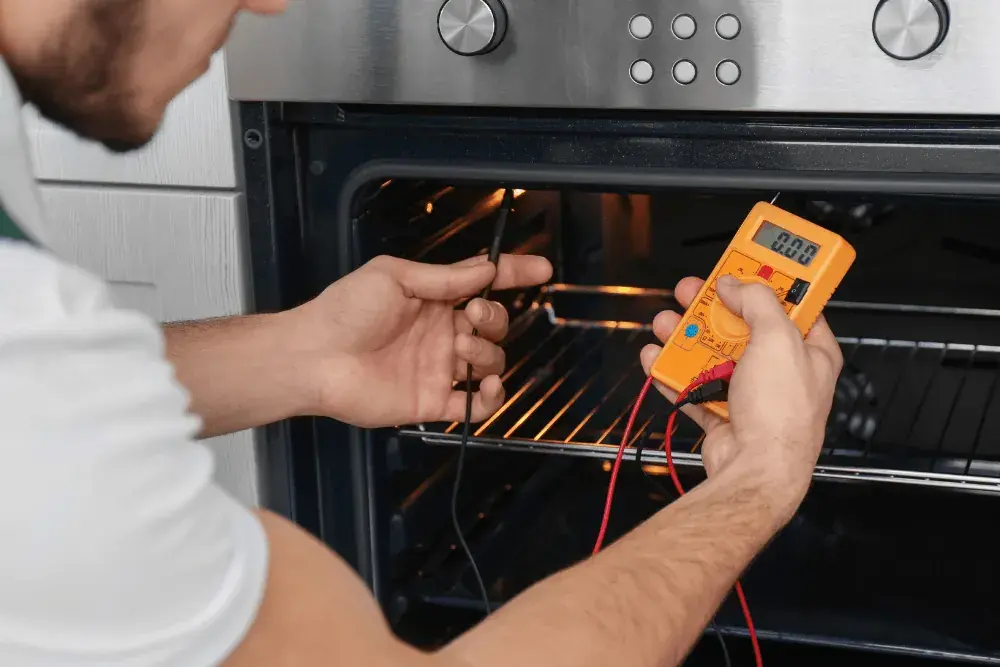
One Click Dubai repairs electric stoves, electric cookers and ceramic hobs at home across Dubai, with a technician sent the same day. We repair coil and solid-plate stoves, glass ceramic hobs, the hob tops and ovens of freestanding electric ranges, and countertop hot plates, and we install electric hobs including the electrical connection.
An electric stove is the simplest cooking appliance to diagnose. Each burner is a heating element, a control that switches it and the wiring between them. When a burner stops, one of those three has failed, and a meter finds which in minutes. This page explains each type of electric stove, each fault and each part, what a repair involves, and what an electric stove costs to run compared with what it costs to fix.
Electric stove repair in Dubai from One Click Dubai starts with a AED 100 diagnostic visit, plus VAT. The technician tests the supply, each element, each switch or control and the wiring, and gives a fixed price before any repair.
QuestionAnswer
How soon can you come?The same day, at any hour
Which appliances?Coil and solid-plate stoves, ceramic glass hobs, freestanding electric cookers and ranges, built-in hobs, countertop hot plates
What do you repair?Elements, energy regulators, switches, control boards, indicator lights, terminal blocks, wiring, oven elements and thermostats
Do you install?Yes, including the cooker circuit connection
Which parts?Genuine parts. About 90% of what we use is in stock
Is it repaired at home?Yes
What does the visit cost?AED 100 plus VAT, with no night or weekend surcharge
Is the repair covered?Yes. One month on parts and labour
An electric stove heats with exposed coils, sealed solid plates or radiant elements under glass. Induction is a fourth kind that works differently and has its own page.
TypeHow to recognise itHow it heatsTypical faults
Coil stoveSpiral metal elements that lift out of a drip pan and plug into a socketCurrent heats the coil directlyCoil burnt through, plug-in socket burnt, switch failed
Solid plate (sealed hot plate)Flat cast iron discs, often with a red dotAn element inside the platePlate open circuit, slow heating, rusted surface, switch
Ceramic radiant hobFlat black glass. Zones glow red when onA ribbon element under the glass, with a temperature limiterZone dark, zone stuck on full, cracked glass, touch control faults
Halogen zone on a ceramic hob, or an infrared cookerLights up bright and instantlyHalogen lamps or an infrared element under the glassLamp or element failure
Freestanding electric cooker or rangeHob on top, oven below, one supply cableAny of the above, plus oven elementsHob and oven faults, terminal block overheating
Countertop hot plateOne or two plates with a plugCoil or solid plateThermostat, element, lead
InductionGlass hob that only heats magnetic pans and does not glowA magnetic field heats the panSee induction hob repair A zone that glows red without a pan is ceramic. A zone that does nothing without a pan is induction.
An electric stove burner not working has a failed element, a failed control or a break in the wiring. If one burner is out, the fault is local to it. If all are out, the fault is in the supply.
SymptomLikely causeRepair
One burner dead, others fineElement open circuit, or its switch or regulatorTest both. Replace the failed one
Coil works when wiggledBurnt contacts in the plug-in socketNew socket block, and usually a new coil
Coil has a blister, a split or a bright spotElement failingNew coil
Two burners on one side deadA shared supply wire or one phase lost at the terminal blockRepair the connection
All burners dead, oven worksHob supply link or a common wireTrace and repair
Everything deadBreaker tripped, isolator off, supply cable or terminal block burntRestore the supply. Repair the terminal
Burner works on high onlyEnergy regulator failedNew regulator
Burner stays on with the knob offRegulator or switch contacts weldedIsolate at the wall. New regulator
Inner zone works, outer does notDual-zone element or its switchElement or switch
With the stove off and cool, swap the dead coil with a working one of the same size. If the fault moves with the coil, the coil has failed. If the fault stays at the same position, the socket or the switch is at fault. Do not do this on ceramic or solid-plate stoves, where the elements are wired in.
A burner that heats, and heats wrongly, has a control fault or a mismatch between pan and element. On ceramic hobs the temperature limiter under the glass also plays a part.
SymptomCauseFix
Slow to boil on every burnerLow supply voltage, or one phase missing on a split supplyCheck the supply and the terminal links
Slow on one burnerElement partly failed, or a poor connection heating up instead of the elementReplace the element. Remake the connection
Glows only in partA section of the ribbon element has failedNew element
Cycles off too soon on a ceramic hobLimiter cutting in early, or a pan with a warped base trapping heatNew element with limiter. Use a flat pan
Full heat at every settingRegulator stuck closedNew regulator
Clicking sound as it cooksNormal. The regulator switching the element on and off to hold the settingNo fault
Solid plate takes very longNormal to a degree. Solid plates are slow. Worse if the plate is pitted or the pan base is not flatFlat, heavy pans. Replace a badly pitted plate
Pan boils unevenlyPan smaller or larger than the zone, or a thin baseMatch the pan to the zone
An energy regulator does not lower the element's power. It switches the element fully on and fully off in a cycle, longer on for higher settings. That is why a ceramic zone pulses red at a low setting.
Electric stove element replacement is the most common repair. Elements wear out with use, and each type is changed differently.
Element typeHow it is replacedTime
Plug-in coilLifted and pulled from its socket. The socket block is inspected and usually renewed if a coil has burntMinutes
Wired coilHob top lifted, wires unscrewed from the element terminalsUnder half an hour
Solid plateHob top lifted or cooker top raised, the plate's clamp and wires released from belowAbout half an hour
Ceramic radiant elementHob lifted from the worktop, or the cooker's glass top raised. The element is unclipped from its tray and its wires and limiter transferredUnder an hour
Dual or triple zone elementAs above, with more connectionsUnder an hour
Halogen lampAs ceramicUnder an hour
Elements are matched by diameter, wattage, voltage and terminal layout. A similar-looking element of the wrong rating overheats the switch or underheats the pan.
On ceramic hobs the new element must sit pressed up against the glass by its springs. An element that sags heats badly and cycles on its limiter.
Where one element has failed from age on an old stove, the others are of the same age. We test them all.
We fit elements specified for the stove's model, which is on the rating plate: under the hob, inside the oven door frame or on the back of a cooker.
Switches, energy regulators and controls
The control behind each knob is either a multi-position switch, which selects fixed heat levels, or an energy regulator, which gives stepless control. Touch-control ceramic hobs replace both with relays on an electronic board.
SymptomCauseRepair
Knob turns, no heat, element tests goodSwitch or regulator open circuitNew switch or regulator
Only some positions workContacts burnt inside a multi-position switchNew switch
Knob hot, smell of burning plasticOverheated terminals on the switchNew switch and repaired wiring
Knob loose, spins freelyKnob or spindle brokenNew knob, or a new control if the spindle has snapped
Touch controls dead or erraticMoisture or grease on the panel, or the control boardClean and dry. New board
A zone will not switch off on a touch hobRelay welded on the boardIsolate at the wall. New board
Hob beeps and shuts downSpill or object on the touch panel, or a safety timeoutClear the panel
Child lock onKey symbol litHold the lock key for a few seconds, as the manual describes
Regulators and switches are rated for the element they control. They are replaced with the correct part for the model, not a general-purpose one.
Indicator lights and residual heat warnings
Electric stoves have a light that shows a burner is on, and ceramic hobs have a residual heat light that stays on while the glass is too hot to touch.
SymptomCauseFix
Power light stays on with all knobs offA regulator or switch has not opened. A burner may still be liveIsolate at the wall and have it repaired
Power light never comes on, burners workIndicator lamp failedNew lamp
Residual heat light stays on when coldThe limiter's hot contact has stuckNew element with limiter
Residual heat light never comes onLamp or limiter contact failed. The safety warning is lostRepair
Light flickersLoose connectionRemake
A hot-surface light that does not work is worth fixing even though the hob still cooks. It is the only warning a ceramic hob gives.
Tripping the breaker and electric shocks
An electric stove that trips the breaker has current leaking to earth through a damaged element, damp or worn wiring. Do not keep resetting it.
When it tripsLikely causeRepair
As soon as the stove is switched on at the wallSupply cable, terminal block or a mains filter faultRepair the connection
When one burner is turned onThat element's insulation has broken downNew element
After a spill or boil-overLiquid in a switch, socket or under the glassDry, clean and test. Replace damaged parts
When the oven is switched onOven elementNew oven element
Only with several burners on highCircuit or breaker too small for the loadThe circuit needs upgrading
A tingle from the stove body or a panEarth fault with a poor earth connectionStop using it. Urgent repair
A tingle or shock from a stove means its metal body is live and its earth is not carrying the fault away. Switch it off at the breaker and leave it off until it has been tested.
A freestanding electric cooker has an oven below the hob with its own elements, thermostat and fan. Oven faults are separate from hob faults, though they share the supply.
SymptomLikely causeRepair
Oven does not heat, fan and light workBake or fan element failedNew element
Heats slowly, undercooksOne element of two failed, or the door seal leakingElement. Seal
Too hot, burns foodThermostat failed or its sensor displacedNew thermostat
Grill does not workGrill element or its switchReplace
Fan noisy or not turningFan motorNew motor
Oven dead, clock blank or flashingThe clock or timer is not set, which locks the oven on many cookersSet the clock. Put the timer to manual
Door will not close or dropsHingesNew hinges
The full set of oven faults is on our oven and cooker repair page.
Supply, terminal block and wiring
The connection where the supply cable joins the stove carries the whole load, and it is the commonest place for an electric cooker to burn out. A terminal that was not tightened fully heats a little every time the stove is used until it chars.
Signs. a smell of hot plastic from behind the cooker, a brown mark on the cooker switch or the outlet plate, burners that cut in and out, half the hob dead.
A burnt terminal block is replaced, the damaged cable end is cut back to clean copper and the connection remade and tightened to the correct torque.
The cable must be the size required for the cooker's rating. An undersized cable runs warm along its whole length.
Terminal links must be set for the supply, single-phase or three-phase, as shown in the diagram on the back of the cooker.
A full electric cooker needs a dedicated cooker circuit with its own breaker and isolator. It should never run from an ordinary socket.
We repair the connection at the appliance. Where the fault is in the building's circuit or the breaker is undersized, we tell you what the electrician needs to do.
Electric stove running cost and what affects it
People searching for electric stove cost usually want to know one of two things: what a stove costs to run, or whether repair is worth it against a new one. The running cost is simple to work out.
ItemTypical figure
Small burnerAbout 1.2 kW
Large burnerAbout 2 to 2.5 kW
Oven elementAbout 2 to 3 kW
One large burner on full for one hourAbout 2 to 2.5 kWh of electricity
Multiply the kilowatt-hours by the tariff on your DEWA bill to get the cost. In practice a burner is rarely on full for long, because the regulator cycles it, so real use is lower than the rating suggests.
Use pans with flat bases that match the zone. A warped or undersized pan wastes a large part of the heat.
On ceramic and solid-plate stoves, switch off a few minutes early and use the stored heat.
A burner that takes far longer than it used to is wasting electricity as well as time. It is failing or has a poor connection.
On repair against replacement: an element or a regulator costs a small fraction of a new cooker, so on a stove that is otherwise sound the answer is nearly always to repair.
We fit genuine parts chosen from the model on the rating plate.
PartSigns it has failed
Coil elementDead, blistered, split or glowing unevenly
Coil socket (receptacle) blockBurnt contacts, coil works only when moved
Solid plateDead, or badly pitted and slow
Ceramic radiant element with limiterZone dark, part glowing, residual light stuck
Energy regulatorNo heat, full heat only, or will not switch off
Multi-position switchSome settings missing
Touch control boardDead or erratic controls, a zone that will not switch off
Indicator lampsNot lighting
Terminal block and supply cableBurning smell, scorch marks, intermittent supply
KnobsCracked or loose
Oven elements, thermostat and fan motorOven not heating or heating wrongly
Ceramic glassCracked. See glass cooktop replacement Electric hob and cooker installation
We install electric hobs and freestanding electric cookers, including the connection to the cooker circuit.
PointRequirement
CircuitA dedicated circuit with a breaker and cable sized for the appliance's rating
IsolatorA cooker switch within reach, not directly behind the hob
ConnectionHeat-resistant cable of the correct size, terminals tightened, strain relief clamped
Terminal linksSet for single-phase or three-phase supply as the diagram shows
Worktop cut-outTo the maker's dimensions, with the hob seal seated
VentilationClearances below a built-in hob and above an oven as the instructions require
EarthTested
TestEvery zone and the oven run and checked
If you are moving from gas to electric, the kitchen needs a cooker circuit that may not exist. We check what is there and tell you what has to be added before you buy.
Solid plates and coils: rust, pitting and drip pans
Solid plates and coil elements are exposed to everything that boils over, and their condition affects how well they heat.
ProblemCauseWhat to do
Solid plate rustyLeft wet, or cleaned with water and not driedClean when cold, heat briefly to dry, then wipe on a thin film of cooking oil or a hot plate conditioner
Plate surface pitted or crackedYears of spills burnt on, or cold water on a hot plateReplace. A pitted plate heats unevenly and slowly
Plate smokes when first usedThe protective coating on a new plate, or oil from conditioningNormal. It clears in a few minutes
Coil sits crooked or rocksBent support, or a warped drip panNew drip pan. Reseat the coil
Drip pans blackenedBurnt-on spillsSoak and scrub, or replace. Do not line them with foil, which traps heat and can short the element
Coil terminal ends corrodedSpills running into the socketNew coil and socket block
Stainless trim ring discolouredHeatCosmetic
A pan must sit flat on a solid plate to heat properly. Hold a ruler across the pan base. If light shows under it, the pan is warped, and no repair to the stove will make it boil faster.
Electric stoves need little maintenance, and what they need is mostly about keeping liquid out of the electrics and the surfaces clean.
Wipe spills once the surface has cooled. Sugar on a ceramic hob is the exception: lift it off at once with a glass scraper, since it bonds to the glass as it cools.
Never pour water on a hot plate or a hot ceramic zone.
Clean ceramic glass with a hob cleaner and a soft cloth, and a razor scraper held flat for burnt deposits. No scouring pads.
Keep liquid away from knobs and touch panels. Spray the cloth, not the stove.
Lift pans on glass. Do not drag them.
Use the back burners for tall pots where children are around, and turn handles inward.
Once a year, check the cooker switch and the outlet plate for warmth or discolouration after cooking. Either means a loose connection.
Brands we repair
We repair electric stoves, cookers and ceramic hobs of every make sold in Dubai.
TypeMakes
Built-in ceramic hobsBosch, Siemens, Neff, AEG, Electrolux, Zanussi, Beko, Ariston, Indesit, Hotpoint, Teka, Smeg, Candy, Samsung, LG
Freestanding electric cookers and rangesWhirlpool, Samsung, LG, GE, Frigidaire, Beko, Ariston, Bompani, Glem Gas, Nikai, Super General
Coil and solid-plate stoves and hot platesWhirlpool, GE, Frigidaire, Kenmore and the regional brands
Send the model from the rating plate when you book. For Bosch in detail, see Bosch hob repair.
A countertop hot plate is a low-cost appliance with a thermostat, one or two elements and a lead. Simple faults are worth fixing.
SymptomCauseWorth repairing?
DeadLead, plug fuse, thermal fuse or thermostatUsually
One plate of two deadThat element or its thermostatUsually
Overheats, no controlThermostat stuckYes
Trips the breakerElement insulation failedCompare with the price of a new one
Body rusted or the plate badly pittedAgeReplace
For countertop induction cookers, see induction hob repair.
What electric stove repair costs, and repair or replace
Electric stove repairs are mostly single parts and are done in one visit.
RepairScale of jobWorth doing?
Coil element or socket blockSmallYes
Solid plateSmall to mediumYes
Ceramic radiant elementMediumYes
Energy regulator or switchSmall to mediumYes
Indicator lamp, knobSmallYes
Terminal block and cable repairSmall to mediumAlways
Touch control boardMedium to largeOn a hob in good condition
Oven element or thermostatMediumYes
Ceramic glassLargeCompare with a new hob on older or basic models
Replace the stove when the glass is cracked on a low-cost hob, when the body has rusted, or when the control board has failed on a model whose parts are no longer supplied. The diagnostic visit is AED 100 plus VAT, with a fixed price before any work.
For other types see stove and hob repair and gas stove repair.
We cover all of Dubai, including Dubai Marina, JBR, Palm Jumeirah, JLT, Downtown, Business Bay, Jumeirah, Al Barsha, Dubai Hills and Deira.
Who repairs electric stoves in Dubai?
+
One Click Dubai repairs electric stoves, cookers and ceramic hobs at home across Dubai, the same day. Call or WhatsApp +971 55 209 9785.
Why is one burner on my electric stove not working?
+
The element has failed, or the switch or regulator behind its knob has. On a coil stove the plug-in socket may be burnt.
Why is my electric stove burner stuck on high?
+
The energy regulator has failed with its contacts closed. Switch off at the wall and have it replaced.
Can an electric stove element be replaced?
+
Yes. It is the most common repair and takes under an hour.
Why does my ceramic hob keep switching off and on?
+
That is the regulator cycling the element to hold the setting. It is normal.
Why does my electric stove trip the breaker?
+
An element or wiring is leaking current to earth, often after a spill. Do not keep resetting it.
Is it safe to use a ceramic hob with a crack?
+
No. Switch it off at the wall until the glass is replaced.
How much electricity does an electric stove use?
+
A large burner is about 2 to 2.5 kW, so about 2 to 2.5 kWh for an hour on full.
Do you install electric hobs and cookers?
+
Yes, including the connection to the cooker circuit.
Do you repair countertop hot plates?
+
Yes, for thermostat, element and lead faults.
How much does electric stove repair cost?
+
The diagnostic visit is AED 100 plus VAT. The repair is quoted at a fixed price once the fault is found.
Is the repair guaranteed?
+
Yes, for one month on parts and labour.
Call or WhatsApp +971 55 209 9785 at any hour, or use the booking form. Tell us the make and type of stove, which burners are affected and whether the breaker has tripped.